Dalton Special Town Meeting Rejects Land Buy for Police Station
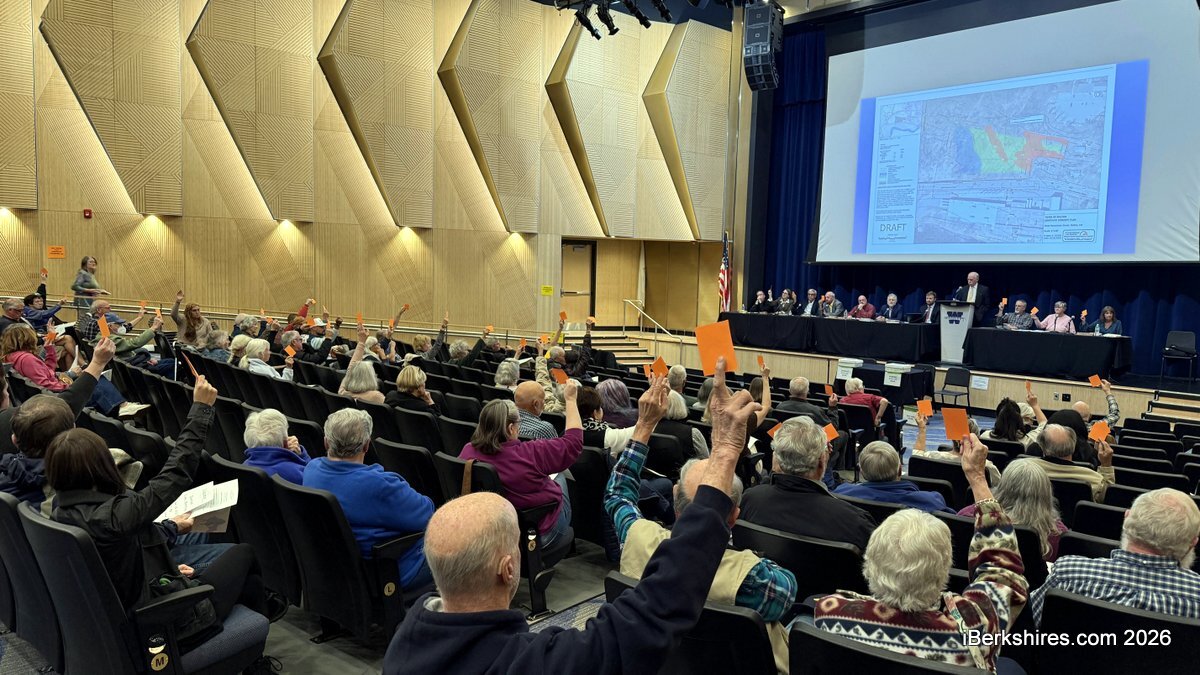
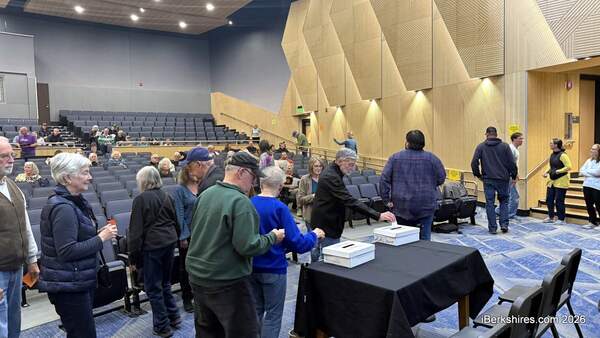
Voters hold up cards to be counted on a vote to cast secret ballots on purchase of land question. Voters rejected the land purchase but authorized buying electronic devices for future voting.
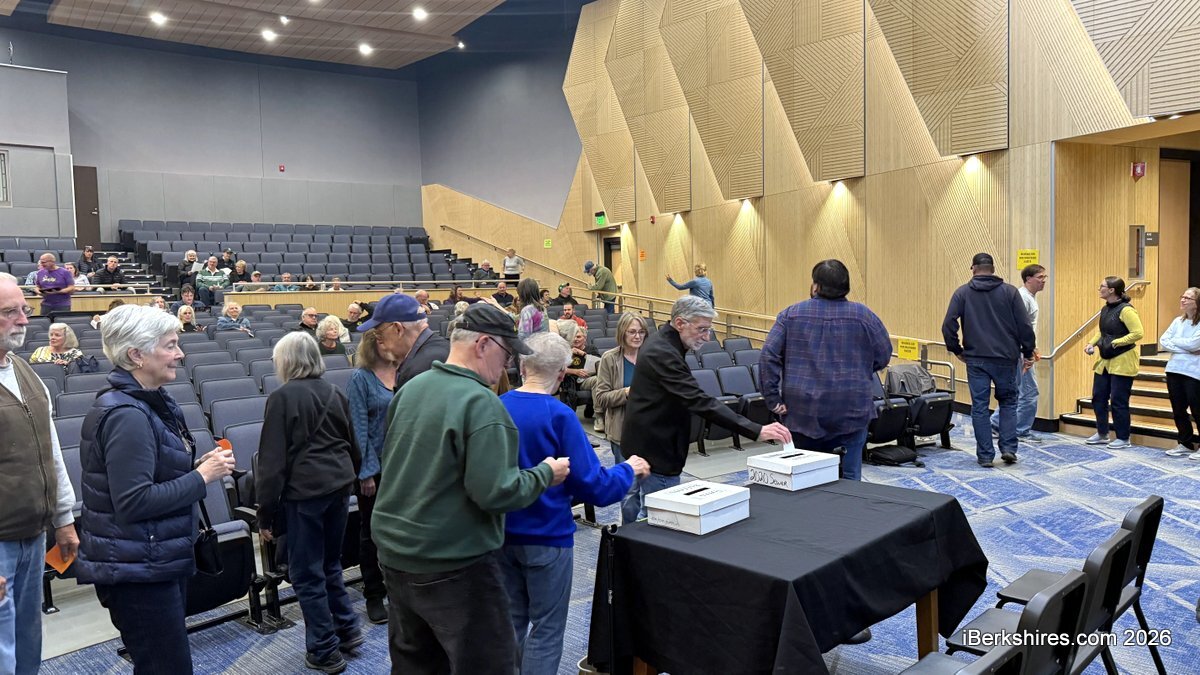
After nearly an hour of discussion, 113 voters rejected by secret ballot the purchase of land on West Housatonic Street for $69,700.
Article 2 needed two-thirds to pass, and failed 65-48, about 10 votes short.
A motion was made by Robert Collins for the article to be voted on by secret ballot to ensure ballot privacy, which was approved by 72-19.
Town officials have been debating options for a new police station for more than year, focusing on several parcels that could host a new building and, more recently, the possibility of a combined fire and police station. These included the West Housatonic site, another on Main street and the vacant Dalton High lot next to the Senior Center.
Resident Adelard Nadeau Jr., who previously served on the Fire District's Prudential Committee, argued that the town is spending money that it does not have.
He advocated for the lot by the Senior Center which he believed to be cheaper and shovel ready.
Resident Louise Frankenberg expressed concern with the topography of the West Housatonic 3.9-acre property, specifically possible wetlands and the belief that it could be too steep for emergency personnel to traverse.
Town Manager Eric Anderson said that although the property has varying elevations it is buildable.
Development would require filling a roughly five-foot grade difference near the West Housatonic Street entrance and potentially excavating portions of the rear. However, the uneven terrain could accommodate a multistory building with entrances and parking areas at different elevations, he said.
During the meeting, officials reviewed a map prepared by Foresight Engineering that preliminarily identifies wetlands and outlines the property's buildable area.
Most of the nearby wetlands are located on adjacent property rather than the parcel under consideration, Anderson said.
Following previous apprehension from some residents surrounding the Senior Center property, the town put out a request for proposals for potential land acquisitions — it received three proposals.
One of the proposals was the purchase of Crane & Co.'s West Housatonic Street property, which officials said offers flexibility for future use if a public safety facility is not developed on it, including housing.
Unlike the other proposals, the property would have a relatively small impact on the town's tax base, removing approximately $70,000 in assessed value, he said.
Some voters questioned the legality of this sale with one saying that it seems like a quid pro quo with Crane & Co.
One resident claimed that there had been unconfirmed reports that Crane & Co. planned to donate the proceeds from the sale to the property to the Fire Department. However, Anderson emphasized that this is not part of the sale agreement as that would not be legal and is not a factor in the town's decision.
There was initially some confusion as it was initially believed the article failed, then that it had passed, then later clarified as a failed vote.
Voters approved Article 4, to transfer $4,800 from the General Stabilization Fund to rent electronic voting devices to be used at future town meetings.
Supporters of renting the devices say they would improve meeting efficiency, ensure privacy, and make voting more accessible. Williamstown has been using electronic clickers at its town meetings for several years.
Monday's Dalton meeting underscored the potential value of electronic voting devices after a resident challenged the moderator's determination of a voice vote on whether to use a secret ballot for Article 2, prompting a second vote using voting cards.
"Clickers like this allow those verbal affirmations to just be a simple push of a button, which creates a much more unified and a much more efficient, a much more uniform vote process than simply voting aye or nay," the voter said, echoing the statements made by others.
The clerk's office does not have concerns over the current process, Town Clerk Heather Hunt said, emphasizing the department's capable staff and volunteers.
However, the decision about how votes are conducted at town meetings ultimately rests with voters, she said.
The idea of using electronic voting devices has been raised over the years, particularly as a method to ensure privacy, Hunt said.
"We realistically can't expect a secret ballot vote on a warrant with 30 articles because we would be here for three or four days. So that's where this kind of came into play," she said.
Articles approved with little to no discussion:
Article 1: to amend the vocational education budget amount that was approved at town meeting by $137,004. Since the initial vote, the number of students enrolled in vocational education programs has changed.
Article 3: to transfer $1,000,00 from the Capital Stabilization Fund for the reconstruction of the town's lowest-rated bridge on Grange Hall Road.
A hot topic in town has been the recent spike in sewer rates, which has more than doubled and detailed discussion on how to address this persisted during the meeting with Article 5.
For fiscal year 2027, the average user will see an annual bill of $1,217.08, which is billed biannually. The total bill for the town is $1,777,728.50.
Voters approved Article 5, authorizing the transfer of $200,000 from the Sewer Stabilization Fund to conduct the study, aimed at reducing the amount of wastewater that Dalton produces.
Dalton sends roughly 350 million gallons a year to Pittsfield’s wastewater system, compared with an estimated 175 million that it should be sending, Anderson told voters.
Previous work has been done to address the infiltration but the town still needs to identify where excess water is entering the aging sewer system. Anderson explained to voters how the town tracks the wastewater it sends to Pittsfield, how the town is billed, and the age of the infrastructure. Some of the infrastructure is up to 130 years old.
Voter Amy Turnbull made a motion to conduct a feasibility study and cost analysis for residential water meters and reading devices, but the motion failed.
Articles approved with little to no discussion:
• Article 1: to amend the Vocational Education budget amount that was approved at town meeting by $137,004. Since the initial vote, the number of students enrolled in vocational education programs has changed.
•Article 3: to transfer $1 million from the Capital Stabilization Fund for the reconstruction of the town's lowest-rated bridge on Grange Hall Road.
•Article 6: to increase the town's sewer and wastewater treatment budget by $866,800 to cover costs exceeding the original appropriation approved at the May 4 annual town meeting. The costs for treating the wastewater has been revised based on engineering evaluation of the contract. The increase would not affect property taxes, as the expenses are funded through sewer user fees.
•Articles 7, 8 and 10 were transfers from stabilization to pay prior year invoices: $524 to WJ BluePrint & Digital Graphics; $880.48 ti Revolution IT Inc.; and $126.22 to Orkin.
•Article 9 was "taken off the list," Town Moderator Anthony Doyle said.
•Article 11: to transfer the sum of $4,000 from the Sewer Stabilization Fund to satisfy the settlement agreement between the town and Cheryl Nelsen in lieu of litigation related to issues with sewer overflow at the residence.
• Article 12: to reduce the number of Conservation Commission members from seven to five.
Tags: police station, special town meeting,