Dalton Consultant Says Dust Mitigation Plan Insufficient
DALTON, Mass. — An assessment by the town's consultant determined that Berkshire Concrete's dust mitigation plan is insufficient.
The topographic survey and completion letter that Berkshire Concrete submitted as its dust mitigation plan, in response to the Board of Health's order to implement one, lacks several key components, the consultant said.
"The final topographic survey prepared for Berkshire Concrete is not so much a dust mitigation plan, but a map of the physical alterations made on a portion of the parcel Map 105, Lot 16 to address the generation and offsite transport of dust. The survey was accompanied by a very short written narrative describing the physical map," the assessment states.
The town contracted Berkshire Environmental Consultants Inc. to conduct the independent assessment of the Berkshire Concrete's mitigation efforts.
During the Planning Board meeting last week, Maura J. Hawkins, the president of Berkshire Environmental Consultants, presented the findings and recommendations, which the board will use to inform its decision about Berkshire Concrete's special permit request. There will be a public hearing on the permit on Wednesday, Nov. 19.
The state Department of Environmental Protections is working with Berkshire Concrete to address concerns with its equipment and operations and some of the town's governing bodies are also developing questions and concerns for Berkshire Concrete to address at the Nov. 19 public hearing.
On June 13, Berkshire Concrete's legal counsel, Cohen Kinne Valicenti & Cook, submitted a notice of completion for the implementation of the dust mitigation plan.
In her assessment, Hawkins broke down the improvements, highlighting the lack of detail and inconsistencies between the completion notice and the topographic survey. The survey was
stamped by Frederick Haley, professional land surveyor.
For example, the survey shows eight white pines by the pond and 20 trees above the constructed berm. However, the completion letter indicated that the company had planted 40 white pine trees along the top of the gravel berm and that 20 were planted near the pond to help reduce wind and create a natural windbreak.
Once fully grown, the trees would create a natural windbreak and help mitigate the dust leaving the site but the survey should show the as-built changes, Hawkins said in the assessment.
The remaining four of Berkshire Concrete's improvement areas were reclaiming unused areas, slope stabilization and grading, dust and noise control berm, and stone slope installation.
Although Berkshire Environmental Consultants believed that improvements will partially assist in mitigating the dust, it also demonstrated how several of the items lack detail or clarity, or were inconsistent with the written text of the final report.
The stone slope installation was the only item the consultant observed as consistent and agreed it will stabilize the slope and berm above it.
Berkshire Environmental recommended that the permit apply to the entire permitted areas of the site, be updated annually as part of the permit renewal process, and include a condition that Berkshire Concrete develop and maintain a comprehensive dust mitigation plan.
For an effective dust mitigation plan, it advocated for updating the topographic survey to reflect the as-built conditions of the entire parcel, including reclaimed and disturbed areas, the topography, and an accurate count of trees and vegetation planted.
Additionally, the consultant advised the development of a written plan that addresses the entire parcel, not just the portion where modifications have been complete, and includes the following:
- Identify activities and operations that generate dust, such as the disturbed areas, active excavation activities, vehicle traffic, etc.
- Specify appropriate control strategies for these activities and operation, including vegetation cover, water application, physical barriers, containment systems, etc.
- Identify operational procedures and frequencies for routine inspections for dust, watering schedules, maintenance activities, tree replacement, etc.
- Identify protocols for managing vehicle and equipment traffic to minimize dust generation
- Identify the reporting and tracking systems for inspections, maintenance requirements and responding to complaints/issues
- Define roles and responsibilities among team members to ensure proper implementation and ongoing maintenance of dust control measures.
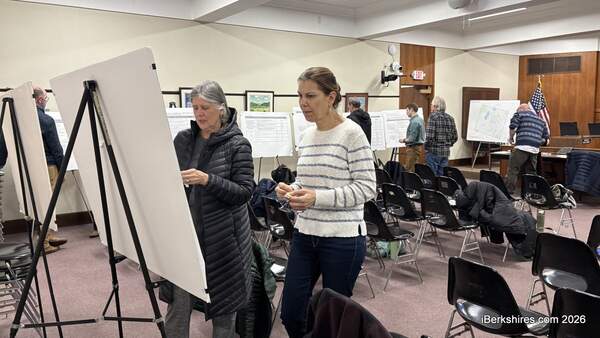
During the Planning Board meeting, which lasted three hours, Clean Air Committee members presented some of their recommendations for the special permit.
The 10-page document emphasizes strict monitoring, enforcement, and third-party oversight for noise and air monitoring.
Some recommendations included standards for restoration, that no excavation permits for BCC parcels adjacent to residential properties, the permitted excavation and mining area be limited to five acres and be greater than 1,000 feet from the nearest residential property, and that a truck washing station be mandatory, among other requests.
Progress in terms of air monitoring has been made, with the town's consultant, Air Partner, taking sand samples from the site and neighboring properties and installing four air monitors, one upwind and three downwind, Select Board member Tony Pagliarulo said during the Select Board meeting on Oct. 14.
The intent of the air monitoring is to get real-time data and coordinate with the Board of Health in establishing thresholds of quality air standards, he said.
Residents will be able to make violation complaints and there will be data to back up their claims, Pagliarulo said.
The board also met with a litigator from KP Law if legal counsel becomes needed, he said.
Pagliarulo is questioning the amount of taxes that Berkshire Concrete pays. He pointed out that the company applied to mine all of its parcels, totaling approximately 275 acres. According to the tax collector, the company pays $42,000 in total taxes, which includes the Fire District tax.
He raised concerns with the assessor, noting that "his property must be valued much higher due to the mineral rights." The assessor is currently looking into this matter.
Special Permit Brief Background:
On Sept. 17, Berkshire Concrete, a subsidiary of Petricca Industries, submitted an application for a special permit, to excavate, extract, and transport minerals including sand, gravel, topsoil, rock, and fill on several parcels, some of which abuts residential neighborhoods.
In addition to its annual renewal of its current permit, the application requests the continued excavation on the unauthorized dig site on parcel 105-16, part of which has since been partially mitigated, and continues the work up towards Renee Dr., on parcels 101-25 and 105-12. More information on Berkshire Concrete's plans here.
Earlier this month the Zoning Board of Appeals determined that the unauthorized dig site on parcel No. 105-16 needs to be fully remediated or covered to abide by town bylaws.
Tags: dust, debris, special permit,