MassWildLife: Unexpected river hitchhikers
 |
| Provided photo |
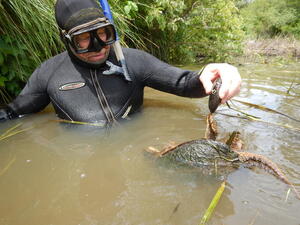
BOSTON — Freshwater mussels are not known for speed and most only move a few meters per week. But biologists from MassWildlife and collaborators in other New England states discovered some may have found a faster way to travel: hitching rides on turtles.
While freshwater mussels are no strangers to hitchhiking, they typically travel only during their earliest life stage. Species such as the eastern elliptio (Elliptio complanata) disperse by releasing microscopic larvae into the water that temporarily attach to the gills or fins of fish. After developing, the young mussels detach—often far from where they began—and settle into the riverbed, where they spend the rest of their adult lives moving only short distances.
But, what biologists thought they knew about adult mussels changed when they recently discovered some adult freshwater mussels traveling around by attaching to turtles. The first observation occurred in 2007, when a male wood turtle was seen walking along the river bottom with an eastern elliptio firmly attached to its right hind foot.
Since then, researchers have documented eight observations involving three turtle species in three New England watersheds. In nearly every case, the mussels were attached to a turtle's claws or feet. Although the behavior appears to be uncommon, seeing the same pattern repeated across multiple turtle species and watersheds suggests these encounters are more than isolated accidents.
These observations are more than an unusual wildlife story—they could change how scientists understand freshwater mussel movement. Until now, biologists thought mussels mainly moved upstream as larvae attached to fish hosts and traveled downstream through flooding events. Adult mussels traveling on turtles introduces another pathway for dispersal. If turtles occasionally carry attached mussels over land between streams or watersheds, they could connect populations that were previously isolated. Even rare movements like these could have important implications for the genetic diversity of freshwater mussel populations.
This mussel behavior appears rare today—researchers documented these mussel-turtle interactions only after more than 11,000 direct observations of turtles. Yet that rarity may not reflect how often the behavior occurred in the past. Wood turtles and freshwater mussels were once far more abundant, meaning these encounters may have been a more routine part of New England’s river ecosystems. The discovery offers a glimpse into ecological connections that may have become harder to see as species have declined.
Many questions remain. Researchers still don't know how often adult mussels hitch rides on turtles or how this relationship may impact mussel and turtle populations. But each new observation adds another piece to the puzzle and reminds us that the natural world is often more connected—and more surprising—than we realize.