

Community, Investment Keep Silver Screens Lit in the Berkshires
This is the second of three articles in a series on the evolution and current status of movie theaters in Berkshire County. Read Part I here.
In the wake of the 2020 COVID pandemic and its disruptions to the film industry, the county lost its two largest multiplex cinemas.
The 10-screen Regal Cinema in the Berkshire Mall in Lanesborough closed in 2022. Then in 2023, the eight-screen North Adams Movieplex in the Steeple City Plaza closed.
As a result, there are currently three full-time multi-screen movie theaters in the county — Images Cinema in Williamstown, the Beacon Cinema at 57 North St. in Pittsfield, and the Triplex Cinema at 70 Railroad St. in Great Barrington. These three surviving theaters in Berkshire County are totally separate operations and have their own individual histories and roles in their communities.
Nevertheless, there are also connections and common themes, including their downtown locations.
For a number of years, both the Triplex Cinema in Great Barrington and the Beacon Cinema in Pittsfield were siblings. Both were founded and originally owned by Richard Stanley, a South County real estate developer and investor who is also active in community-revitalization initiatives. Both theaters were established as vehicles to stimulate their local downtowns.
In Great Barrington, the primary destination for movies for most of the 20th century was the historic downtown Mahaiwe Theater. However, in 1988, it was facing potential demolition. That triggered a long community campaign that successfully saved and restored it as the Mahaiwe Performing Arts Center.
However, while the Mahaiwe does show some films, it changed from being primarily a movie house into a performing arts center presenting concerts and other live events. This left a void for a full-time movie theater in southern Berkshire County.
Meanwhile, Stanley was looking for a project that would bring people to downtown Great Barrington, which was experiencing the impact of outlying shopping centers. After considering various options, Stanley decided to build the Triplex and a mixed-use commercial structure on the site of a burned-out lumber storage facility on Railroad Street in the town center.
"I started the Triplex primarily as a community asset," said Stanley in an interview with this writer for an article in 2022. "By the early '90s, two shopping centers in the south and north ends of town had sucked the life out of downtown Great Barrington. …I wanted the Triplex to create a 'heart space' that would draw people back to downtown."
The Triplex Cinema opened in 1995. It was named the Triplex because it originally had three screens. A fourth was later added but the name remained. Stanley said it contributed to downtown revitalization and also was successful as a business until the 2020 pandemic forced it to close for over a year.
In 2022, in consideration of his age and the challenge of reviving the Triplex, he decided to pass the theater on to new owners. He initially had a preliminary deal to sell it to an outside chain, but when that became uncertain, Stanley announced that he would close
the theater if he could not find a buyer.
A community drive called Save the Triplex, led by local resident Nicki Wilson, was quickly organized. It gained strong support and within several months managed to raise sufficient funds to make an offer to buy the Triplex for $1 million. Stanley facilitated the deal by providing a five-year mortgage to spread out the purchase price.
After closing for physical updates, the Triplex reopened in November 2023. A non-profit organization, Triplex Cinema Inc., was formed as the owner and operator. Gail Lansky, the organization's board chair, said the Triplex, which has a $1 million annual budget, is doing well overall.
"We have a mortgage but no other significant debt," she said. "The faith and support of the community helped propel us, and it remains strong. We have about 700 members."
Nevertheless, she added, continuing fund raising and local support is a perennial necessity and challenge because of the nature of the film industry.
"Between 40 to 60 percent of our revenue from ticket sales goes to the distributor, so we have to supplement that with contributions, memberships, and grants," she said.
Currently, the organization is completing the development of a long-term strategic plan to set priorities and guide its operations and business strategy.
"After three years, this is the logical next step," said Lansky. "Everything initially happened quickly. We had to raise money, renovate the theater, develop programming and keep it operating. So it's been a very organic process. Now that it is established, it's time to evaluate where we are, and map out our plans for the next five to 10 years."
With the change in ownership, the Triplex has continued its original role of showing a mix of mainstream commercials films and more specialized independent and foreign films. It has also placed an emphasis on events, including themed series, special screenings featuring the filmmakers or others involved with it, and other community-related programming.
"Our mission is 'movies for all' and we want to keep our prices accessible," Lansky said. "I'm excited that our programming is rich and diverse."
The Triplex is also the home of the 20-year-old Berkshire International Film Festival, an annual event in late May which is sponsored by a separate organization that uses the theater as its primary venue. "We're two entities that work together," said Lansky.
The festival, which has garnered international recognition, screens independent features, documentaries, shorts, and family films as well as panel discussions and special events. It recently donated $600,000 to the Triplex which will be applied to the renovation of one of its auditoriums.
.jpg)
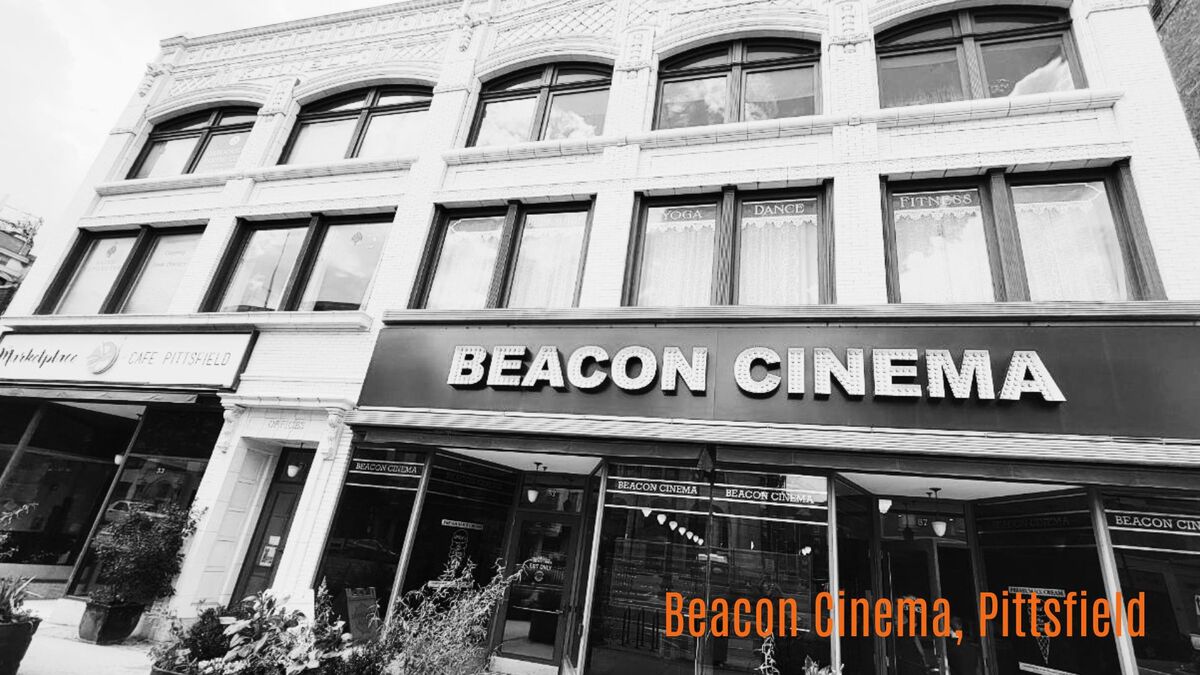
Further north, the Beacon Cinema in downtown Pittsfield operates as a more traditional commercial business. It is a for-profit six-screen multiplex owned by Phoenix Theaters, an independent chain that operates 10 cinemas in the Midwest, Tennessee and Massachusetts. It specializes in acquiring and revitalizing existing theaters. Its operations and programming are closer to the traditional model of mainstream commercial multiplexes.
However, the Beacon was also established and operated by Richard Stanley as a downtown economic revitalization project.
That effort originated in 1997 with a proposal by Downtown Pittsfield Inc., a business support organization. It suggested establishing a downtown movie theater as part of an overall plan to diversify Pittsfield with arts and cultural activity.
At the time, Pittsfield was struggling to rebuild its economy after the loss of General Electric and other industrial mainstays. Downtown had been especially hard hit by competition from the Berkshire Mall in Lanesborough. In addition, its downtown theaters had all closed because of competition from the multiplex in the mall.
Although the goal was popular in theory, it remained in the limbo of studies and pipe dreams for many years. During that time, the city approached Stanley several times to take on the project because of his experience with the Triplex, but he wasn't initially interested.
In 2002 the concept began to achieve momentum, and Stanley changed his mind. He purchased for $150,000 the Kresgie-Kinnell Building, a three-story 1918 commercial block just north of Park Square. It once housed a department store but had deteriorated into a visible symbol of downtown blight.
Stanley, the city administration and other proponents began to actively pursue a plan to restore the building as a mixed-use commercial block anchored by the theater.
The project was envisioned as a public-private partnership between Stanley, the city, state and Federal governments, with the participation of banks, and other entities. It took seven years of planning, debate, and negotiation to arrange a complex package of financing that included investments by Stanley, mortgage loans, tax credits and deferrals, grants, and other sources.
During that time, the cost had escalated from the original estimates of about $8 million up to over $22 million. The extensive construction process finally began in 2008 and the theater opened in November 2009 to much fanfare. Its prospects were immediately bolstered by its first film, "The Twilight Saga: New Moon," which was a national blockbuster.
The restoration of the classic Queen Anne-style façade brightened up downtown's gateway. While the Beacon became a popular destination, the recession, a national decline in moviegoing and other pressures required a reevaluation of the project in 2016.
Cory Jacobson, founder and president of Phoenix Theaters was brought in as a consultant. In 2017, he and Stanley came to an agreement in which Jacobson's company would purchase and operate the theater and commercial block. After some controversy about the terms regarding payments to the city, the sale was approved and the Beacon became part of the Phoenix chain in 2018.
Over time the company has made significant investments in new seating, projection and sound equipment and other improvements and amenities. Its most recent update was made in 2025.
Jacobson said the Beacon has been successful.
"In terms of the community, it's been doing what we all hoped it would do," he said. "It brings audiences downtown, which adds to the customer base for shops, restaurants and other businesses."
It has also exceeded the company's expectations as a business. He noted that the Beacon is the highest performing theater in the Phoenix chain, in terms of attendance per seat.
"We've had to change to the coverings of our seats because so many people have sat in them that they wore out," he said. "That's a good problem to have."
He acknowledged that the Beacon struggled during the pandemic and its disruptions to the film industry but said the situation has steadily improved.
"It was a difficult time for everyone, but the industry is normalizing again," he said. "May was the best month for the Beacon in eight years."
The pandemic did have a silver lining for the Beacon, with the closing in 2022 of the Regal multiplex in the Berkshire Mall, which had been its primary competition.
Jacobson believes that has made the market more realistic. In addition, the overall decline and closing of the Berkshire Mall itself had made the Regal a less appealing environment for moviegoers.
"It 'right-sized' the market because the central Berkshires were overscreened with two multiplex theaters, in terms of the population and level of demand," he said. "Now instead of being divided, audiences come downtown to the Beacon."
Currently he is seeking city approval to add a seventh screen in the adjacent storefront in the building, which the Beacon owns. That has been vacant since the recent closing of the Marketplace Café.
In Northern Berkshire County, the role of the non-profit Images Cinema has also shifted with the closing of the North Adams Movieplex. Instead of being an alternative, Images became the only full-time movie theater in that section of the county.
The core of Images was established In 1916 when Hiram C. Walden converted a former Williams College fraternity house into a theater. It is one of the oldest continuously operating movie theaters in the world through a succession of different owners and names.
It eventually came to feature foreign and independent arthouse films. By the late 1980s the financial realities of the movie industry threatened its survival.
In 1989, the late actor Christopher Reeves, then a Williamstown resident, led a fundraising campaign to support the theater, which enabled it to continue as an independent commercial theater.
However, by the late 1990s it was still not financially viable, and a community organization was formed to purchase it, and convert into a non-profit operation.
Images features a combination of popular mainstream commercial movies and independent and foreign films. It also features specialized programming.
The completion of its major renovation this month has converted it from a single-screen theater into a small multiplex with two auditoriums and a lounge capable of also showing films for small audiences.
The two auditoriums have new seating and equipment. The main theater features Dolby Atmos immersive sound and 4K laser projection. The second screen has 7.1 surround sound and 2K laser projection. The entire theater has also been made physically accessible according to the standards of the Americans with Disabilities Act.
While the additional screens are not on the same sale as larger multiplexes, it will give the theater more flexibility and offer more options for audiences, according to Dan Hudson, the executive director of the organization that operates Images.
"It will improve our ability to schedule a variety of films according to the requirements of studios," he said. "We'll also be able to show two films simultaneously, in addition to more intimate events in the lounge."
(Continued in Part 3.)
Tags: deep dive, movie theater,