Williamstown Elementary Principal Making Plans to Use New Math Position
WILLIAMSTOWN, Mass. — Williamstown Elementary School's principal last week told the Mount Greylock Regional School Committee that the best use of an additional $120,000 in the fiscal year 2027 budget is to hire a math interventionist for the school.
Benjamin Torres on Wednesday gave the board an update on the school with a focus on the need to address instruction in mathematics.
Those concerns prompted a request from the WES School Council to include the full-time math interventionist position in the FY27 budget.
School councils are committees of staff and community members in each building of a regional school district that are charged with assessing and advocating for the needs of individual schools.
Although funding for the position was not included in what district administrators characterized as a "level services" budget that it sent to both member towns, some Williamstown parents took their case directly to town meeting, which voted to amend the town's assessment to the district, adding the additional $120,000 to cover salary and benefits for new position.
Torres last week reminded the School Committee of the arguments he made for an interventionist when he presented the School Council's report back in February.
"My goal is to highlight the amazing growth we've seen with our students and the amazing work being done by our teachers, but also highlight there's a small group of students who are not closing the gaps quickly enough to be prepared to be successful at the upcoming grade level," Torres said. "This is why the School Council has been advocating not just for an interventionist but for a more systematic approach when it comes to interventions."
To address that slippage, WES last year implemented a new mathematics curriculum, i-Ready. And the investment is paying off, Torres told the committee.
"We definitely see a significant reduction in the students behind or below grade level," he told the panel, showing a slide that outlined i-Ready student assessment data collected in the fall, winter and spring of the 2025-26 school year.
The data showed that the number of pupils performing below grade level fell in every grade at the school with results ranging from 76.1 percent in Grade 1 (87 percent below grade in the fall and 10.9 percent in the spring) to 14.6 percent in Grade 6 (46 percent in the fall to 31.4 percent in the spring).
Torres explained that it makes sense that pupils in the primary grades would catch up more quickly.
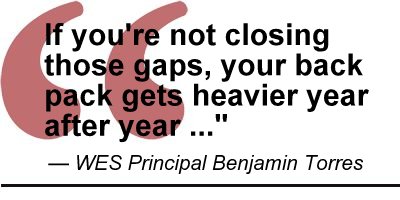
"In third grade you learn how to multiply and divide, fourth grade you start getting introduced to fractions and decimals, fifth grade, you expand on that," he said. "By the time you get to sixth grade, you're now working with ratios and proportions. You get promoted every year, but if you're not closing those gaps, your back pack gets heavier year after year with the gaps."
An interventionist can help children overcome those gaps, and Torres told the committee he is working on a job description for the position and mapping out how the new instructor can be used both to "push in" to classrooms and "pull out" pupils for individual or small group instruction.
"The goal is to replicate a lot of what our reading specialists are doing but in a more systematic way," Torres said. "There are opportunities to tailor instruction for students who are testing two or three grades above grade level as well.
"The goal is not to keep students separated from the core instruction, because Tier 1 instruction is obviously very important."
School Committee member Carolyn Greene asked Torres if he had considered other uses for the additional $120,000 in the FY27 budget, noting that while the interventionist position was the intent of the amendment made on the floor of town meeting, the meeting itself does not decide how money is spent in the district's omnibus budget.
Torres said there are other challenges facing WES, including its instruction in writing. He said he hopes to address that part of the WES School Improvement Plan by creating opportunities for more collaboration among teachers across grade levels.
"Having said that, it's my opinion we do have more space in our current structure and the potential new schedule where we can address the writing in a much more tangible way without requiring a lot of funding, unless it's utilized for professional development purposes," Torres said.
"Where I see the biggest leverage in terms of moving the needle for our students is definitely the math."
The School Committee's June meeting, held one night after the Lanesborough annual town meeting, offered district officials a chance to reflect on the FY27 budget season generally.
"The number of people who came out to support our budget is really significant," School Committee Chair Julia Bowen said. "I know I'm deeply grateful ... for the faith in our district to continue to serve our students.
"We do know that there are people for whom these [property tax] increases are really hard, and their voices aren't always the loudest in those rooms. I heard it behind me last night in Lanesborough. People who are living on fixed incomes. And those concerns are real. So I want to acknowledge and name that we know that exists, and I know, as a committee, we've always been thoughtful about that."
Superintendent Joseph Bergeron echoed Bowen's thoughts.
"Budgets as numerical documents don't adequately explain the toll that what we do has on things outside of just line items and numbers," Bergeron said. "So seeing the support within our community, the trust, it's a very real, very tangible, you can feel it type thing. I'm really appreciative.
"I think it would be helpful to talk about this for the next year in our communities: What can we do, how can we do it, how can we have consensus going forward."
Later in the meeting, Greene noted that the district was planning a community outreach initiative for the fall as part of its strategic planning process.
At Wednesday's meeting, the committee finalized its first evaluation of Bergeron, who began as full-time superintendent in September after working for more than a year as an interim superintendent.
Bergeron received strong grades from the committee members, and the official report, compiled by Bowen, includes passages like the following: "His communication is described as clear, concise, transparent, and data-driven, and his accessibility to any member of the community is valued. One member noted that, ‘a call to him by anyone in the community leads to an engaged conversation.' Another observed that the district has not experienced a more stable period in recent memory, with Joe fostering trust and creating conditions for educators and students to focus on their core work."
In Wednesday's meeting, Greene called out a specific example of Bergeron's ability as an administrator.
"I never would have dreamed we'd be in a position to negotiate with [the district's teachers union] in such a collaborative fashion," Greene said. "Setting the tone and providing the data and providing the requests — not demands — but requests, in partnership, is something to really be proud of."
And those negotiations bore fruit. The last work of Wednesday's meeting was an executive session to discuss the terms of new three-year deals with the district's collective bargaining units covering teachers, custodians, cafeteria workers and paraprofessionals. After returning to open session, the committee voted, 7-0, to authorize Bowen to execute those contracts following affirmative votes from the union members.
Tags: math, WES,