Vermont Fish & Wildlife: Protect Nesting Loons and Loon Chicks
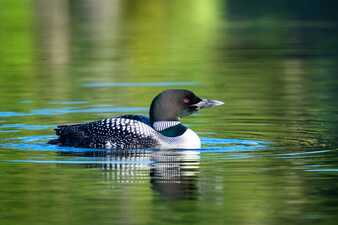 |
| VTF&W photo: Loons nesting along lake shorelines are susceptible to human disturbance, and their nests can be flooded and destroyed by motorboat wakes. |
MONTPELIER, Vt. — Few birding experiences rival hearing the haunting call of the loon or seeing them glide by in protected coves on a lake.
However, for the birds' protection, Vermont Fish and Wildlife is asking boaters and anglers to enjoy loons from a safe distance this summer, and take precautions to keep them healthy.
"Loons were removed from Vermont's endangered species list in 2005, but they continue to face threats from human disturbance during the breeding season and mortality from the ingestion of fishing gear," said Jillian Kilborn, wildlife biologist with Vermont Fish and Wildlife.
"Fortunately," said Kilborn, "there is a lot people can do to help keep loons safe."
Many areas where loons nest on Vermont's lakes are surrounded by signs reminding people to give loons the space they need, but not all nesting areas are marked.
"We're asking people to enjoy loons from a distance," said Kilborn. "If a curious loon approaches you, just enjoy it, but if a loon is constantly swimming away from you, they can become stressed and may even abandon their young."
Bringing all fishing line home helps prevent loons from becoming entangled, which can lead to death for loons. Eric Hanson, biologist with the Vermont Loon Conservation Project and Vermont Center for Ecostudies (VCE), asks anglers to reel in for a few minutes if loons are diving nearby.
"Loons will take live bait and lures, killing a few each year," notes Hanson. "A few loons have even learned that anglers are a source of easy food, and just like bears, it is very important that loons do not learn this problem habit."
VCE coordinates loon conservation efforts in partnership with the Vermont Fish and Wildlife Department, and they remind people to avoid using lead fishing tackle. Every year Vermont loons die from lead poisoning after swallowing lead tackle. Lead sinkers weighing one-half ounce or less are prohibited in Vermont, but larger tackle still has the capacity to slough off lead into the environment over time.
To give anglers a place to discard their lead tackle and fishing line, VCE is placing collection tubes at over 30 popular boat access areas around the state.
Hanson added, "These collection tubes make it easy and convenient for anglers to get the lead out of those tackle boxes."
Hanson added most people are respectful of nesting loons and give them space, but people sometimes inadvertently harm loons without meaning to.
"Loon chicks can be difficult to see, so we ask motorboaters to note where loon families are and to avoid those areas," said Hanson. "We also ask that motorboaters obey ‘no wake' laws within 200 feet of shorelines because boat wakes can flood and destroy shoreline loon nests."
Shoreline property owners have an opportunity to maintain appropriate habitat for loons, including shrubby and forested areas along the shore, where loons can nest or feed their young. Having shrubs and trees instead of lawns along shorelines also improves water quality which is essential for healthy lakes, aquatic insects, fish eggs, fish, and loons.
Volunteers interested in monitoring loons for the Loon Conservation Project should go to the VCE website loon participate page. Volunteers can sign up with the new online LoonWeb platform for both LoonMonitor and LoonCount.
LoonMonitor is the program where volunteers follow loons all season long with a focus on lakes with loon pairs and nesting, but it is also for people who visit a lake at any time and want to report loon activity. LoonCount is the annual one-day survey that takes place on July 18 between 8 and 9 a.m. The goal is to survey all lakes greater than 20 acres at the same time, which provides a population count and checks on small lakes that are surveyed less often during the rest of year.
You can help loon conservation in Vermont with a donation to the Nongame Wildlife Fund. Every dollar donated leverages up to three dollars of federal funds to help protect wildlife species at risk, including birds, bats, orchids, and bumblebees.