Mount Greylock Students in Argentina For Cultural Exchange Program
.jpg)
This is the second trip for Mount Greylock students to La Cumbre. The school has a relationship with St. Paul's School there and hosted 36 Argentine students last year.
"So many kids who have taken this trip come back and they're transformed," said Spanish teacher Joe Johnson. "... I guess, the spoiler is, that what these students learn is that they are the same … even though they may be from opposite poles, literally, of the Earth, and grew up speaking different languages … So that's what we're really hoping for. Let's get them to just fall in love with each other, and learn about the world and the culture through those friendships."
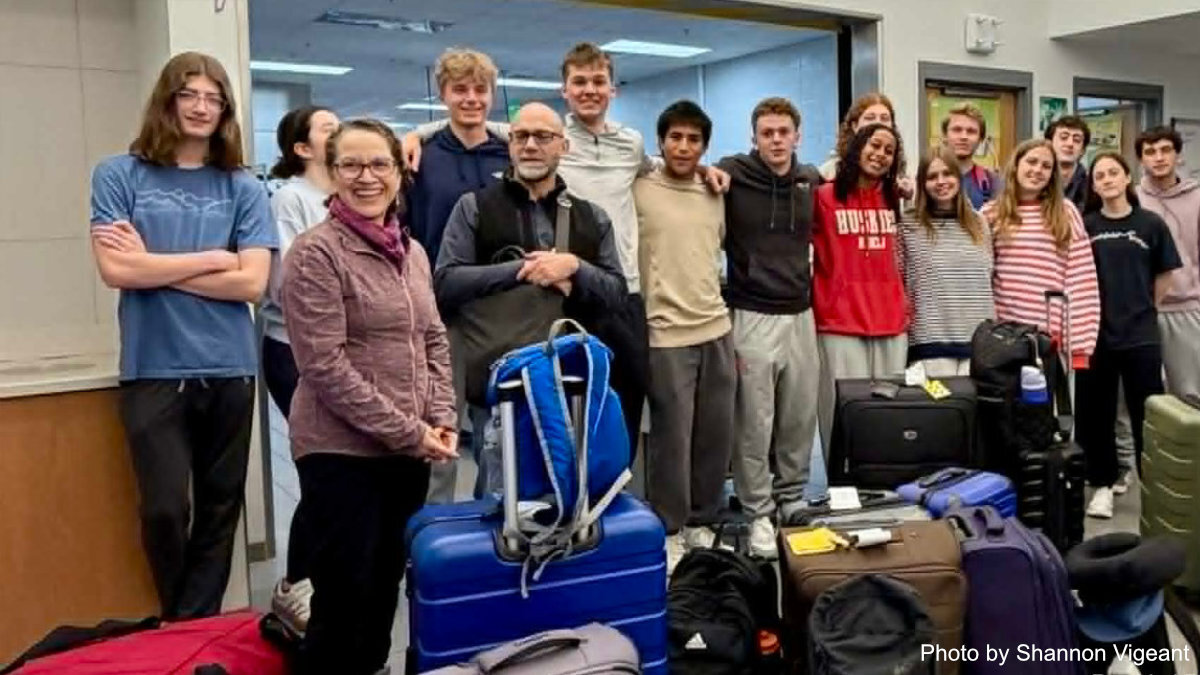
Students took off on Friday, April 17. They will spend nine days in La Cumbre, a community the school has built a relationship with over the years.
Mount Greylock hosted 36 students from St. Paul's School in La Cumbre last year, and the exchange program has become a cornerstone of Mount Greylock's Spanish curriculum. Johnson said the AP Spanish course has become hyper-focused on Argentina in preparation for the trip.
"It is all about what can you understand? What can you communicate? And we cover a lot of daily life things as the years go by. What do you need to be able to say? or what do you need to be able to understand?" he said. "We have geared the AP curriculum to where it's very Argentina centered… so we'll just focus on that, and that way, they get used to the accents, they know what kinds of food to expect, what kind of social interactions to expect."
Students have been building these relationships throughout the year. Johnson noted that each Mount Greylock student is connected with a St. Paul's student, and they regularly exchange messages in both English and Spanish.
As for the town itself, Johnson said it is the perfect community for a cultural exchange and reminds him of Williamstown.
"It's popular with tourists from Argentina. It's very pretty. It's very rural. It's about the size of Williamstown," he said. "But there aren't big-ticket tourist items. There's no beach; there's no skiing. I kind of like that for a student trip because I don't have anybody coming along so they can go to the beach, just so they can ride the roller coasters."
The travelers will shadow Argentine students at their school, but they also have activities planned including horseback riding and a scenic, daylong hike — activities designed to allow students to build on their relationships and language skills.
"They go up out of town into the high grasslands where they take care of the cattle, and it's very beautiful," he said. "We have one day of horseback riding … Go up into the scenic mountains, have lunch, come back down."
He added that they will also spend an evening at a dilapidated early 20th-century hotel that has been converted into a haunted house. Other than scheduled events, there will be plenty of downtime.
"There will be a lot of meals together, a lot of family time," he said. "There's a big welcome barbecue, and there's a goodbye barbecue. It's always barbecue, and we're all gonna eat so much beef."
The last time Mount Greylock students visited La Cumbre, they stayed in a hotel. Johnson said this time, students are staying with host families, which deepens the immersion in a way that cannot be replicated in a classroom.
"This year, everybody is all in. It's an English immersion school so the kids speak very good English," he said. "But their parents don't. So when they sit down for supper they better fire it up and start talking."
On the Tuesday before the trip, several students soaked up the early spring Berkshire sun at lunch before their long flight. Student Roman Nixon was excited to travel somewhere new — he just had to finish packing first.
"I think procrastination has not helped. Packing is always a nightmare," Nixon said. "But I am excited for more experiences traveling. I have been to Spain, but I am excited to see the cultural differences."
Student Everett Crowe is looking forward to reuniting with old friends and perhaps playing some soccer.
"I look forward to getting to meet some new people and spend time with all of the friends that I have made when they came up here," he said. "We have stayed in contact, and I am looking forward to spending time with them again."
Johnson emphasized that travel is a vital experience for young students.
"It's hard to beat. I remember a girl last year. We were up on that hike, and she was watching across the valley. There were some Argentine Cowboys, called Gauchos, moving cattle across this hill, slowly," he said. "... I just checked in with her because she'd been a little sick. She said, 'I am watching Argentine cowboys moving cattle with my own eyes. This has happened right in front of me right now. It is like a dream.' … you just can't duplicate that."
He added that the trip is often life-changing; one student who participated last year even took a semester off from college to go back.
"He took his first semester off … so that he could spend it in La Cumbre with the friend that he had made," Johnson said. "... He said it just changed the direction of his life. It is what he wants to do now, he wants to study this, he wants to speak this."
Even though the visit is only about a week long, Johnson said the bonds develop quickly between students and host families, making goodbyes difficult.
"When we had it out here when they were all about to get on the buses, just the endless rivers of tears, and long hugs," he said. "It's permanent; it is entrenched. The connections are hard to make, but when they are made they do not go away."
However, it isn't goodbye forever; La Cumbre students are already planning a return to Williamstown in 2027. Johnson noted that the exchange has become a fixture at Mount Greylock, especially now that the school committee has voted to make it an annual trip.
Moving forward, the program will focus on smaller groups. Johnson noted that if they brought every eligible student, they would be globetrotting with 60 people. This smaller scale ensures every student has an opportunity to visit and can plan for it years in advance.
"We want folks to know that from seventh grade by the time I get to be a senior, I'm going to be able to go on this trip and meet those people," he said. "... Every time those Argentines come here, we have such a great time and they could go and stay with them. So start saving your pennies."
Tags: field trip, MGRHS, sister school, Spanish,