Cheshire Hears Schools, Police Budget

By Breanna SteeleiBerkshires Staff
Print Story | Email Story

CHESHIRE, Mass. — The Select Board heard presentations on the the two regional school districts that education the town's children and reviewed, again, the police budget. 

The total spending plan for the Northern Berkshire Regional Vocational District is $13,218,090, up $564,753 or 4.46 percent over this year. The budget includes a second assistant principal, a special education teacher and interest on the building repair project. The budget was approved in March.

With a capital project in place this year for the school, nine municipalities including Cheshire, has a proportional cost based on population.

"According to the district's agreement in compliance, this is how that proportional cost is put together. So in this case, that's 8.96 percent population, and it's the equalized valuation and the population get those percentages, add them together, divided by two," Superintendent of Schools James Brosnan said.

The equalized value for Cheshire is $447,945,500.

Chair Shawn McGrath asked if any programming was eliminated with the few cuts with numbers.

Brosnan said it was not necessary as they were able to shift numbers and replaced a full-time librarian who retired with part-time post that meets expectations. He also said building maintenance has been a lot of internal repairs and modernization that has minimized costs. 

"So we've done a lot of those in the building itself to save money on certainly when the roof goes in and the windows are done, we're going to go back and say, now we have an energy savings that we are going to add to that as well as the maintenance piece," Brosnan said.

Brosnan also mentioned with the school fixings triggering a need for Americans with Disabilities Act compliance and was able to get permission to have students do some of the work. Metal fabrication, carpentry, and computer assisted design students worked on the projects.

"The occasion was an exciting period for the students who absolutely loved it. It's an opportunity that we couldn't give them or simulate that, to get out and work those build the forms, get set, get ready, pour the concrete, do the finishing. Anybody that's involved in that it's very time consuming, and it's very time exactly," he said. "So the kids had a great time doing it. And looking forward to the next piece, fab will be doing all the railings and will be doing all the fittings. So that's kind of a little bit of a unique piece of what we're doing with the project we're fixing the school with your funds, thank you, and with MSBA and also with our students being involved."

They are already starting construction during school vacation week with the gym roof and once school ends June 12 they will start full construction to hopefully be ready to open in August.

Afterwards the Hoosac Valley Regional School District presented its budget. Cheshire will see its total assessment rise by $196,900, or about 6 percent, to $3,402,982. This budget was also approved by the School Committee in March.

The major drivers are special education costs, including out-of-district placements, and insurance, as well as students school choicing out and charter school tuition, for about $10,012,070, or almost half the budget. That's up about $1.6 million over this year. Dean explained he doesn't have much of a choice over the number of the special education costs.

"So we'll have students that move in, families that move in, and we have to assume responsibility for for the special education services, whether in district or out. So we get what's called an LEA [local education agency] designation, and here's your bill," said Superintendent Aaron Dean. 

Dean also explained the amounts and why they have risen.

"School choice, going from $915,000 to $1.1 million. Now the majority of that is a student actually choiced to a district and ended up on an outplacement through that district, and we get billed back through the school choice," he said. "So we have a $252,000 increase that, again, is not anything we created, something that we would get and then our out-of-district placements, we're looking at probably a $300,000 increase at this point in time. ...

"The increase to our budget has nothing to do with the students that walk through our doors, they're students that we're financially responsible for."

The district has partnered with the New England Center for Children to help run severe needs programs. The center will supply a licensed teacher, a board-certified behavior analyst, the curriculum program, and the training while the district will provide the support staff. The superintendent said it's very hard to find severe-needs teachers.

The program was expanded to elementary as well, saving money to help keep students from needing to go out of district.

"So we felt this was an investment worth making in terms of servicing the kids. And again, we're keeping them in their community and making them part of who we are, which I think they deserve," he said.

Lastly, interim Police Chief Timothy Garner came to answer questions on his budget, including whether the chief's salary should be $100,000. Some board members felt this necessary to attract candidates based on other communities' pay. It was also questioned if a third full-time officer was necessary right now.

"At one time Cheshire had 12 part-time officers, and we covered from 7 in the morning until 10 on weekdays and midnight on weekends. Part-timers are gone. If we don't have that third full-timer, you're going to with a four-day on two-day off schedule. You're going to have a ton of gaps, but it won't be any coverage," Garner said, acknowledging relying on State Police and can be difficult.

Garner also said it could leave only the chief and two full-timers.

The board also mentioned that they may have to look at the budget with a pair of scissors since they are over budget or if town meeting doesn't approve it.

"So you're beating me up for one full-time officer, but you said absolutely nothing to the people that were sitting here (referring to school budgets)," he said. "You know, every year they come in and sit down and present you what they have, and we're up against what they present. But you get something that wants to keep the town going and moving forward, and we're bucking it."

The board members said they don't want to cut the third officer but might not have a choice, as they may have to pivot if town meeting does not support it and maybe only focus on a chief and two full-time officers.

"Someone could stand up at town meeting, set aside that budget and make a motion to reduce it, and if it gets voted on at the town meeting. It's out of our hands. Yeah, we wouldn't support it, but that's the power of town meeting," said McGrath.


Tags: cheshire_budget,   fiscal 2027,   
If you would like to contribute information on this article, contact us at info@iberkshires.com.

Cheshire Debates Transfer Station Blue-Bag Abundance

By Breanna SteeleiBerkshires Staff

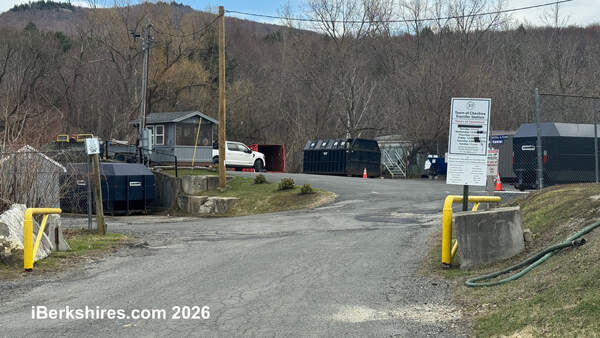
CHESHIRE, Mass. — The town is trying to remedy the transfer stations pay-as-you-throw model as the trash tonnage per permit is significantly higher than what it is supposed to be because of an abundance of blue bags last purchased in 2021.

Resident Mary Ellen Baker brought up at a prior meeting that she saw on Facebook that the transfer station will be requiring extra stickers for the 33-gallon blue bags starting July 1.

The town had switched from color-coded bags to stickers four or five years ago; one sticker was good for an 11-gallon bag and three trash tags for 33-gallon bags. But the blue bags were still being accepted as one trash tag. 

"We paid for those blue bags in good faith, and it seems that those of us who do more composting, recycling, reusing are being penalized, because we don't bring as much down as those who used them up faster. So I really would like you to reconsider that," she said.

The board noted that it was not aware of the decision and brought it forth at their April 7 meeting.

At that meeting, Department of Public Works Director Corey McGrath gave the board comparable numbers from other towns based on their permits and tonnage reported in January from Casella Waste Management.

He said Adams has 500 permit holders and reported 13.12 tons of solid waste. Dalton has 600 permits and 22.8 tons, and Williamstown had 1,043 permits and reported 15 tons, noting it is a very strict pay-as-you-throw community.

He said Cheshire has 600 permits and reported 36.10 tons.

After compiling a list of permit holders, he found 39 percent of residents did not purchase tags with their permits because they had leftover tags from last year or blue bags. He was unsure how many blue bags there could be left over. The first three days of April, he counted how many blue bags were tossed.

"That's a total of 63 blue bags, which is also a total of 187 allowable 11-gallon trash bags. Right? You're allowed to put 33-gallon blue bag, that's three 11 [gallon] kitchen bags. So that's the allowable. So it's 187 kitchen bags on a blue bag that was included with a permit. So, our numbers are absolutely horrible, and we've adopted the pay-as-you-throw but we don't abide by it," he said.

Northern Berkshire Solid Waste Program Director Linda Cernik was able to give the history of the blue bags that stopped being sold in 2021.

"You started your pay-as-you-throw program in 1990, $80 per for the permit, 52 free bags, and it was still going on in 2006 so you've never stopped getting free bags. So you have multitudes of free bags out there," she said.

While the bags were not "free" they were discounted and residents have been getting bags for years, most recently through a package deal.

"It was cheaper if you bought it as a package. It was essentially a 50 percent discount. If you think about it, it's an incentive to buy it as a package. If you were a family, we would see it all the time. If you're a family that knew that you were going to go through more than 52 bags a year, or the equivalent bag tag amount, they would just buy it in one fell swoop and that was an additional $100," said Board of Health Chair Christopher Garner.

"So we would do the permit is $100, $150 for the permit and the year's worth of bags or tags. And if you needed more, you could buy them at that time or anytime in the future you could come down and spend another $100 and buy an additional year's worth of bags or now tags."

He also said since they never put an expiration date on the bags, they are just going to have to try and deal with that.

Some board members were shocked by the amount of blue bags still out in the community.

"I was always under the assumption that if you buy your sticker, you get 52 bags, one per week. That's what you're allowed. That's what we allow. How we've allowed it to get to this point is insane," said board member Raymond Killeen. "We haven't given out bags since 2021 and I understand there's a chance where you could have a few bags left over and carry them over, but we have gone so far where we still got the blue bags going on." 

Cernik also finds it hard to believe there are that many blue bags out there, but that people need to be more educated on diverting their waste into the many different programs at the transfer station.

It's suggested some are abusing the blue bags and stuffing them as much as they can in them.

Baker said she is worried about being penalized because she does recycle, donate, and compost, using not that many blue bags.

"You're a very rare case. Mary Ellen, I had somebody say to me, I have yellow stickers. And when I have my kitchen bag, I put one sticker on it, I take it down. But if I have five or six of them, I throw them in a blue bag," said Town Administrator Jennifer Morse. "People are jamming those blue bags, and they're abusing the system. And unfortunately, not everyone is doing what you guys are doing." 

Cernik said the station is losing grant money because of the program is not really a pay-as-you-throw anymore. Based on a point system the station gets when applying for grants, the transfer station only receives around $3,000, when it could have gotten around double. 

It was also suggested some of the employees let people throw bags without a sticker on them.

"Obviously there's still certain people that work there that enforce things that others don't, and that's an internal issue. But you know, aside from that, and we obviously have to do a better job. So with a deficit of $61,000.15, 100 households, that's $41 per household,"  said board member Michelle Francesconi, noting Cernik said it will go up next year. "So even a household that doesn't have anything to do with the transfer station, which is 900 households, and 900 households are paying $41 per household for trash to be discarded that they don't have anything to do with." 

The board members debated on how they should go about the change, whether to do an exchange program for the bags, have a set date where the bags are no longer allowed, and what costs they should set for permits, tags, and stickers.

It was repeatedly mentioned that people accurately reduce waste and increase recycling to save money.

"We have to get a handle on this, because in five years, I'm gonna be retired, but you guys are going to be paying, I don't even know … it's gonna be out of control. You won't be able to afford it," said Cernik. "I'm serious, it's $130 now we have a five- to three-year contract, and then you have to go up two years, and we'll renegotiate, and it's going to go up because the trucking, everything has to go to another state, because we don't have vehicles."

The board tabled the discussion to get more numbers on how much it waste disposal could cost and how much they should be pricing the permits, and how many tags must be on a 33-gallon bag as currently it is two (although the change in 2021 stated three).

View Full Story

More Adams Stories