Work-Based Learning Initiative Launched for Public Higher Ed Students
LOWELL, Mass. — The Healey-Driscoll administration announced the Massachusetts Cooperative Education Initiative to expand cooperative education (co-ops) for students at Massachusetts public higher education institutions, creating more opportunities for students to gain paid work experience while strengthening the state's workforce pipeline.
This is the first pilot initiative out of the Department of Higher Education's (DHE) Innovation Hub. DHE is awarding $20,000 each to Bridgewater State University, Framingham State University and the Massachusetts College of Art and Design (MassArt) to establish regional co-op partnerships, which are slated to launch for students starting in the fall 2026 semester. The agency is also partnering with UMass Lowell, which has a co-op program, to provide state universities with guidance to grow co-op programs on their campuses, including through technical assistance and coaching.
"In Massachusetts, a college degree should come with real experience and a direct path to a good-paying job," said Governor Maura Healey. "That's why we've made historic investments in public education and set a goal of 100,000 apprenticeships over the next decade, and now we're launching this initiative to expand co-ops and work-based learning so more students can build skills, earn a paycheck and graduate ready to succeed."
Co-ops are a type of work-based learning where students participate in full-time, paid work experience for four to eight months and do not attend classes during that time. Research shows that co-op participation leads to better employment, earnings and career satisfaction.
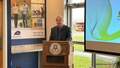
Lt. Governor Driscoll, Secretary of Education Stephen Zrike and Higher Education Commissioner Noe Ortega announced this co-op initiative today at UMass Lowell, in partnership with the campus and Massachusetts Business Alliance for Education (MBAE). The announcement was followed by a panel discussion with UMass Lowell Chancellor Julie Chen, Bridgewater State University President Fred Clark, Framingham State University President Nancy Niemi, MassArt President Mary Grant, co-op students and employers, and Strada Education Senior Vice President Dave Clayton.
DHE's Innovation Hub was announced in March 2025 following a $2.1 million grant award from the non-profit Axim Collaborative. The first-of-its kind in the nation, the Hub allows DHE to pilot innovative approaches to enhancing public higher education co-ops, strengthening pathways from high school to college, and integrating high-value non-degree credentials such as industry recognized certificates or licensure.
"Cooperative education can be transformative for college students — providing invaluable work experience, creating connections that turn into good-paying jobs after graduation and making a college education more affordable. We're thrilled by the success of our co-op program at UMass Lowell, supported by partnerships with the Department of Higher Education and Axim Collaborative. We look forward to sharing the recipe for success we're developing with colleagues across the Commonwealth so that other students will also experience the benefits of these programs," said UMass Lowell Chancellor Julie Chen.
UMass Lowell's co-op program has grown steadily toward efforts to integrate co-op experiences more seamlessly into academic requirements while building interest among students and opportunities among employers. According to UMass Lowell, students completing six-month co-ops earn on average $20,714 during these work-based learning experiences, a significant factor in making college more affordable, while creating connections that in some cases turn into permanent jobs after graduation.
"We are thrilled to see our state higher education institutions embrace this model of education that pairs academic preparation with the development of work readiness skills that are essential to career success. Cooperative education allows students to enter the workforce seamlessly after college, and that is a huge benefit to the student and the employer," said Ed Lambert, Executive Director, Massachusetts Business Alliance for Education.