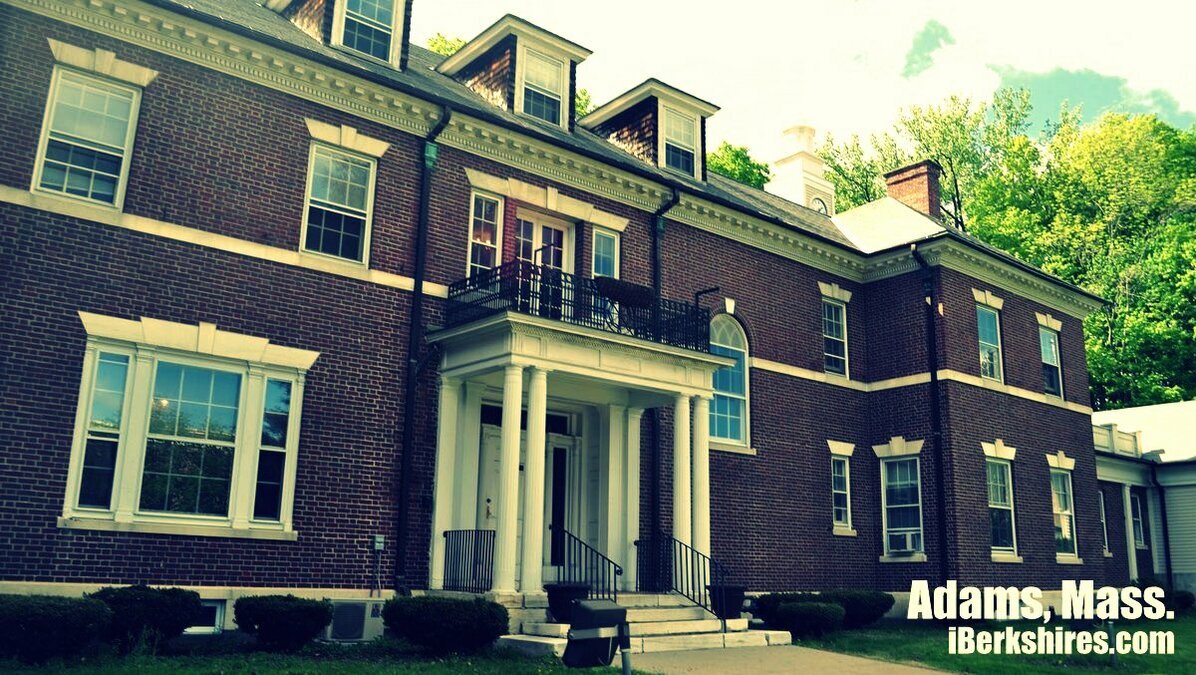
image description

Adams Town Hall's Rooftop HVAC Out of Order

By Sabrina DammsiBerkshires Staff
Print Story | Email Story
ADAMS, Mass. — It's the coldest time of year, and one of the town's HVAC systems is out of order. 
 
One of the town's heating, ventilation, and air conditioning systems needs repair or replacement, said Town Administrator Nicholas Caccamo, during the Selectmen's meeting Wednesday. 
 
The building has three heating units, each serving a designated section: the southern, the middle (primarily where radiators are located), and the northern sections.
 
Upon inspection, the HVAC unit, located on the roof, was "red tagged" and shut down, cutting off heat to the northern end of the building, after a natural gas smell was detected, Caccamo said. 
 
The assessor's office has been relocated to the third floor and the clerk is utilizing additional electric space heaters until the issue is addressed, Caccamo said.  
 
"I think it's really important to note the graciousness and the flexibility that the [town] clerk's office and the assessor's office have exhibited," he said. 
 
Caccamo presented the board with two quotes for service from Jamrog HVAC, a contractor used by many town buildings — one replaces the defective heat exchanger and the other replaces the rooftop unit. 
 
"That system is probably original to the 1996 renovations. It's about a 30-year lifespan. That's a pretty good run with that. The new systems are just more efficient," he said. 
 
"In fact, the utility companies will offer a rebate, a little over $10,000 if you do install these new systems. So, it'll take down the total dollars spent on the project." 
 
Replacing the defective heat exchanger would cost about $7,995, including labor and materials. 
 
However, the age of the system could mean additional repairs may be needed in the future, so the town will eventually have to pay the cost associated with a new unit, Vice Chair Ann Bartlett said. 
 
The cost for a new rooftop system was quoted at $30,995; a $12,660 rebate from the Mass Save Commercial Heat Pump Program, reducing the cost to $18,895. 
 
"It makes a lot more sense to go with a new one. There's been quite a bit of technology since one that was put on the roof," Selectman Joseph Nowak said. 
 
Additionally, the unit is outside so has faced weathering over the years, he said. 
 
It was emphasized that the cost for a new system is uncertain because of unknown variables, including prevailing-wage labor rates, equipment needs, and other repairs. 
 
The town will not want to go over budget, and with any major project, there should be a 10 percent contingency, to ensure the town does not have to make additional allocations later, Caccamo said. 
 
Any funds not used are returned to free cash. Budgeting up to $65,000 would be on the high end to ensure the system can be purchased, installed, and to cover any other repairs associated with the project, such as drywall and additional pipe fittings to replace the leaking pipes, he said. 
 
Caccamo will be in communication with Jamrog to get more accurate cost estimates that include  prevailing-wage and will discuss the project with the Finance Committee. 
 
The board requested a reserve fund transfer for the replacement of the rooftop system, of an amount to be decided by the Finance Committee once additional figures come in. The town has $175,000 in reserves. 
 
During the meeting, resident Cathy Foster, said the aging HVAC system has been something the town has known about for several years. 
 
At previous town meetings, voters approved funding for capital projects three years in a row. Foster questioned whether any funds remained for this project.
 
Finance Committee Chair Carol Cushenette said the committee has a detailed accounting of how the funds were spent.
 
Caccamo, who came on as town administrator in November, said this information is new to him and that he plans to discuss it further with the Finance Committee. 

Tags: HVAC,   municipal buildings,   
If you would like to contribute information on this article, contact us at info@iberkshires.com.

State, Local Leaders Celebrate Funding Boost For Ashuwillticook Rail Trail Extension

By Sabrina DammsiBerkshires Staff

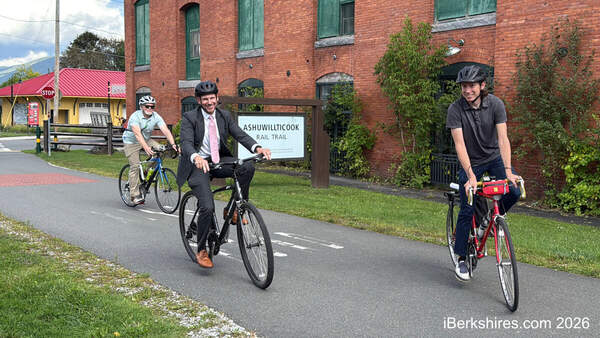
ADAMS, Mass. — State officials and local leaders kicked up their kickstands and took a ride along the final stretch of the Ashuwillticook Rail Trail on Thursday to celebrate new investments in rural communities.

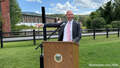
Federal Funds and Infrastructure Office (FFIO) Director Quentin Palfrey joined local leaders, including State Rep. John Barrett III and Berkshire Regional Planning Commission (BRPC) Executive Director Laura Brennan, in Adams to highlight the newest round of FFIO funding. The grant will provide BRPC with $64,700 in state funds to help advance the Ashuwillticook Rail Trail expansion.

"When Governor Healey came into office, one of her big day-one commitments was to make sure that Massachusetts was fighting for every dollar possible coming out of Washington," Palfrey said, speaking about FFIO, a program created in 2023 to help the state aggressively pursue and coordinate federal funding opportunities.

This builds on a $17.3 million federal award secured last year for the project, dubbed the A2A project, which supports the design of a 9.3-mile shared-use path connecting the existing Ashuwillticook Rail Trail to the Williamstown Mohican Path.

"One of the things that she emphasized to me when we set up the Federal Funds and Infrastructure Office was that we need to make sure that these resources not only come into Massachusetts, but benefit all of Massachusetts," Palfrey added.

The additional $64,700 will allow BRPC to gather information about transportation needs in northern Berkshire County to help inform the design of the trail expansion. BRPC will partner with Williams College and Luminary Evaluation, LLC to use the University of Michigan's Transportation Security Index (TSI).

Brennan said BRPC will deploy a 16-question survey that will allow them "to research local and regional perspectives and surface the needs of our neighbors when it comes to transportation in the Berkshires."

"The best-case scenario would be if the survey turned up results that all needs are met and that everyone has access to the places and the things that they need to travel to – but we know that is not true," Brennan said. "We know that folks in Berkshire struggle to get to their place of employment, to be able to access important medical appointments, [and] other engagements. So, the transportation security index is going to help us really hone in on those specific needs, identify pockets of needs or areas where there is a strong concentration or depth of need."

She said FFIO's investment offers a "wonderful augmentation" to BRPC's current plans for the bike trail extension. It's also an investment that will make the region more competitive for other transportation opportunities.

"This is an incredibly multifaceted and valuable investment, and we deeply appreciate it," she said.

Barrett said these investments drive growth in the Berkshires.

"I've always found that if you're going to grow an area, you grow with what you have here to grow. You don't bring something in. We have a natural beauty. We have an environment that's second to none, and that's what we are going to grow on," he said.

Barrett said that in the First Berkshire District alone, 4,000 new people moved to the area.

"We're seeing that migration here. They're going to have activities. They're going to have jobs, and we're going to have a great educational system that goes with it with our two colleges that are here," he said.

Palfrey said it was clear during the initial creation of FFIO that federal funding often went to wealthier and more urban communities with larger planning departments and greater access to consultants. He added that FFIO helps reverse this trend and get projects in rural communities off the ground.

View Full Story

More Adams Stories