No Drought Conditions in Berkshire County
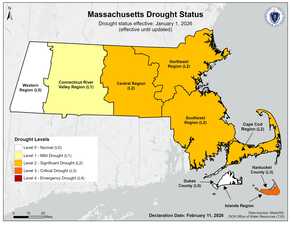 |
BOSTON, Mass. — The Energy and Environmental Affairs (EEA) Secretary Rebecca Tepper declared the Southeast Region has worsened to a Level-2 Significant Drought, and the Millers River Basin has improved.
All other regions remain unchanged, including Berkshire County that remains at a normal drought level.
Drought is a look back at conditions over a period of time. The Drought Management Task Force (DMTF) collected and analyzed data from August 2024 through January 2026.
During January, Massachusetts received a significant amount of snow and a total of 2 to 3.5 inches of precipitation. In spite of this, precipitation deficits since 2024 remain. Additionally, record cold temperatures and frozen ground have prevented snowmelt from occurring and soaking into the soil, limiting groundwater recharge and discharge to streams.
The current drought, which began in 2024, has continued to have significant impacts on the natural environment, including low streamflow, decreasing water levels in lakes and ponds, and declining groundwater in nearly all regions. Although local water supplies are currently stable, as the drought continues to persist and with reduced recharge at this time of the year, it is prudent for all to be very conservative and save water whenever possible.
As outlined in the Massachusetts Drought Management Plan, continued detailed monitoring of drought conditions must continue. The drought levels also require ongoing coordination among state and federal agencies to implement drought response actions such as water-use restrictions. Additionally, engagement with municipalities, including local Boards of Health (BOH), is essential. This includes providing technical outreach and assistance to water suppliers and affected municipalities. Residents are asked to report to their local BOH if wells drying up; BOHs are asked to report here on the condition of local private wells.
Residents can report dry environmental conditions and submit photos to help monitor the situation on the Massachusetts Water Impact Reporter (here). Additionally, a FAQ is now available for questions regarding the current drought status and water conservation; and private well owners can go here for information on how the drought may impact them.
The Massachusetts Department of Environmental Protection (MassDEP) will continue to assist communities in managing their water systems. The Massachusetts Water Resources Authority (MWRA) water supply system is not experiencing drought conditions.
Tags: drought,