Fines, Appeals, Lawsuit Collide in Berkshire Concrete Dispute
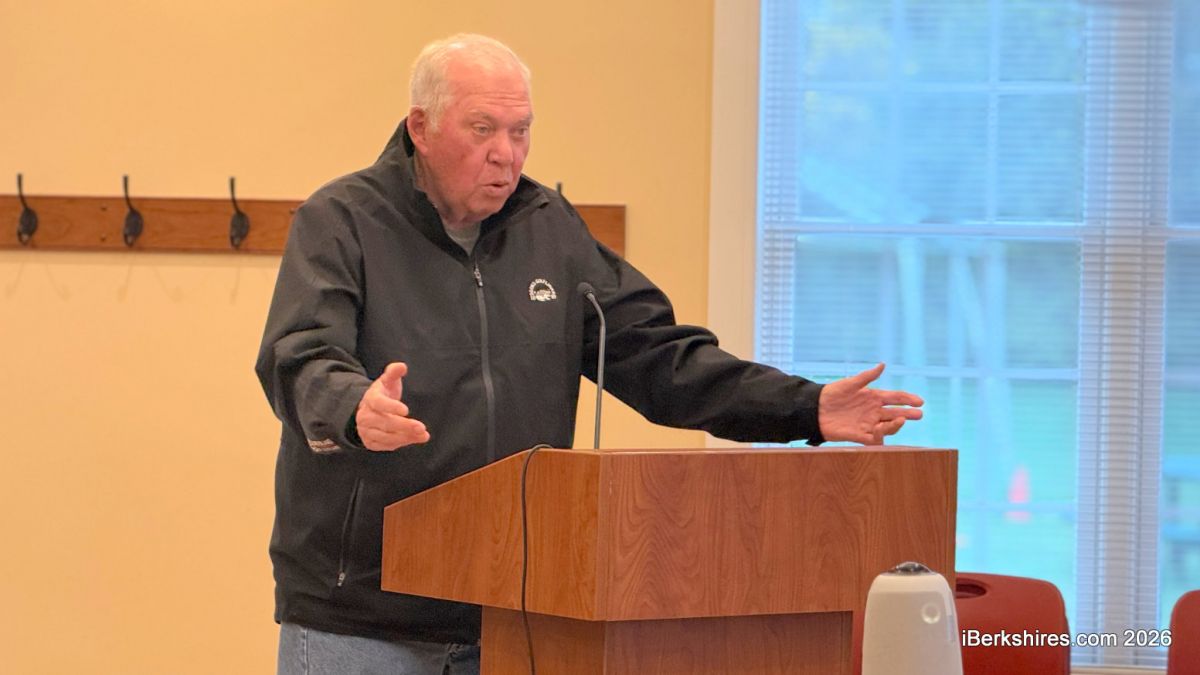
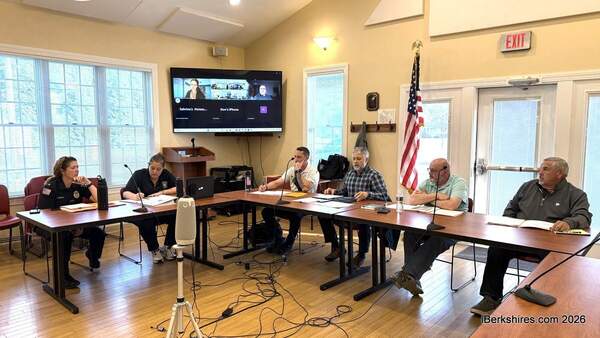
Resident Ron Griffin speaking at Tuesday's Board of Health meeting, thinks the fight with Berkshire Concrete has resulted in some public officials leaving. He is one of the first abutters to speak against Berkshire Concrete.
Petricca Industries, the parent company of Berkshire Concrete, was issued a $50 fine on Saturday, April 25; $100 on Sunday, and $300 daily fines continuing thereafter until a detailed restoration plan is received, Building Inspector Brian Duval said.
As of Wednesday afternoon, no resubmission of the plan has happened, he said.
Almost a year ago, both the Select Board and Planning Board expressed that they wanted parcel No. 105-16 fully mitigated to abide by the town's bylaws.
This vote was supported by the Zoning Board of Appeals, which ruled that Berkshire Concrete had violated zoning bylaw 350-61 Section E. Restoration.
Petricca Industries appealed this decision, however, ZBA upheld its initial vote and ordered the company to fully remediate or cover the dig site to abide by town bylaws.
During Monday's Select Board meeting, Town Manager Eric Anderson said Berkshire Concrete claimed it did not believe that the board's directive to remediate the unauthorized dig site included parcel 105-16.
This assertion made Chair Robert Bishop laugh. He disputed this interpretation, stating the original vote clearly required full remediation of the site. The board agreed to go on record to reiterate that the entire site, including 105-16, needs to be fully remediated.
In a correspondence to Berkshire Concrete on April 21, Duval informed the cement supplier that the written plan they submitted did not indicate that the entire parcel was to be restored to the standard required by the 350-61 Section E. Restoration bylaw.
"You were asked to revise it and submit a new, more detailed plan [and timeline of remediation work.] As of today's date my office has not received a revised copy," he said.
In the notice, Berkshire Concrete was ordered to supply the information to the town by no later than April 24 and that the site be restored in its entirety no later than May 31.
These daily fines coincide with Berkshire Concrete's effort to appeal the fines issued by the Board of Health.
On March 2, the Board of Health issued a $5,000 fine to Berkshire Concrete for creating a public nuisance by allowing sand and dust to leave the property and for failing to submit an adequate dust mitigation plan despite numerous orders.
This fine went unpaid and was not appealed. However, Berkshire Concrete did appeal the subsequent fine of $10,000.
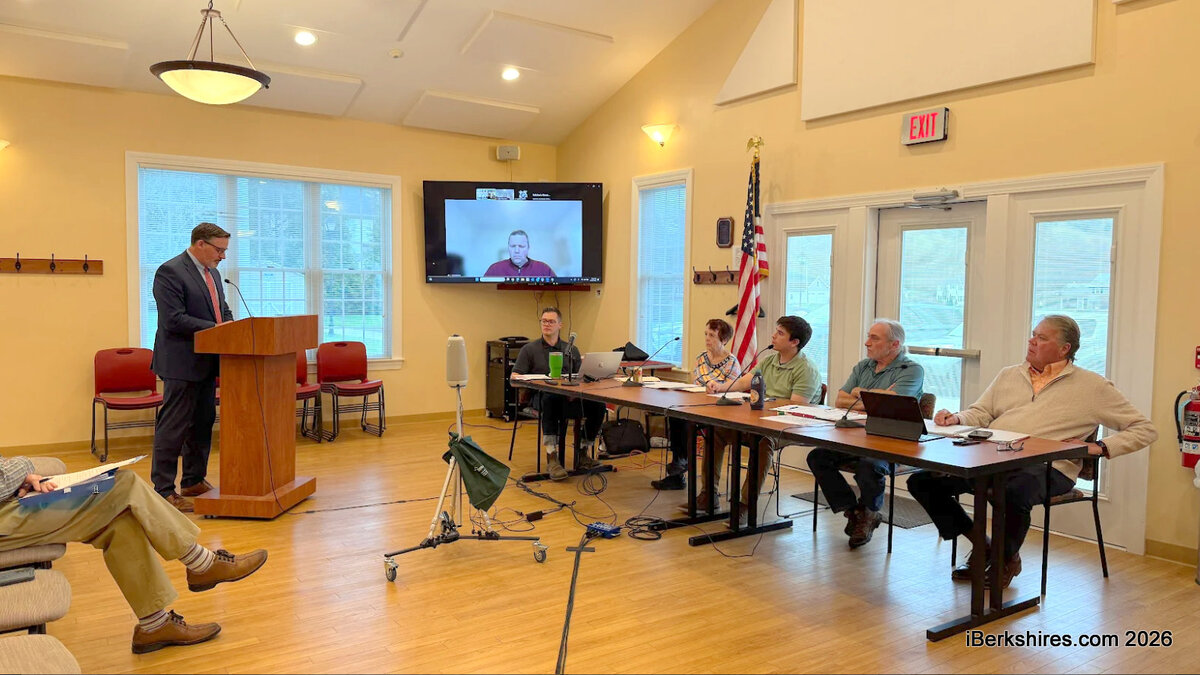
During its meeting on Tuesday, the Board of Health voted to uphold the fines.
At that meeting, Berkshire Concrete's attorney, Dennis Egan Jr. of Cohen Kinne Valicenti & Cook LLP, argued that the fines were issued without proper due process.
He said the company had complied with the order to reclaim the land, had not been informed that its efforts were insufficient, and had not received formal notice of a legally declared ongoing nuisance.
"There's been letters back and forth. We've submitted revised plans. The point is to arrive at a standard operating procedure that works for this Board of Health, the town, and Berkshire Concrete — there's an easy way to solve that, and the way to solve that is to sit down across the table and have a discussion in real time," Egan said.
"The way to solve it is not to send letters back and forth. And Berkshire concrete stands ready, willing and able to have a discussion."
Board of Health co-Chair Nancy Hopper asked if Berkshire Concrete would be willing to have a third party review its plans.
Egan said they have consistently sought to reach a resolution with the town and is willing to work with environmental consultants or other experts, emphasizing the importance of expert involvement in resolving the issue.
The town's attorney Alex Weisheit disagreed with Egan's conclusions, arguing that the Board of Health has the legal authority to issue the fines for a company failing to abate nuisance conditions.
Berkshire Concrete failing to provide an adequate, comprehensive dust mitigation plan can form the basis for fines, particularly in light of the board's prior orders, repeated requests for compliance, and documented complaints and air quality data supporting enforcement, he said.
Each occasion when the board received credible evidence of off-site dust could support a separate fine, Weisheit said. However, fines also don't solely have to be issued automatically following each dust report, he said.
"I think you also have the ability to order corrective actions to be taken to prevent those types of nuisance conditions from occurring, because at the end of the day, the goal is compliance," Weisheit said.
"The goal is to stop these conditions from happening. So, in my opinion, I think there was a valid basis for the fines."
All of this unfolds against a looming lawsuit involving Berkshire Concrete, the town, the Planning Board, and its members over the denial of the company's special permit application.
The suit, filed on behalf of Berkshire Concrete in Superior Court on April 13, seeks to overturn the board's decision and recover damages.
The company seeks permission to operate on its entire property, and to have any future permit applications granted — unless they violate previous permit conditions and fail to fix them after formal written notice, or if the U.S. Mine Safety and Health Administration finds a public health danger requiring new restrictions.
Berkshire Concrete claims that as a direct result of the town's breach of contract it suffered damages of no less than $1.9 million and will continue to incur additional damages.
"We're entering a potentially adversarial relationship with Berkshire Concrete, and it's difficult to find people as we know to serve publicly," Select Board member Antonio Pagliarulo said on Monday.
Since the start of this issue over a year ago, a number of Board of Health members have left, with only Nancy Hopper and Amanda Staples-Opperman retaining their seats.
The town's former Health Agent Agnes Witkowski also left her position, which is currently being filled by Colin Sykes, of the Berkshire Public Health Alliance.
During the Board of Health meeting, resident Ronald Griffin argued that this issue may have contributed to this low retention.
"We should all understand that if we act in good faith with our conscience here professionally, we are provided insurance," Pagliarulo said during the Select Board meeting.
"I know people are very nervous about litigation, being sued … but if we perform our duties within the confines of our respective authorities, we are safe in terms of insurance blanket through [the Massachusetts Municipal Association] So, sore comfort, but I did want to point that out, given vacancies I see now and possibly in the future."
Tags: berkshire concrete, dust, debris, fines, lawsuit, permitting,