Mount Greylock School Committee Discusses Collaboration Project with North County Districts
WILLIAMSTOWN, Mass. — News that the group looking at ways to increase cooperation among secondary schools in North County reached a milestone sparked yet another discussion about that group's objectives among members of the Mount Greylock Regional School Committee.
At Thursday's meeting, Carolyn Greene reported that the Northern Berkshire Secondary Sustainability task force, where she represents the Lanesborough-Williamstown district, had completed a request for proposals in its search for a consulting firm to help with the process that the task force will turn over to a steering committee comprised of four representatives from four districts: North Berkshire School Union, North Adams Public Schools, Hoosac Valley Regional School District and Mount Greylock Regional School District.
Greene said the consultant will be asked to, "work on things like data collection and community outreach in all of the districts that are participating, coming up with maybe some options on how to share resources."
"That wraps up the work of this particular working group," she added. "It was clear that everyone [on the group] had the same goals in mind, which is how do we do education even better for our students, given the limitations that we all face.
"It was a good process."
One of Greene's colleagues on the Mount Greylock School Committee used her report as a chance to challenge that process.
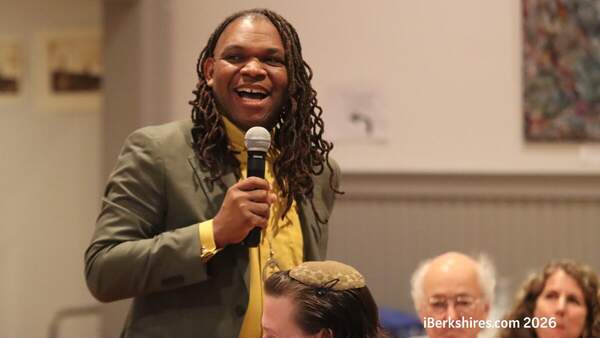
"I strongly support collaboration, I think it's a terrific idea," Steven Miller said. "But I will admit I get terrified when I see words like 'regionalization' in documents like this. I would feel much better if that was not one of the items we were discussing at this stage — that we were talking more about shared resources.
"And before we discuss regionalization, we would actually have some open discussions with members of our community. It was extremely challenging bringing together Williamstown and Lanesborough. There were a lot of issues to make regionalization work. And rather than spending time and resources on something like that, I would much rather see the efforts going toward shared resources."
Greene noted that regionalization is just one of the options that the consultant will be asked to look at.
"I appreciate the comment, Steve, and it's one that you've made pretty consistently," she said. "I think there is a shared understanding in this [North County] group that regionalization is something that may apply to some districts and not others. But there are ways in which we can all help each other figure that out.
"Mount Greylock may not be talking about regionalization at this point, but Hoosac and Drury might be, or the Northern Berkshire School Union and Drury might be. There are ways regionalization might make sense for some districts down the road and may not for others. But there are still opportunities for us to support each other in those conversations and offer experiences and feedback. … It's not meant to strike terror in your mind or others, quite honestly. But there are some districts for which the word 'regionalization' is important to bring up as a way to help them in the future — help them survive and help them to figure out better ways to educate the kids.
"That's what this is about, finding better ways to educate the students of Northern Berkshire County."
The RFP approved by the representatives from the four districts calls for the consultant to, "Develop at least four sustainability scenarios, such as shared services, grade reconfiguration, collaborative programming, and/or partial/full regionalization."
Greene said the options are not mutually exclusive.
"I suspect there will be a combination of options that bubble to the surface," Greene said. "But we can't lead with fear. I've said that before, and I'm just going to say it again. We have nothing to fear. We only have the best intentions, and I think we have enough wisdom around the table to understand what our limits are."
Each of the four member districts in the collaboration effort is set to finalize its four members on the Steering Committee by mid-January, Greene said.
In other business on Thursday, the School Committee heard a report from Mount Greylock Principal Jake Schutz on a draft program of study for the 2026-27 academic year.
Schutz said the changes were minimal in some departments and, in others, "more targeted to focus our support and interventions."
"The focus, overall, is on creating opportunities while maintaining the robust programming, which oftentimes are competing requirements," he said.
Faculty, counselors, administrators and the School Council were involved in the process of developing the proposed program of study presented on Thursday.
Some of the potential changes Schutz discussed included: seeing if there is student interest in a course in contemporary issues as a social studies course; combining college prep and honors classes, if needed, in English in grades 11 and 12; increased section offerings with smaller class sizes in math; and a Advanced Placement classes in Spanish literature and music theory.
And, on a related note, Superintendent Joseph Bergeron discussed recent announcements from Boston on potential graduation requirements for high schools in the commonwealth.
"If updated graduation requirements are adopted [in the summer of 2027], those most likely would be phased in," Bergeron said. "So we would be looking at a number of years for any of this to actually come to fruition."
Bergeron said that the program of study under discussion in Boston is, "pretty compatible with what we already do." An exception: Mount Greylock does not currently require two years of a world language or one year of arts in high school, but, "they are very common things for students to do."
Changing those to requirements would not be a heavy lift at Mount Greylock, but it could change the way students think about electives, he said.
Tags: education task force,