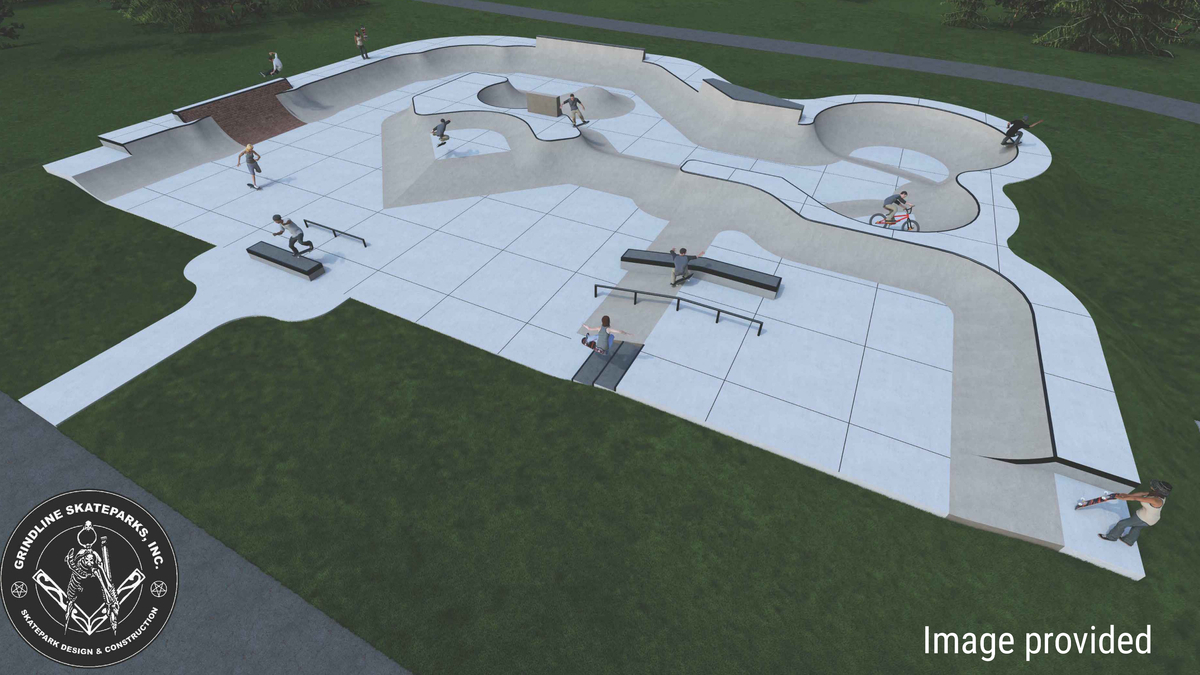
Williamstown's Planned Skate Park Before Conservation Commission
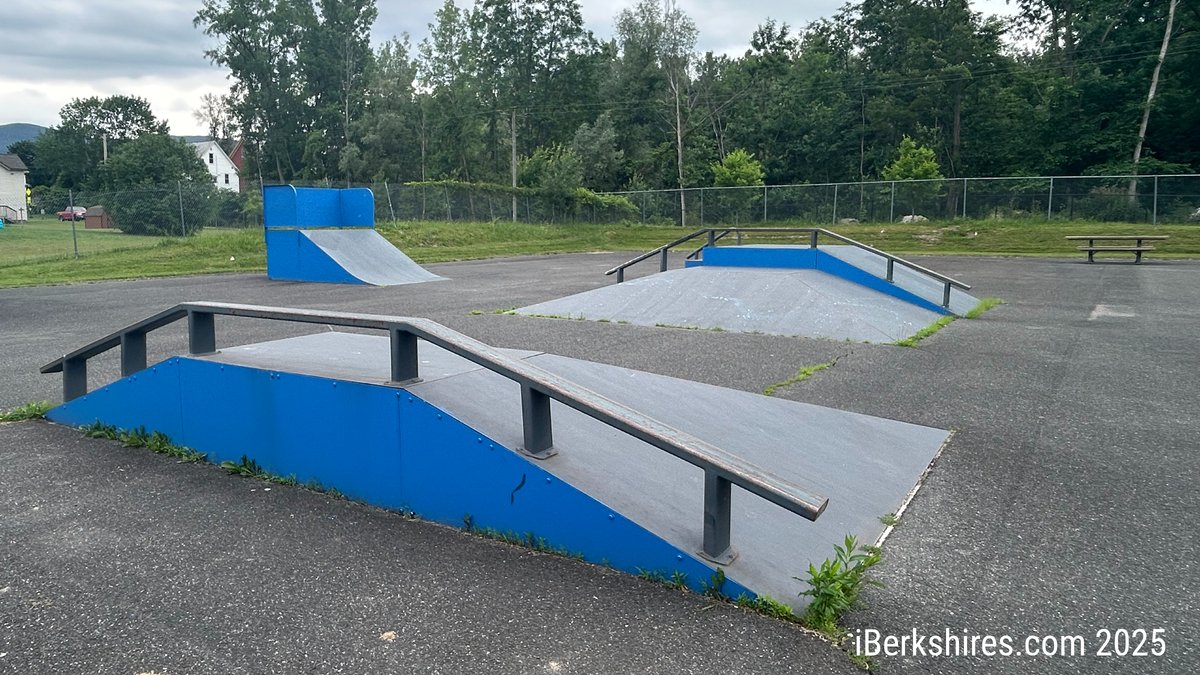
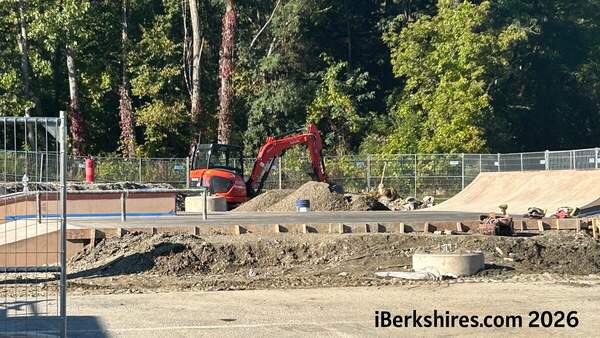
The current outdated skate park on Stetson Road.
The project, which received a $32,000 infusion of Community Preservation Act funds from town meeting in May, is currently before the commission because of its proximity to bordering vegetative wetlands off Stetson Road.
"There is wetland southwest of the project area behind a chain link fence," Andre-Anne Chenaille of civil engineering firm Guntlow and Associates told the Con Comm at its June 5 meeting.
"We are also in bordering land subject to flooding, the 100-year flood zone of the Hoosic River [to the north]."
Unlike the current park — a blacktop pad with metal structures that are showing their age — the planned park will feature concrete ramps and bowls, similar to the facility on State Street in North Adams.
As such, the new park will displace flood volume by raising the grade in the town-owned parcel.
"So if that flood water was to flow in, the skate park would be displacing it outward," Chenaille explained. "If you're doing that, you have to provide compensatory flood storage, meaning you have to dig out somewhere else where the water can go that it did not go before."
The town has the acreage to do just that.
The question is how much storage is enough.
An official from the Western Regional Office of the commonwealth's Department of Environmental Protection told the town on June 4 that its plan is not specific enough.
The town, through its civil engineer, argued to the Con Comm this month that its method for determining the volume of water displaced by the project is functionally the same as the more complex calculation recommended by the DEP official.
"Cut and fills must be shown at each 1 foot incremental elevation, which was not done," Mark Stinson wrote, referring to the Notice of Intent the town filed with the Con Comm. "Please resubmit a correct flood table showing cut and fill at each 1 foot incremental elevation, which the regulations require, to the commission and this reviewer."
Chenaille said instead of doing a 1-to-1 analysis of the displacement as the DEP called for, the engineers calculated the total displacement of the concrete park and used that figure to determine how much compensatory storage is needed.
"We can certainly try to figure out [each 1 foot incremental elevation] before the next meeting, but it's very complex," she said. "And for a very large flood plain like this one, we're only filling [200 cubic feet]."
She later suggested that the commission could think of that volume as a 20-by-20 foot room (about the size of the town hall meeting room) with one foot of water.
Community Development Director Andrew Groff, who also serves as the town's conservation agent and advises the Con Comm, asked the commissioners whether they felt the town, as Guntlow's client, should incur the extra expense involved in a foot-by-foot calculation.
"Think about a skate park," Groff said. "As I understand it, to do it foot-by-foot, you've got to scan in the complex geometry of that skate park and look at it layer by layer by layer.
"That's why Andre-Anne's approach was to say, 'OK, we know the total cubic volume of concrete it takes to build this thing. Let's use that as our basis instead of this layer cake, very detailed approach."
Con Comm Chair Philip McKnight asked whether that explanation would satisfy Stinson. One of his colleagues on the town commission indicated the approach made sense to him.
"I'm in favor of saving the town some money and using the most efficient method we can to get the correct result," Tim Carr said. "If we have another way of gauging the volume of displacement versus replacement, we don't need to incur the extra expense."
Chenaille said it was up to the commission to determine if the current calculation is sufficient.
"That's the complication, McKnight said. "This has to go back to Stinson because he says so in his letter."
"It's our judgment, though," Carr replied.
McKnight agreed that the DEP official's letter was advisory.
The consensus of the commission was to not send the engineer's back to the drawing board to do a more detailed analysis of the displacement before coming back to the panel.
But the Con Comm took no formal votes on the Notice of Intent other than to continue it to the commission's next meeting because the town is waiting on another state report.
Because the proposed work is in Zone 1 of the public water supply, the town needs review from the DEP's Drinking Water Program.
As of Thursday, June 26, the town was still waiting on the Drinking Water Program report, meaning the hearing on the skate park NOI likely would have been continued yet again had the Con Comm met as scheduled. That meeting of the commission was canceled on Thursday morning. The next scheduled meeting of the body is July 10.
The Con Comm did OK a few projects at its June 5 meeting.
The Massachusetts Department of Transportation submitted two emergency certifications for work to repair culverts on Route 7 — one on the Simonds Road portion and another on Cold Spring Road.
"The rain we had the last two weeks has damaged the head walls," Groff told the commission. "And [the culverts] are in danger of failing and damaging the road."
The other matter before the commission concerned a private property on Roaring Brook Road, where a homeowner essentially sought the commission's forgiveness for work already begun on the property near the water resource.
Groff told the commissioners that the property owner had begun installing an inground pool — which is exempt from the Wetlands Protection Act — while also planning to put a small addition on their home, which is subject to review under the WPA.
When the homeowner was informed by contractors that the excavation for the addition should be done first because of the need to get equipment in where the pool was planned, that work was begun.
"He got himself in a little bit of a logistics issue," Groff said of resident J.J. Filiault, who did not attend the June 5 hearing.
Filiault was before the board with a Request for Determination of Applicability under the Wetlands Protection Act. A positive determination — i.e., a ruling that the WPA does apply — would have triggered a more costly Notice of Intent, or NOI, entailing the use of an engineer.
McKnight appeared irked that work had begun without the commission's approval and told his colleagues they would be within their right to order that everything on the property be "put back the way it was." But McKnight also acknowledged that the commission likely would have given the work in question the OK if the application had been filed first.
"I think we are entitled under our statutory authority to permit him to go forward under whatever conditions we choose, with the understanding that we do so reluctantly," McKnight said.
Ultimately, the commissioners chose to make a negative determination of applicability but to condition the work as follows: All "overburden" from excavation on the property must either be removed from the site unless the property owner file a Notice of Intent to change the topography of the site by redistributing the excavated earth on the property.
"You could tell him to get rid of the overburden, get it off site," Groff told the commission before it set the condition. "That is clearly within your authority. … If he's upset, [he can] file a Notice of Intent to change the topography of the lot.. … If you're spreading all this material out, how is that impacting drainage? How is that impacting sediment flow into the brook, etc.?
"You can always take [the excavated earth] off site. That happens all the time."
Tags: conservation commission, skate park,