Mount Greylock School Committee Declines State Budget Resolution

By Stephen DravisiBerkshires Staff
Print Story | Email Story
WILLIAMSTOWN, Mass. — The Mount Greylock Regional School Committee on Thursday opted not to advocate for fundamental changes to state budgeting in Boston.
 
Members Steven Miller and Curtis Elfenbein brought their colleagues a resolution that the pair proposed their committee send to the Massachusetts Association of School Committees for adoption at its 2025 annual meeting.
 
If advanced and, eventually, adopted by the statewide advocacy group, the resolution would have urged "elected representatives to immediately move to sustainable budgets over the next three years so that constitutionally mandated services, in particular education, receive the necessary funding."
 
The authors argued that, "it is not sustainable long term to consistently spend more than is collected," as they say Beacon Hill currently does.
 
And they argued that public education, which is enshrined in the commonwealth's constitution, stands to suffer if the portion of Massachusetts' budget dedicated to paying off debt continues to grow.
 
"We need to make sure we have the resources necessary [to fund education]," Miller said at Thursday's special, single-item meeting. "Our district will be OK this year. A lot of districts will be making painful cuts. If things continue on the trajectory they are on, it's going to be worse and worse and worse.
 
"The earlier the decisions are made, the less damaging it will be."
 
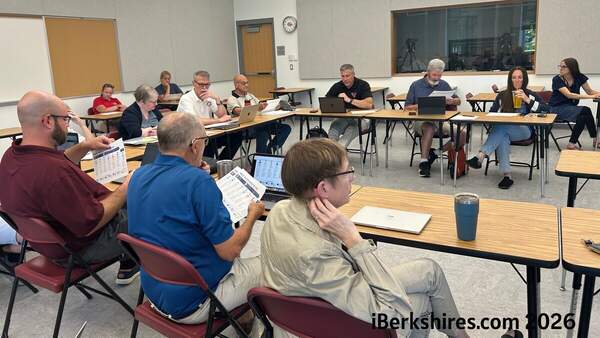
Four members of the seven-person committee attended Thursday's meeting. Chair Julia Bowen told the group on the Zoom call that members Elfenbein, Jose Constantine and Christina Conry had emergencies that kept them from participating.
 
Miller and Elfenbein had taken the proposed resolution to the committee's regular May meeting, but other members raised concerns — principally that, as written, the resolution did not stress that education was not an area that could be cut to make budgets more "sustainable."
 
Miller said at the time that he could amend the resolution to clarify that point, and Bowen agreed to call the special meeting so that the committee could — if it chose — agree to send the amended resolution to MASC in time to meet its deadline for member submissions to its Resolutions Committee.
 
Thursday's revote was 2-2 with Miller and Bowen voting in favor of the resolution and Greene and Maloy voting against. Three "yays," a majority of the members present, would have been necessary to move the resolution forward.
 
Miller said Tuesday that legislators need to understand that the commonwealth is spending money it doesn't have and that it needs to prioritize expenditures.
 
"If we stop spending money on things that are nice but are not top priorities, that are not mandated, that frees up more money to pay off the interest and principle [on the state's debt] and pay for the truly mandated needs, like education," he said.
 
Greene asked Miller what he considered "not top priorities," but he answered that he did not think the committee wanted him to enumerate that and the resolution was designed to let the legislators in Boston make those kinds of decisions.
 
"There is something driving you toward this conclusion that we're spending money on things other than education," Greene said. "Are you saying you want legislators to stop spending money on X, Y and Z to pay down the debt and pay for education? I think the legislators would say we're spending quite a bit of money on education."
 
Bowen answered that Miller's main argument was that the state needs to stop spending more than it takes in as revenue. And, she said, that change can come either through spending cuts or increased taxes or some combination of the two.
 
Miler said the solution could be "creating an environment that leads to more economic activity."
 
Greene pressed Miller about his intent in proposing the resolution.
 
"Are you advocating for cuts like what is happening at the federal level, just cutting agencies?" Greene asked.
 
"Yes," Miller responded. "There are certain programs that are luxuries. What I'm saying right now is it is not a long term solution to spend money you don't have.
 
"It is very easy to spend money on every program. You're not going to upset anyone. But the bill is going to have to be paid at some point."
 
Bowen asked Miller if the resolution, if advanced, would be a home-grown idea or part of some national movement of which she was not aware.
 
"I've been advocating for something like this for a year," Miller said.
 
"But you've been advocating we not spend on immigrant populations … " Greene began.
 
"Illegal, illegal," Miller interrupted. "I'm not putting any of that in [the resolution]."
 
Miller said he found it "interesting" to be getting resistance to a resolution that he later characterized as "symbolic" since, even if passed by MASC it likely would be ignored on Beacon Hill.
 
"This is the weakest ask I can think of: Don't spend money you don't have," Miller said.
 
Just prior to casting the second "nay" to kill the resolution, Greene told Miller she appreciated the work he did on it and supported the spirit of it. She also encouraged any of the School Committee members concerned about the issue to reach out to legislators on their own.
 
Miller wrapped up the conversation by making an agenda request for the "sustainable budget" resolution to be brought back to a future meeting and saying he plans to make it a standing agenda request at every regular School Committee meeting.
 
The next meeting is scheduled for Thursday, June 12.

Tags: MGRSD,   

If you would like to contribute information on this article, contact us at info@iberkshires.com.

Puppets Teach Resilience at Lanesborough Elementary School

By Breanna SteeleiBerkshires Staff

The kids learned from puppets Ollie and a hermit crab.

LANESBOROUGH, Mass. — Vermont Family Network's Puppets in Education visited the elementary school recently to teach kids about being resilient.

Puppets in Education has been engaging with young students with interactive puppets for 45 years.  

The group partnered again with Bedard Brothers Chevrolet, which sponsored the visit. 

Classes filtered through the music class Thursday to learn about how to be resilient and kind, deal with change and anxiety, and more.

"This program is this beautiful blending of other programs we have, which is our anxiety program, our bullying prevention and friendship program, but is teaching children the power of yet and how to be able to feel empowered and strong when times are challenging and tough," said program manager Sarah Vogelsang-Card.

The kids got to engage with a "bounce back" song, move around, and listen to a hermit crab deal with the change of needing a new shell.

"A crab that is too small or too big for its shell, so trying to problem solve, having a plan A, B and C, because it's a really tough time," Vogelsang-Card said. "It's like moving, it's like divorce of parents, it's changing schools. It's things that children would be going through, even on a day to day basis, that are just things they need to be resilient, that they feel strong and they feel empowered to be able to make these choices for themselves."

The resiliency program is new and formatted little differently to each of the age groups.

"For the older kids. We age it up a bit, so we talk about harassment and bullying and even setting the scene with the beach is a little bit different kind of language, something that they feel like they can buy into," she said. "For the younger kids, it's a little bit more playful, and we don't touch about harassment. We just talk about making friends and being kind. So that's where we're learning as we're growing this program, is to find the different kinds of messaging that's appropriate for each development level."

This programming affirms themes that are already being discussed in the elementary school, said school psychologist Christy Viall. She thinks this is a fun way for the children to continue learning. 

"We have programs here at the school called community building, and that's really good. So they go through all of these strategies already," she said. "But having that repetition is really important, and finding it in a different way, like the puppets coming in and sharing it with them is a fun way that they can really connect to, I think, and it might, get in a little more deeply for them.

Vogelsang-Card said its another space for them to be safe and discuss what's going on in their life. Some children are afraid because maybe their parents are getting divorced, or they're being bullied, but with the puppets, they might open up and disclose what's bothering them because they feel safe, even in a larger crowd. 

"When we do sexual abuse awareness that program alone, over five years, we had 87 disclosures of abuse that were followed up and reported," she said. "And children feel safe with the puppets. It makes them feel valued, heard, and we hope that in our short time that we're together, that they at least leave knowing that they're not alone."

Bedard Brothers also gave the school five new puppets to use. Viall said the puppets are a great help for the students in her classroom, especially in the younger grades. 

"Every year, I've been giving the puppets to the students. And I also have a few of the puppets in my classroom, and the students use them in small groups to practice out the strategies with each other, which is really helpful," she said. "Sometimes the older students, like sixth graders, will put on a puppet show. They'll come up with a whole theme and a whole little situation, and they'll act it out with the strategies for the younger students. It's really cute, they've done it with kindergarteners, and the kids really like it."

Vogelsang-Card said there are 130 schools in Vermont that are on the waiting list for them to come in. Lanesborough Elementary has been the only Massachusetts school they have visited, thanks to Bedard Brothers. 

"These programs are so critical and life-changing for children in such a short amount of time, and we are the only program in the United States that does what we do, which is create this content in this enjoyable, fun, engaging way with oftentimes difficult subjects," she said. "Vermont is our home base, but we would love to be able to bring this to more schools, and we can't do this without the support of community, business funders or donors, and it really makes a difference for children."

The fourth-grade students were the first class to engage with the puppets and a lot of them really connected with the show.

"I learned to never give-up and if you have to move houses, be nervous, but it still helps," said William Larios.

"I learned to always add the word 'yet' at the end," said Sierra Kellogg, because even if she can't do something now, she will be able to at some point.

Samuel Casucci was struck by what one of the puppets talked about. "He said some people make fun of him if he dresses different, come from different place, brings home lunch, it doesn't matter," Samuel continued. "We're all kind of the same. We're all kind of different, like we have different hairstyles, different clothes. We're all the same because we're all human."

"I learned how to be more positive about myself and like, say, I can't do this yet, it's positive and helpful," said Liam Flaherty.

The students got to take home stickers at the end of the day with contact information of the organization.

View Full Story

More Williamstown Stories