Williamstown Proposes 'Contingent' Hike in Wastewater Assessment
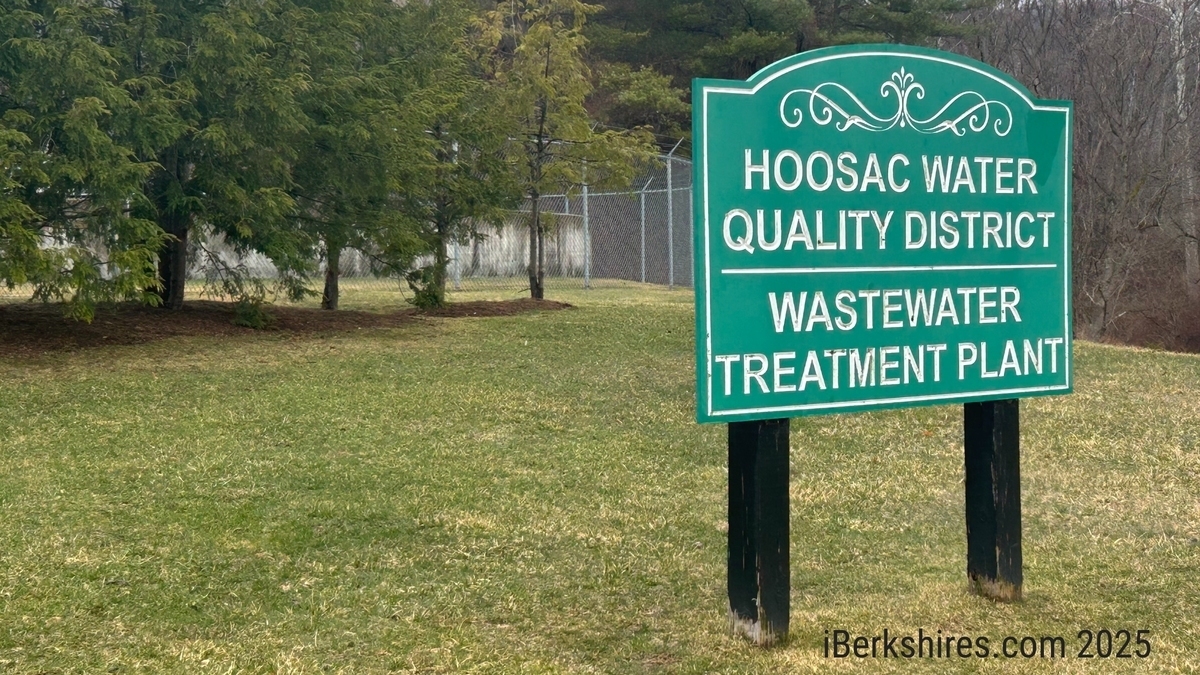
WILLIAMSTOWN, Mass. — The Finance Committee on Thursday voted unanimously on a plan that would give the Hoosac Water Quality District the flexibility to scrap a plan to import sewage from other communities to compost at the district's Simonds Road facility.
It remains to be seen whether town meeting and the town's partner in the district, go along with the idea.
Starting with the water quality district's initial budget presentation to the Fin Comm this winter, there has been a conversation in town about whether the district — a joint enterprise of North Adams and Williamstown — should enter into an agreement with waste hauler Casella to take in processed sewage and compost it for eventual sale for use as fertilizer.
The district has operated a composting operation for decades. But in the last several years, it has come to light that processed human solid waste contains perfluoroalkyl and polyfluoroalkyl substances (PFAS), which have been linked to cancer.
Some states, including Maine, already have banned the use of compost from human waste from agricultural application, and Massachusetts has legislation that would do the same.
For now, while such application is allowed, there still is a market for the compost. Casella has proposed a deal under which it would bring treated sewage from other water quality facilities to the Williamstown site to utilize its excess capacity, and the hauler would, in turn, take the resulting compost to sell it for use in agricultural or horticultural application.
The HWQD sent Williamstown an FY26 spending plan that assumed the Casella deal goes through and which has a resulting "bill" to the town offset by the revenue the district would receive from Casella.
Two weeks ago, the Select Board voted 2-3, to recommend against town meeting passage of the warrant article that would set a 2025-26 sewer rate reflecting the budget the district proposed.
On Thursday, the Finance Committee, which previously voted to recommend passage of the HWQD's original number, offered another potential path forward.
By a vote of 8-0, the Fin Comm decided to offer an amendment to the printed warrant article at the May 22 annual town meeting.
Chair Fred Puddester proposed that the article be amended on the floor of the meeting to add $200,000, a sum which, he said, would represent Williamstown's share of a more expensive sludge disposal method that involves using a landfill rather than spreading the PFAS-contaminated compost in agriculture.
"That's estimated to cost [the district] $600,000," Puddester said. "Our share is about a third or $200,000."
Based on flow rate, the district's smaller municipality pays anywhere from 30 to 33 percent in a given year. North Adams, which also takes in metered sewage from Clarksburg and sends it west to Williamstown, pays the bulk of the district's operating budget.
Puddester emphasized that Williamstown is just one member of the district, which is governed by a board of appointed commissioners — two from Williamstown, two from North Adams — and the town cannot tell the district what to do with the sewage it processes.
"If we want to take the position that we wanted to give the district the opportunity to choose a different method, we could at least put up our side of the money as an option," Puddester said. "We can't tell them to do that. We can't force them to do it. But we can, in my estimation, provide the funds."
The committee Thursday voted to bring an amendment to the floor of town meeting that would increase the assessment from the HWQD from $1,018,044 (the number the district proposed and that is printed in the warrant) to $1.218 million, "contingent on the Hoosac Water Quality District implementing a sludge disposal plan different from that recommended in the budget."
Fin Comm member Melissa Cragg ran the numbers to find what the impact would be.
The current water rate in Williamstown — where residents pay one bill that includes the cost of water they receive and sewage they send out of the home — is $12.31 per cubic yard.
"What was in the original [FY26] warrant was taking that rate to $12.25," Cragg said. "With this change, the $12.25 becomes $13.25. If you take that $13.25 and compare it to the current $12.31, that's an increase of about 7.63 percent on your water bill.
"So I looked up what's the average water bill, and if you were paying monthly, based on the annual Massachusetts household, the bill would go, on average, from $83.55 a month to $90.34 a month. So that's an increase of less than $7 per month. But that's the average household."
There are, of course, two parties that would need to be on board with such an increase.
At Thursday's meeting, Select Board Chair Jane Patton, who voted in the minority of the 2-3 vote on the HWQD assessment at that body's April 14 meeting, expressed concern about expecting the neighboring city to go along with the idea of declining the Casella proposal.
"There's also a moral responsibility to our neighbors, and to put that burden on North Adams, who, no criticism intended, does not have the resources Williamstown does, I think we need to be mindful of that, as well," Patton said, referencing the moral objections raised by Williamstown residents concerned about producing more PFAS-contaminated compost.
"We have to be mindful of the decisions we make and how it impacts our neighbors, if we're going to use the moral argument."
Puddester noted that nothing would change from the budget proposed by the district unless the four commissioners who govern the district say so — at least in the short-term.
The decision of whether to compost sewage for fertilizer could be taken out of the district's hands altogether if the commonwealth outlaws the practice, as has been proposed on Beacon Hill.
The next meeting of the Hoosac Water Quality District board is May 14.
"The one thing I like about this contingent thing is, they may decide on May 14 they're going to keep composting, and there's nothing we can say about that," Puddester said. "But on Sept. 30, the state may say you can't compost. Then they've got to change plans, and we've already appropriated the money so they can do that.
"Otherwise, we'll get soaked with a bill that goes way up next year because they'll spend down the reserves to get through this year. This not only protects us if they make the decision but if they get forced to make the decision at a later date."
Cragg asked the Select Board to consider taking up the question of whether to endorse the Fin Comm's proposed amendment at the board's May 12 meeting, in hopes that the two town bodies might present a united front at the town meeting on May 22.
Tags: HWQD, town meeting 2025,