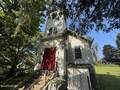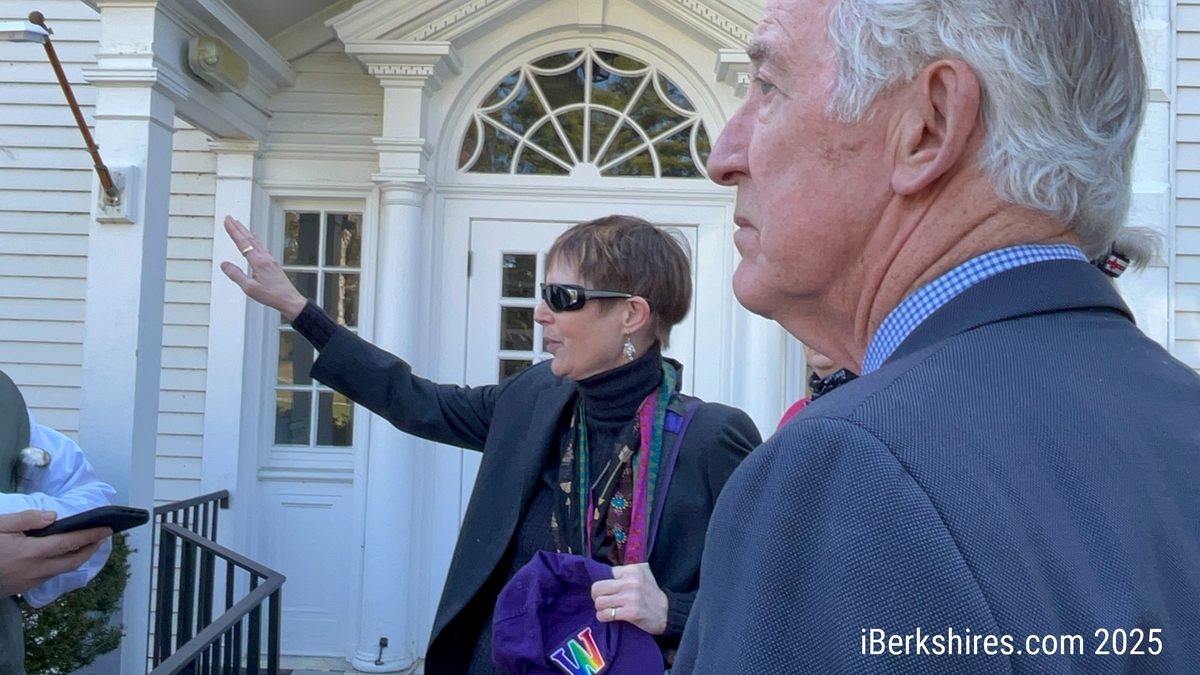
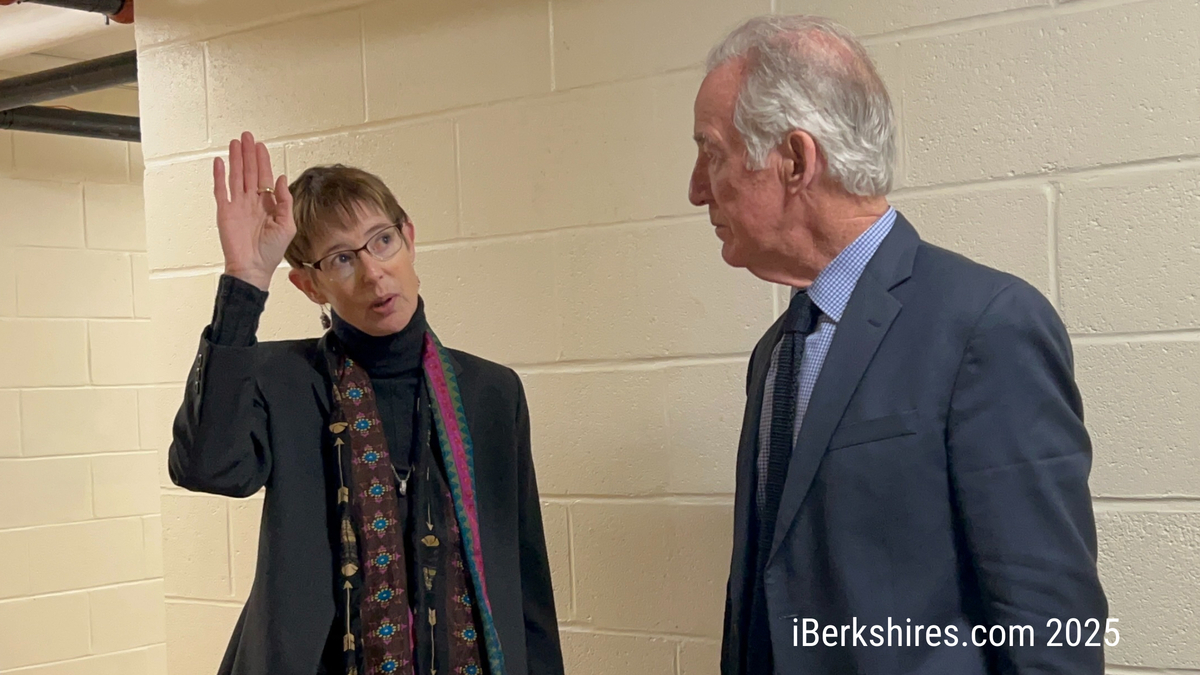
Williamstown Meetinghouse Preservation Fund President Carolyn Greene points out features of the 1869 structure and its additions to Congressman Richard Neal, who has secured $500,000 toward ADA work in the historic structure.
Greene shows Neal the basement of the Williamstown Meetinghouse.
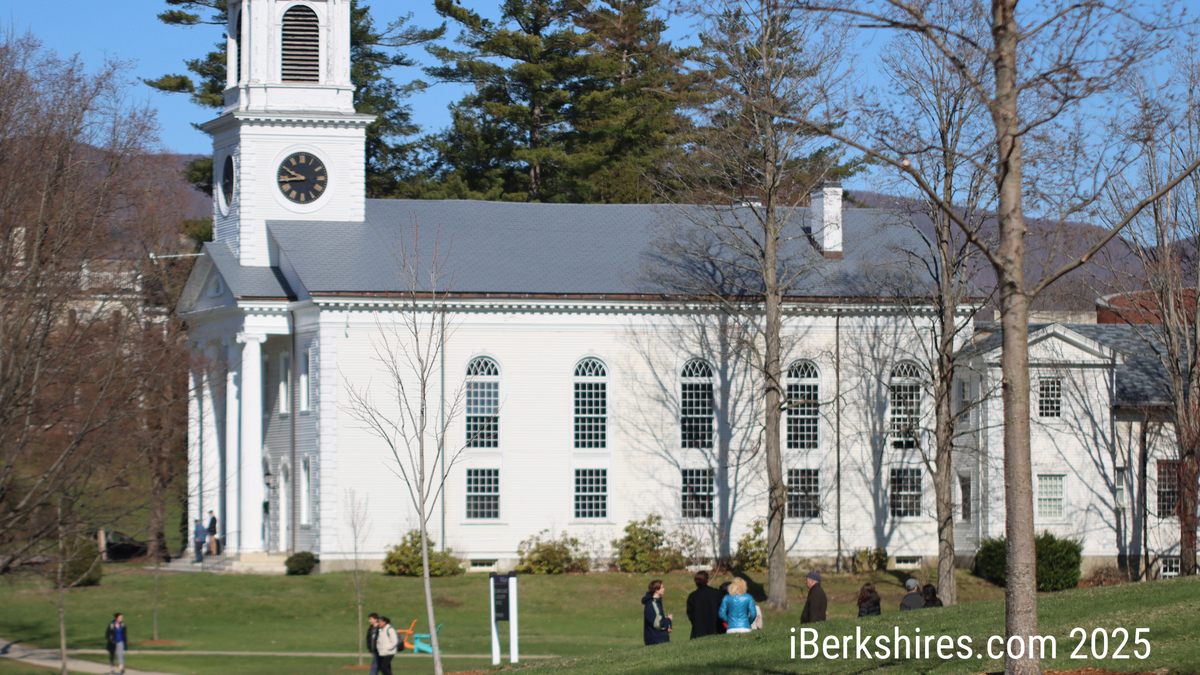
The Williamstown Meetinghouse on Main Street (Route 2) is home to First Congregational Church and its community activities, including education, a thrift store, and cooking meals for shut-ins.
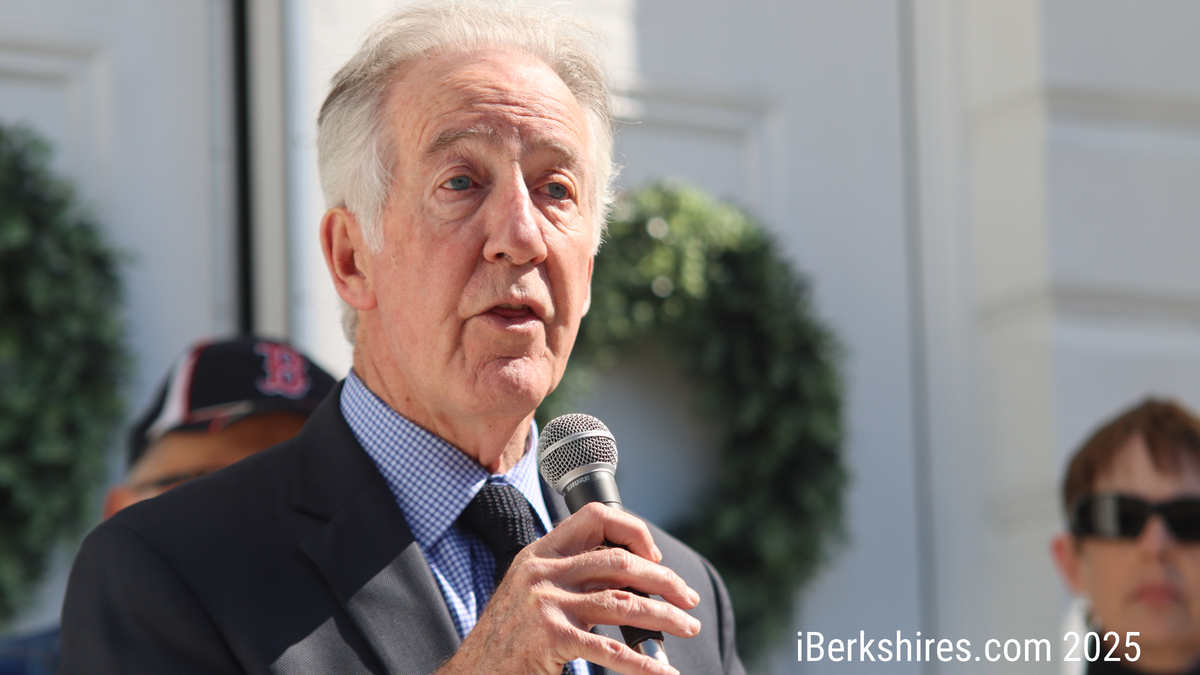
Neal says New England meetinghouses were symbols of representative democracy: 'where people have the right to assemble and petition their government and to make their voices heard.'
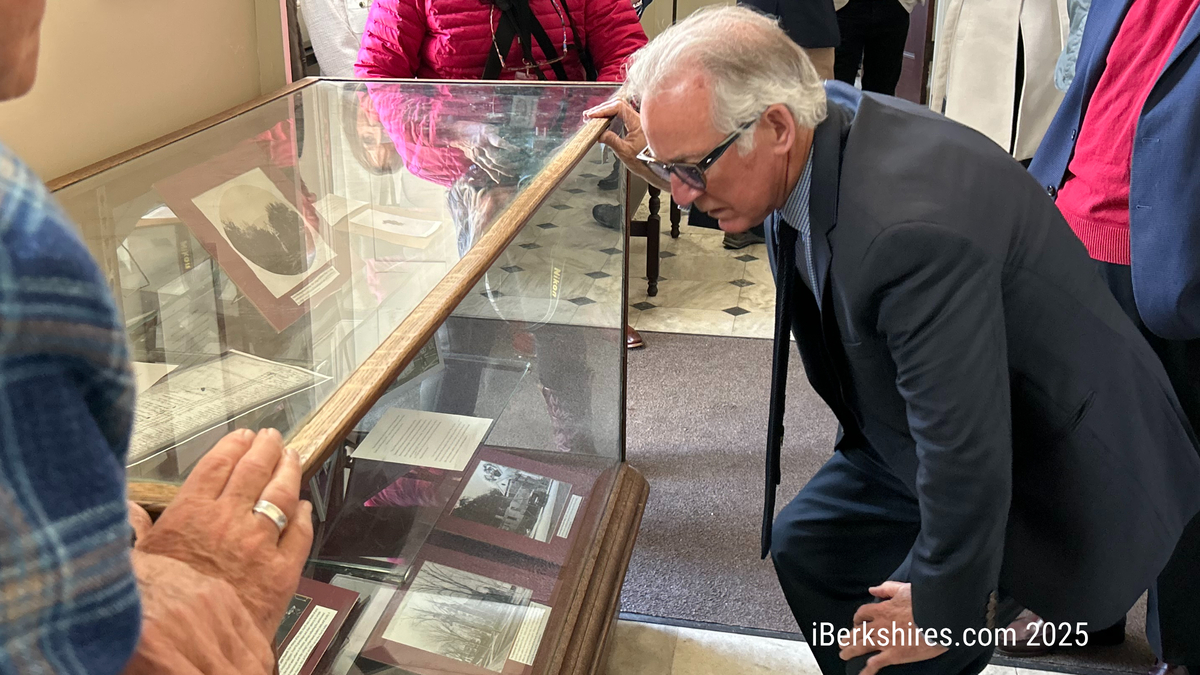
Congressman Richard Neal looks at historic photos of the 19th-century meetinghouse during a tour Thursday.
WILLIAMSTOWN, Mass. — A longtime Democratic member of Congress on Thursday lauded the democratic ideals embodied in a local landmark.
U.S. Rep. Richard Neal, D-Springfield, was in town to celebrate a $500,000 federal earmark to support the renovation of the Williamstown Meetinghouse, a project that will make the iconic structure more compliant with the Americans with Disabilities Act and more accessible to members of the community.
Referencing the 1869 structure's connection to the town's 1765 founding (the first two meetinghouses burned down), Neal drew a line from Thursday's celebration to a much better known party happening at the other end of the commonwealth this week.
"I hope I'm going to be there on Saturday morning, that's my plan, to be in Concord and Lexington for the acknowledgement of what happened 250 years ago, because that's what we honor with the Meetinghouse: Representative democracy, where people have the right to assemble and petition their government and to make their voices heard," Neal said in prepared remarks on the meetinghouse steps.
"That's what the meetinghouse meant. It was very much in the Puritan history. After a church was constructed, a Congregational church, generally, nearby, there was the library and the meetinghouse. It's all over New England in these beautiful little towns that I represent."
Since 2013, Williamstown has been on that list of towns represented by Neal, a former Springfield mayor who has served in the House of Representatives since 1988. After the 2010 Census, Neal became Williamstown's representative from the newly drawn 1st Congressional District.
On Thursday, he was joined on the meetinghouse steps by state Rep. John Barrett III, D-North Adams, Sherwood Guernsey of the Berkshire Democratic Brigades and Carolyn Greene, president of the Williamstown Meetinghouse Preservation Fund.
Guernsey explained how the meetinghouse, also home to and commonly referred to as First Congregational Church, has a strong non-sectarian place in local history.
"It began as a combination, as it is today — as a meetinghouse and a sanctuary — because that is what was required to incorporate a town back then," Guernsey explained to the small crowd that turned out for Neal's brief visit. "Things have changed, but not the way this building is structured. Yes, there is a sanctuary in the front, but in the back … there will be the opportunity, when we're able to complete the ADA compliance, which we need to do with the North end, the back of the building, so it is accessible to all."
Greene led a tour of the building, where Neal saw not just the sanctuary but the education spaces, the storage for the ABC Clothing Shop thrift store, the commercial kitchen where meals are prepared for shut-ins, the meeting spaces for community groups and the stage for small performances.
Greene also explained the accessibility issues, including restrooms that are not fully ADA compliant and, most significantly, the lack of an elevator.
Since its inception, the preservation fund has done a lot of work to the building's structure already, including a new roof and repairs to the steeple to prevent leakage that was endangering the building below. The non-profit has raised money through private donations, state aid facilitated by Barrett and grants of Community Preservation Act funds from Williamstown's town meeting.
Currently, the board is getting cost estimates for the next phases of the renovation, Greene said. Its priorities include making the main floor fully accessible, adding an elevator to make the basement level accessible and extending that elevator to a third stop on the second floor — in that order.
Greene said the board will apply the $500,000 federal grant secured by Neal as far as it goes toward achieving those goals.
And, speaking one day after it came to light that a culvert restoration project in North Adams lost $144,000 in previously committed federal funds, Greene said the $500,000 for the meetinghouse already is "money in the bank."
"This is money we're working through the [Housing and Urban Development] process, and it will go through the town," Greene said. "That's why I think this announcement is happening now, to assure the community that this money is solid. The money that Rep. Barrett has in the [state] bond issue, which is about $500,000 $100,000, we don't know when that's coming in. It's money we know we have, but it could be in the next five years. It could be in the next 10 years."
Greene told the supportive crowd on the meetinghouse steps that efforts to renovate the 19th century structure and its 20th-century additions will help serve Williamstown in the 21st century and beyond.
"The building is in the heart of Williamstown, it's in the center of Williams College's campus, it has more potential than we even realize to do good for the community, given its place and given the people in this building already," Greene said.
During the tour, Neal lingered over historic photos of the current meetinghouse and its predecessors and chatted extensively about the role of the meetinghouse in New England small towns. In his official remarks, he emphasized the Williamstown icon's place in the nation's history.
"When this request came in, I thought it should be honored, mostly because there's not a better example in America of representative government than what was known as the meetinghouse," he said. "This is where people came together — sometimes, perhaps more assertively than we would like. But, not to miss the point, this is where differences were ironed out, in settings like this."
If you would like to contribute information on this article, contact us at info@iberkshires.com.
Your Comments
iBerkshires.com welcomes critical, respectful dialogue. Name-calling, personal attacks, libel, slander or foul language is not allowed. All comments are reviewed before posting and will be deleted or edited as necessary.
No Comments
Puppets Teach Resilience at Lanesborough Elementary School
By Breanna SteeleiBerkshires Staff
The kids learned from puppets Ollie and a hermit crab.
LANESBOROUGH, Mass. — Vermont Family Network's Puppets in Education visited the elementary school recently to teach kids about being resilient.
Puppets in Education has been engaging with young students with interactive puppets for 45 years.
Classes filtered through the music class Thursday to learn about how to be resilient and kind, deal with change and anxiety, and more.
"This program is this beautiful blending of other programs we have, which is our anxiety program, our bullying prevention and friendship program, but is teaching children the power of yet and how to be able to feel empowered and strong when times are challenging and tough," said program manager Sarah Vogelsang-Card.
The kids got to engage with a "bounce back" song, move around, and listen to a hermit crab deal with the change of needing a new shell.
"A crab that is too small or too big for its shell, so trying to problem solve, having a plan A, B and C, because it's a really tough time," Vogelsang-Card said. "It's like moving, it's like divorce of parents, it's changing schools. It's things that children would be going through, even on a day to day basis, that are just things they need to be resilient, that they feel strong and they feel empowered to be able to make these choices for themselves."
The resiliency program is new and formatted little differently to each of the age groups.
"For the older kids. We age it up a bit, so we talk about harassment and bullying and even setting the scene with the beach is a little bit different kind of language, something that they feel like they can buy into," she said. "For the younger kids, it's a little bit more playful, and we don't touch about harassment. We just talk about making friends and being kind. So that's where we're learning as we're growing this program, is to find the different kinds of messaging that's appropriate for each development level."
This programming affirms themes that are already being discussed in the elementary school, said school psychologist Christy Viall. She thinks this is a fun way for the children to continue learning.
"We have programs here at the school called community building, and that's really good. So they go through all of these strategies already," she said. "But having that repetition is really important, and finding it in a different way, like the puppets coming in and sharing it with them is a fun way that they can really connect to, I think, and it might, get in a little more deeply for them.
Vogelsang-Card said its another space for them to be safe and discuss what's going on in their life. Some children are afraid because maybe their parents are getting divorced, or they're being bullied, but with the puppets, they might open up and disclose what's bothering them because they feel safe, even in a larger crowd.
"When we do sexual abuse awareness that program alone, over five years, we had 87 disclosures of abuse that were followed up and reported," she said. "And children feel safe with the puppets. It makes them feel valued, heard, and we hope that in our short time that we're together, that they at least leave knowing that they're not alone."
Bedard Brothers also gave the school five new puppets to use. Viall said the puppets are a great help for the students in her classroom, especially in the younger grades.
"Every year, I've been giving the puppets to the students. And I also have a few of the puppets in my classroom, and the students use them in small groups to practice out the strategies with each other, which is really helpful," she said. "Sometimes the older students, like sixth graders, will put on a puppet show. They'll come up with a whole theme and a whole little situation, and they'll act it out with the strategies for the younger students. It's really cute, they've done it with kindergarteners, and the kids really like it."
Vogelsang-Card said there are 130 schools in Vermont that are on the waiting list for them to come in. Lanesborough Elementary has been the only Massachusetts school they have visited, thanks to Bedard Brothers.
"These programs are so critical and life-changing for children in such a short amount of time, and we are the only program in the United States that does what we do, which is create this content in this enjoyable, fun, engaging way with oftentimes difficult subjects," she said. "Vermont is our home base, but we would love to be able to bring this to more schools, and we can't do this without the support of community, business funders or donors, and it really makes a difference for children."
The fourth-grade students were the first class to engage with the puppets and a lot of them really connected with the show.
"I learned to never give-up and if you have to move houses, be nervous, but it still helps," said William Larios.
"I learned to always add the word 'yet' at the end," said Sierra Kellogg, because even if she can't do something now, she will be able to at some point.
Samuel Casucci was struck by what one of the puppets talked about. "He said some people make fun of him if he dresses different, come from different place, brings home lunch, it doesn't matter," Samuel continued. "We're all kind of the same. We're all kind of different, like we have different hairstyles, different clothes. We're all the same because we're all human."
"I learned how to be more positive about myself and like, say, I can't do this yet, it's positive and helpful," said Liam Flaherty.
The students got to take home stickers at the end of the day with contact information of the organization.
Students got to showcase their art at the Clark Art Institute depicting their relationship with the Earth in the time of climate change. click for more
The 100th annual meeting will be held on March 10, 2027, the Community Chest's birthday (there will be cake, he promised) and a gala will be held at the Clark Art Institute on Sept. 25, 2027.
click for more