Neal: Dems Need to 'Fracture' Republicans, Challenge Trump Actions in Court
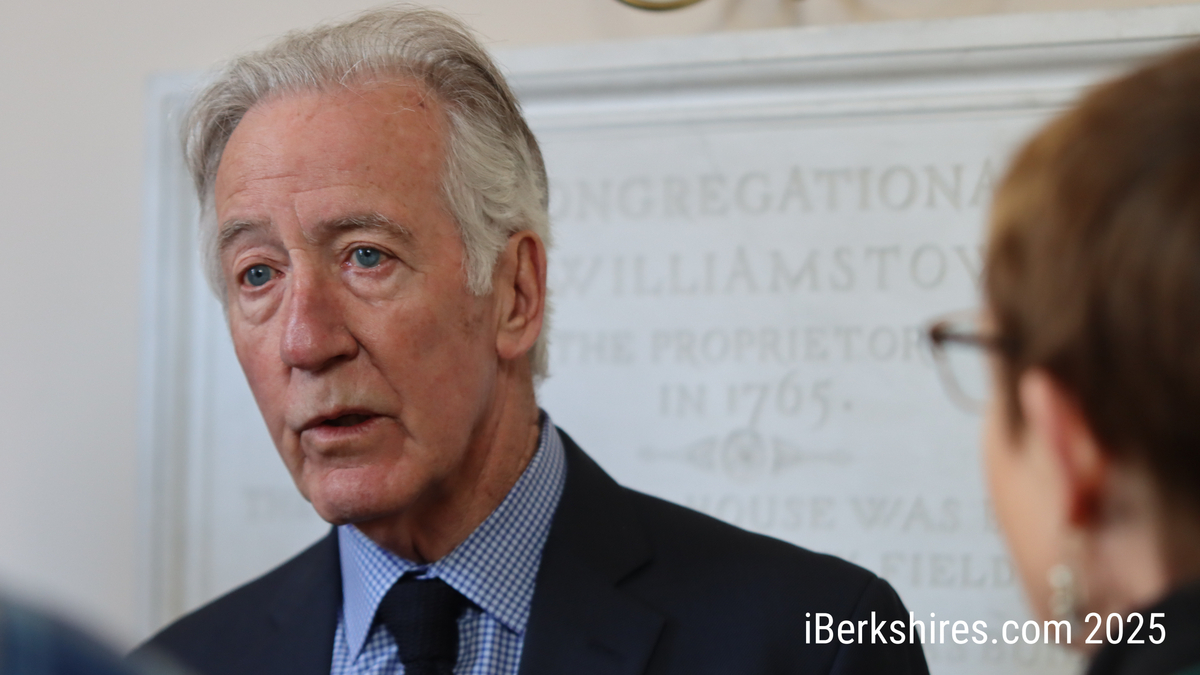
WILLIAMSTOWN, Mass. — U.S. Rep. Richard Neal, D-Springfield, Thursday said Democrats' best strategy to counteract the Trump administration is to "fracture" his support on Capitol Hill and that decisions like the withdrawal of funds to promote resilient infrastructure will be successfully challenged in the courts.
Neal was in town to celebrate a $500,000 appropriation he helped secure to help the renovation of the Williamstown Meetinghouse, the Main Street home of First Congregational Church.
Later Thursday morning, he headed to a closed door meeting with local business people to talk about the impact of Trump's tariff policy.
His visit came 12 days after a rally on the steps of that structure called for action to turn back some of the most aggressive White House actions in the first 90 days of Trump's presidency and 24 hours after news broke that the administration is clawing back $90 million in disaster prevention aid, including $144,000 to support a culvert restoration project in North Adams.
On Wednesday, Neal in a news release called the administration's decision not to allocate funds from FEMA's Building Resilient Infrastructure and Communities program, "another example of the chaotic decision-making that has been a hallmark of this administration."
Thursday morning, he hearkened back to a 1970s dispute between the Nixon administration and Congress that went all the way to the Supreme Court.
"The challenge that we're going to have is that I think a lot of these decisions that the Trump administration has made are likely to be overturned in court, but there's going to be a lot of anguish in between," Neal said. "I thought many of these [court] decisions were correctly reached during the Nixon administration, and that's why [the Trump administration] has been using terms like 'pause' rather than impoundment.
"Because impoundment is a losing argument. The Supreme Court has already ruled on the jurisdiction that I outlined: Congress has the power of the purse. But what they're going to do is delay and deny when they can, and I think pushing back on that is going to be really important for us."
Democrats have been pushing back against the administration since Day 1, but they have had little success against a Republican party that controls the White House and both chambers of Congress and is backstopped by a solid conservative majority on the Supreme Court.
Neal, an 18-term member of Congress and ranking member of the House Judiciary Committee, said the best course of action for his party on Capitol Hill is to splinter the GOP's 220-213 majority.
"We have an arithmetic challenge, as you know, in the House of Representatives," Neal said. "But we need to fracture that support that the president has had. I'll point out here that, obviously, in our constitutional system, members of Congress don't serve under the president. They serve with the president.
"But until Republicans break in the House, we're going to continue to have this challenge. And I do think Medicaid, Medicare, Social Security and veterans' benefits could fracture a lot of them."
Neal admitted there is a major obstacle to driving a wedge between the White House and congressional Republicans, even though he thinks many of the latter, privately, disagree with some of what is coming out of the executive branch.
"You hear it in the elevators, you see it in the eye rolls, but they're all afraid of a primary," Neal said. "As long as they're afraid of a primary that he and his pal, [Elon] Musk have all threatened to finance, a lot of them are just reluctant to say anything.
"Last week, when I talked to the Democratic Caucus, I said there's a new group in town somewhere, we just don't know where, and we don't know if there are any of them. It's called 'Republicans for Tariffs.' I never met any Republicans who were for tariffs. I mean, Ronald Reagan being for tariffs?"
In addition to tariffs and spending cuts, another flash point for progressive outrage against the Trump administration has been its assault on academic freedom, a salient issue in the home to Williams College.
"I think we all should be cheering for what Harvard's doing in pushing back," Neal said. "I think some of the other law firms and universities have succumbed to some of this pressure. And I think they need to push back aggressively."
Pushed on what the colleges' representatives on Capitol Hill can do, Neal returned to familiar territory.
"I think we have to continue to try to fracture them," he said. "And I think the rules in the House make it very difficult because the majority sticks together on rule making. But I think I saw 18 of them yesterday wrote to the president about Medicaid, saying, 'No cuts to Medicaid.'
"And I would like a floor vote on that," Neal added with a smile.
Neal's visit to Steinerfilm comes a week after the president announced a 90-day pause on "reciprocal tariffs," while maintaining a baseline tariff of 10 percent on all imports announced on April 2 and raising tariffs on China 145 percent.
The stop was closed to press but in a statement issued by Neal's office immediately following, he said the American economy had been healthy and growing three months ago.
"In less than one hundred days, this administration has put all of that in jeopardy," said Neal. "For businesses, they are grappling with the uncertainty of these proposals and what it will mean for their overhead. That’s exactly what we're seeing here today at Steinerfilm."
Steinerfilm Inc., part of German corporation Steiner GmbH & Co. KG, began producing metallized dielectric film in Williamstown in 1978 and currently employees about 42.
"I am concerned that, due to the tariffs, we are now forced to increase our prices for customers while the current uncertainty makes it very difficult to determine the correct pricing for our products," said Marc Steiner, CEO of Steinerfilm in the statement. "Until now, we have tried hard to keep prices low to stay competitive with the Asian markets. However, we have already noticed a drop in orders."
Tags: Neal,