PFAS Issue Splits Williamstown Select Board on Sewer Rate
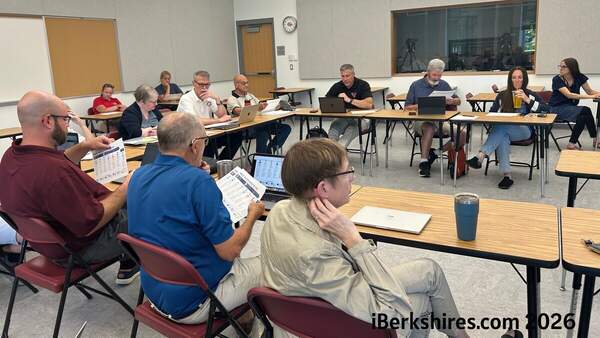
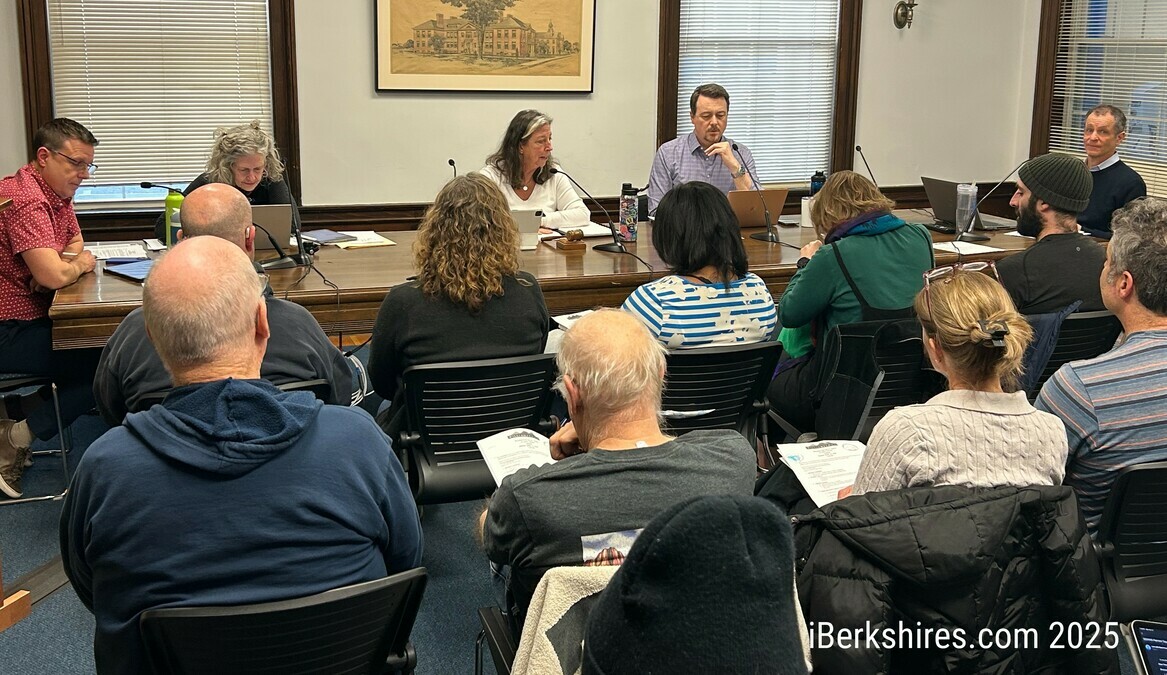
WILLIAMSTOWN, Mass. — About 20 residents and the majority of the Select Board on Monday sent a message to the Hoosac Water Quality District: importing sludge and converting it to compost is a bad deal and unethical.
In a rare break from past practice, a divided Select Board voted against recommending that town meeting OK the HWQD's proposed fiscal year 2026 sewer rate.
The district's plan to accept sludge from other communities and sell off the resulting compost through waste hauler Casella became an issue this winter when the HWQD presented its proposed FY26 sewer rate to the town's Finance Committee.
The district, a joint venture of Williamstown, North Adams and Clarksburg (not a voting member on the district board) has been talking for a couple of years about what will happen if and when the commonwealth bans the production of compost due to the presence of the so-called "forever chemicals," PFAS, which the International Agency for Research on Cancer has classified as a human carcinogen.
Despite that classification, not all states have banned the use of fertilizer derived from human biosolids, which are known to contain PFAS. And it is still legal in Massachusetts for wastewater treatment plants, like the HWQD plant in Williamstown, to operate composters and dispense compost containing PFAS within specified ranges.
District officials have warned the town for some time that once composting no longer is allowed, the cost to dispose biosolids — either through incineration or encapsulation in landfills — will skyrocket.
The HWQD's composting facility is one of the few in the region with excess capacity, and Casella has offered the district a deal under which the hauler will bring sludge (a semisolid byproduct of purifying water) to the Williamstown plant for composting and take resulting compost off-site for sale to users.
Select Board member Stephanie Boyd, who began ringing the alarm bell about the HWQD in February, said a representative of the commonwealth's Department of Environmental Protection told her that the state and federal governments are failing the public by allowing PFAS-contaminated compost to be used in the production of food.
"And I don't want to be part of that."
Boyd last month asked the Select Board to table its vote on a recommendation of the sewer rate article among all the other fiscal articles on the town meeting warrant in order to allow a fuller consideration.
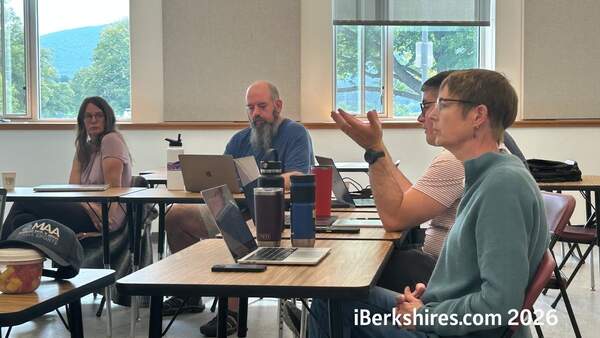
Resident Laura Bentz, one of a dozen residents to address the Select Board from the floor of Monday's meeting, said she said she felt lucky to live in Williamstown when she read a February New York Times article about a Texas county dealing with high concentrations of PFAS on cattle land.
"Since I heard about this [HWQD plan] a few weeks ago, I've been doing research," Bentz said. "I've found this sludge is illegal on farm land in Maine. It's only been illegal there for two years, and it became illegal because a whole bunch of dairy cows died and the milk was polluted.
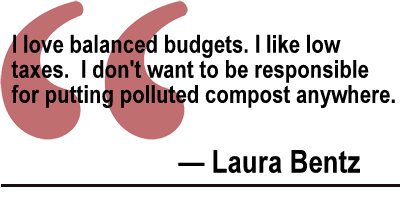
"I love balanced budgets. I like low taxes. I don't want to be responsible for putting polluted compost anywhere."
Hugh Daley and Russ Howard, Williamstown's representatives to the four-member HWQD Board of Commissioners, appeared at Monday's meeting to explain the district's rationale for negotiating a deal with Casella that is yet to be finalized.
"What we really are in is the expense management business," Daley explained. "We have a little bit of revenue, and the rest of our expenses we assess in sewer fees. The amount is apportioned between the towns based on flows.
"The goal that the board set was to, based on the idea of composting, of bringing in sludge, making compost and having that compost be moved out was we were going to generate more revenues than we traditionally have generated … which would lead to a lower net budget. What we're offering to the town is a level-funded budget."
Williamstown's sewer rate — proposed by the district and, generally, approved without comment at the annual town meeting — is actually slated to go down a little in FY26 because of the apportionment formula, Daley said. Generally, North Adams' share of the district's operation is about 70 percent, he said.
The Fin Comm, which vets budgets and sends fiscal articles to town meeting, recommended passage of the FY26 HWQD budget on a vote of 9-0.
Select Board members Boyd, Randal Fippinger and Jeffrey Johnson voted against a motion to recommend town meeting approve the water rate. Jane Patton and Matthew Neely voted in the minority of the 2-3 vote.
Patton expressed sympathy for the arguments raised by residents concerned about the plan to import sludge, but she noted that while the town can lobby the HWQD and the Select Board appoints two of its four commissioners, the town cannot tell the special district what to do — any more than it can control the two-town regional school district.
"I don't see [recommending the budget] as endorsing this process," Patton said, referring to the plan to bring in sludge from outside the district. "I think anyone who is reasonable struggles with this — at a minimum struggles with this.
"I don't know that I agree that saying we recommend this [budget] is saying we approve of what the Hoosac Water Quality District says is going to get us to this number."
In addition to the ethical argument against participating in a system that produces more contaminated compost for use in agriculture, participants in Monday's meeting raised a some less philosophical arguments against the HWQD entering the proposed deal with Casella.
Among them, critics noted that sludge in the district's compost yard already leaches water that is then fed into "clean" water discharged into the Hoosic River; that water meets the federal standard for PFAS concentration. Adding "imported" compost — i.e. biosolids not produced in Clarksburg, North Adams and Williamstown — will increase the total volume of PFAS molecules released into the Hoosic, part of the Hudson River watershed.
Daley countered that the "couple of hundred gallons of leachate" the compost yard might give off after a rain is a tiny percentage of the "couple of million gallons" of water processed and released each day by the plant's normal, highly regulated and monitored processing of sewage.
Another resident raised the issue of whether the district — and, by extension, its member municipalities — would be on the hook if they profit from "imported" compost if and when that compost leads to contaminated fields, illness and even death linked to PFAS down the line.
"The question you have around liability, I can't answer," Daley replied. "I think that answer is unknowable. In the grand scheme, anyone can sue anyone for anything."
Another unknown — as of Monday's meeting — is what happens if town meeting ultimately rejects the sewer rate proposed by the district, given the fact that its overall budget is divided among the member communities. In the case of the nearest local parallel, a regional school district, budgets that pass in one community and fail in another can be reworked and revoted in special town meetings. Ultimately, that process can end in a districtwide vote.
Town Manager Robert Menicocci advised the Select Board that he has to consult counsel to determine what next steps would be if Williamstown's May 22 annual town meeting follows the recommendation of the board and rejects the rate proposed by the district.
Daley said if the district's negotiations with Casella fall through for any reason — including a decision by the commissioners to pull out — the district likely would be able to lean on reserves and deferred expenditures to get through FY26 without raising the rates it currently is proposing. But those steps would make the FY27 rate increase that much steeper, he implied.
The idea was floated that the HWQD could drop out of the Casella deal and raise rates incrementally for FY26 — not enough to reflect the true cost of disposing its sludge in a post-composting world but starting the district and its ratepayers on the path to what even district officials say will be the new reality once state laws start shutting down composting operations altogether.
A former member of the Select Board, Anne O'Connor, was one of many residents who emailed the board and HWQD officials since the plan to import sludge came to light.
"It is one thing to seek to ethically dispose of our own sewage sludge in an imperfect world," O'Connor wrote in the email. "It is quite different to go into the composting business, taking in sludge and 'selling the problem down the road' as people naively contaminate their properties with a product they thought they could trust. As communities learn of the risks, they are opposing and litigating land-based application of biosolids. In short, there hasn't been adequate ethical and legal review."
O'Connor called on the Select Board to ask the district to amend its FY26 budget and come back with a new rate to propose to town meeting.
Neither Howard nor Daley were able on Monday night to confirm the date of the next HWQD Commissioners meeting. Daley said they generally meet the second or third Wednesday of the month, but are not meeting in April because the plant's chief operating officer is out of town. The third Wednesday in May would be just one night before Williamstown's annual town meeting.
One point that came through in several of the comments at Monday's meeting: The local water quality district should not be involved in distributing more PFAS-contaminated compost just because the law says it can do so.
When one resident, Wendy Penner, pointed out that federal regulations are more likely to be torn up than strengthened around PFAS contamination, many in the room nodded or murmured assent. But another speaker, Susan Abrams, said state bans, including in Massachusetts, are highly likely.
"This is seriously coming down the pipeline," Abrams said. "It's going to be expensive for everyone. There's no way we can avoid the expense.
"We can't say what other states do, but we can say what we're doing in Williamstown."
Tags: contamination, HWQD, PFOA / PFAS, williamstown_budget,