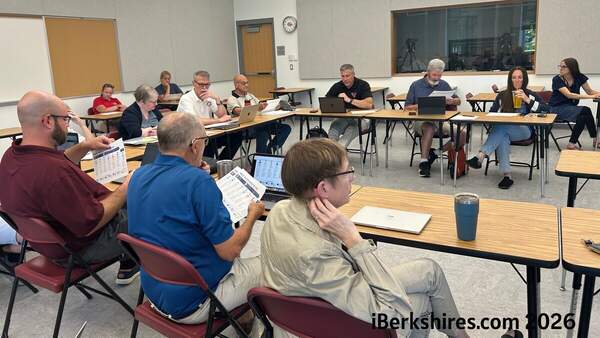
Williamstown Planners Advance Bylaw Proposals, Discuss Sweet Farm Road
WILLIAMSTOWN, Mass. — The Planning Board last week advanced two of its zoning bylaw proposals to keep them on track for inclusion on the annual town meeting warrant and discussed what issues it should consider when considering a proposal it is tasked with considering.
One of the board-generated articles has been on the table for years: limiting the number of days a "primary dwelling unit" can be used as short-term rental to 90 cumulative days in a calendar year. The other is a more recent project of the planners: requiring installers of geothermal wells in the two Water Resource Districts to either use only potable water or prove their systems pose no threat to the town's public water supply.
Both proposals last Tuesday were sent to the Select Board, which will take a ceremonial vote to refer them back to the Planning Board for public hearings in March.
But those are not the only town meeting articles that the Planning Board will need to discuss in the weeks ahead.
The owner of the Sweetwood assisted living facility on Cold Spring Road has submitted a landowners petition to create an overlay district for the South Williamstown property that would allow conversion to multi-family housing. While the planners have no say over the content of the proposal, the board will need to host a public hearing on the article and likely will make an advisory vote to the May meeting.
And the Sweet Farm Road Homeowners Association plans to ask the annual meeting to accept Sweet Farm Road as a public way. By law, that request requires input from the Planning Board to determine whether the road design conforms with the town's bylaw and decide whether to grant waivers before passing the article to the Select Board for a public hearing.
At the outset of the Planning Board's Feb 11 meeting, Chair Peter Beck informed the group that the HOA asked to reschedule a planned discussion of the road acceptance request.
Beck said the petitioner still was in discussions with the town's director of public works about town concerns that might be resolved before the matter is brought before the board.
In the end, the planners decided to postpone that conversation until a special meeting it scheduled for Feb. 25.
"It feels as though it would take an entire meeting to cover this fairly and feels as though it would have an impact on the town budget," Roger Lawrence said of the road acceptance question. "That road is three-quarters of a mile long. There are a lot of questions about it. It's certainly not a thing to be taken lightly.
"It is more work for us, but it makes sense that we would schedule a special meeting if need be."
With neither the attorney for the HOA nor the DPW director in the room, the board did dive into the lengthy documentary evidence filed by the petitioner. But it did talk generally about the parameters of the discussion it will have on Feb. 25.
"The engineering data we have so far is pretty comprehensive," Lawrence said. "I guess my question was what arguments will we listen to? Should we listen only to technical arguments whether we should grant these waivers? Or should we listen to the arguments stated by the homeowners?"
"We should listen to all arguments," Beck suggested. "But in terms of a process order, first I'd want to know the technical deficiencies are not serious before bringing in other reasons to help along the project as much as we can. If the technical deficiencies are serious, I think they need to be fixed before we can listen to the other arguments.
"There's a technical understanding at the baseline that I think we need to have. We're not road construction experts. We need to, as with many things, take the advice we're offered."
Advice from the DPW director prompted the board to draft one of the bylaw amendments it will send to town meeting this spring.
Craig Clough first spoke to the board last summer about his concerns with the use of propylene glycol or other heat transfer media in geothermal wells for heating and cooling homes when those wells are dug in the recharge area for the town's water supply.
The bylaw amendment that resulted represents what the planners have characterized as a first step to try to address the emerging technology. If passed, such closed-loop well systems in the Water Resource Districts could only employ potable water to transfer heat, ensuring that any leaks would not jeopardize public water.
At the last minute last week, the board agreed to expand its proposed bylaw to include both WR1 and WR2.
The proposed short-term rental bylaw would apply to all residential districts in town and would set a 90-day limit on short-term rentals, commonly referred to by the trade name Airbnbs, with the following three exceptions: for individual bedrooms in a home occupied by the owner during the time of the rental; for accessory dwelling units rented while the owner occupies the primary dwelling; and for primary dwellings rented while the owner occupies an on-site ADU.
The intent of the bylaw is to prevent investors from buying up housing stock in town and converting potential full-time residences to de facto motels in residential neighborhoods. At the same time, the Planning Board has tried to find a balance that will allow full-time residents to continue using their homes as short-term rentals on a limited basis to supplement their income.
Though the board has heard little input in meetings from residents as has developed short-term rental bylaw, it has in past years heard criticisms that proposals to increase housing density would create a risk of full-time Airbnbs impacting neighborhoods. And the board has the recent history of successfully passing at the May 2025 annual town meeting a "cottage court" bylaw that included a similar 90-day cap on short-term rentals in homes created under the bylaw.
In order to inform voters and receive feedback on any of the issues heading to town meeting, Planning Board members have scheduled a couple of outreach sessions outside of their regular meeting schedule: March 5 at 6:30 p.m. at the Milne Public Library and March 19 at 5 p.m. at Images Cinema.
Tags: annual town meeting, Planning Board,