Williamstown Expects Spike in Property Taxes in FY26
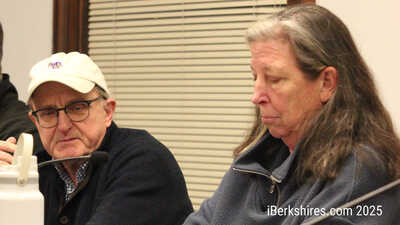 |
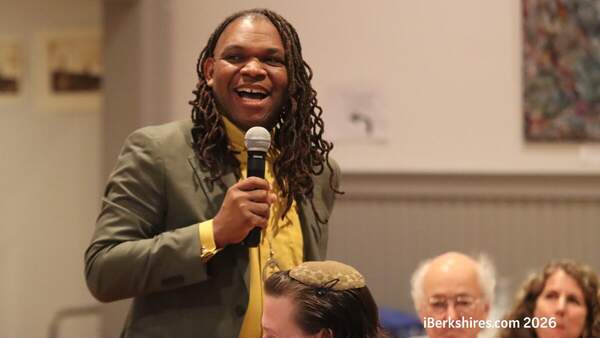
| Finance Committee Chair Fred Puddester, left, and Select Board Chair Jane Patton lead Monday's joint meeting of the two panels. |
WILLIAMSTOWN, Mass. — No details were revealed about the town's fiscal year 2026 spending plan at Monday's joint meeting of the Select Board and Finance Committee.
But it was apparent that FY26 budget will require a significant increase in the property tax levy in the year that begins July 1.
"This is not going to be a year when we're likely to keep the tax increase at 1 percent," Fin Comm member Melissa Cragg said near the end of the hour-long session.
That 1 percent referred to the FY25 increase in the levy — the total amount to be raised through property taxes in a calendar year. Last winter, the Fin Comm, after talking with the Select Board, tried to keep the levy level from FY24. It fell a little short of that goal, but largely the 1 percent rise was seen as a win by officials concerned about an ever increasing tax burden on homeowners.
On Monday night, officials discussed significant headwinds facing the town as it crafts a spending plan that will go before the annual town meeting on Thursday, May 22.
The biggest drag: spiraling health care costs for town and school employees.
"I know some communities already are dealing with a 25 percent-plus threshold from their plans," Town Manager Robert Menicocci told the joint meeting. "Our retiree health care in the fall came in the 20-percent range. After a lot of back and forth, it seems plans may be coming in in the 10- to 15-percent range after some tough conversations about what's covered and what's affordable in health plans.
"That, out of the gate, puts a disproportionate strain on the budget."
The town also this year will be negotiating new collective bargaining agreements with a couple of its unions, Menicocci said.
"We want to make sure we're competitive in the marketplace for health care and wages," he said. "We want to be able to retain staff but also recruit new staff in the future."
Fin Comm Chair Fred Puddester, as strong a voice as any on the panel in favor of holding the line on tax increases, noted that the Mount Greylock Regional School District share of the town budget is likely to rise and commented that it probably should.
"I think we've been tough on the schools the last few years, and I'd expect to see them ask for more money this year," Puddester said. "And they probably deserve it."
And there are even more costs coming down the road, he said.
"When the new building for the Fire Department comes online … while we're having 5 percent increases in [the town/school portion of] taxes, that's going to double when the debt service comes online," Puddester said.
And that is just on the expense side of the ledger.
Most of the discussion on Monday revolved around the question of where the town gets its revenue – overwhelmingly from taxes on residential property.
Rooms and meals tax revenue, which has largely recovered from the impact of the COVID-19 pandemic, is expected to remain flat in the coming year. And the local share of taxation from the town's one cannabis dispensary is actually going down, probably because of the availability of legal pot in neighboring states and the large number of shops in Berkshire County itself.
Unlike similarly sized towns in the region, Williamstown's tax revenue is less diverse and more dependent on homeowners, Puddester said.
"Where we depend 90 percent on property tax, other towns like us only rely 80 percent on property tax," he said. "And within property tax, they rely 80 percent on residential, while we rely 90 percent on residential."
A 2022 analysis by the Fin Comm found that while Williamstown's tax rate was lower than six other Berkshire County towns (including Adams, Lanesborough, North Adams and Pittsfield), Williamstown's average tax bill was the highest in the county, $7,200 per homeowner versus $7,122 in the next highest town, Great Barrington, because of Williamstown's relatively higher property values.
One way to ease the pressure on property tax bills is to grow the property tax base. But, as the Finance Committee has been discussing for months, "new growth" is near stagnant in the town and well below the growth in municipal expenses.
The last few years, a few outliers — the Williams Inn, the Fairfield Inn on Main Street, the conversion of the Cable Mills apartments from rentals to condos — have skewed new growth upward and helped the town avoid larger increases in the amount needed from homeowners.
But, as Menicocci reiterated in Monday's meeting, there are no new big commercial projects on the horizon, beyond the third and final phase of the Cable Mills complex, which broke ground in the fall.
"How do we move the needle to depend less on residential property tax?" Puddester asked the room.
Menicocci said the town could look at designating certain zones in town for entrepreneurial development. And he said the town has had conversations with Williams College – its largest employer and landowner — about other developments, like the Williams Inn, which would not be tax exempt.
Other members of elected and appointed volunteer bodies threw out ideas that could add to the town's vitality and/or tax base.
Select Board member Matt Neely asked how much hotel and meals tax revenue was generated from recent incarnations of the Williamstown Theatre Festival in contrast to years past and suggested the town should engage the summer theater festival in a conversation about how to build it back up.
"Can we, as a board, have someone from their board talk to us about what they project their new season might be able to bring in in terms of tourism, tickets, people coming to town, hotels?" Neely asked. "I don't know that they think of it in those terms."
Finance Committee member K. Elaine Neely suggested that the town itself throws up road blocks to development.
"One of the things that helps our tax base is incremental improvements people make to their residences," she said. "I know people are often put off by the Building Department here at Town Hall's stringent enforcement of regulations.
"That could be a good source [of new growth]. People can't do it because they're told, 'You can't do this, that and the other to a structure just to put another bedroom on.' "
Puddester called out a couple of other ways he sees the town stopping economic activity: delaying a request from the owner of the Sweetwood assisted living community to convert the facility to apartments and slowing or stopping the construction of new homes.
"We might be the only town that argues with Habitat for Humanity," Puddester said, referring to a planned four-home subdivision off Summer Street.
Puddester suggested that the impediments to economic development come from residents themselves.
"What we're doing [as a town] leads to higher home prices and higher taxes," he said. "So it's harder to move here if you're not rich and harder to stay here if you're not rich.
"The majority of the people who show up at town meeting — we spend five minutes on the budget, so they must not be worried about their taxes. That's what we get from town meeting: People who are OK with their taxes and won't support innovative ideas from the Planning Board."
At one point, Puddester said town politics are leading to Williamstown becoming a "rich enclave."
"We're becoming older, wealthier and, frankly, more white," he said. "I don't think that's what we want to be."
The Fin Comm's Cragg said she this winter will propose that the town authorize a one-time expense for a land attorney to look at all the underutilized parcels in town and outline what restriction exist to development and how that restriction could be removed.
The Finance Committee will begin its review of the Fiscal Year 2026 budget next month.
Tags: fiscal 2026, property taxes, williamstown_budget,