Williamstown Planning Board Hears Results of Sidewalk Analysis
WILLIAMSTOWN, Mass. — Two-thirds of the town-owned sidewalks got good grades in a recent analysis ordered by the Planning Board.
But, overall, the results were more mixed, with many of the town's less affluent neighborhoods being home to some of its more deficient sidewalks or going without sidewalks at all.
On Dec. 10, the Planning Board heard a report from Williams College students Ava Simunovic and Oscar Newman, who conducted the study as part of an environmental planning course. The Planning Board, as it often does, served as the client for the research project.
The students drove every street in town, assessing the availability and condition of its sidewalks, and consulted with town officials, including the director of the Department of Public Works.
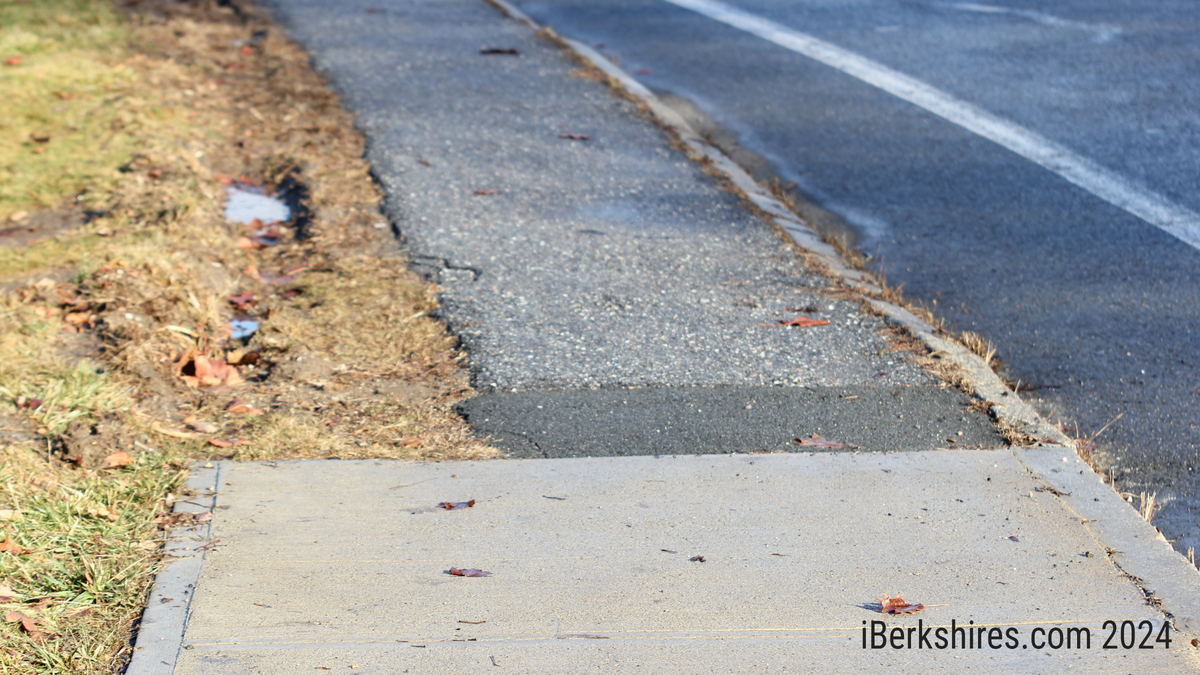
"In northern Williamstown … there are not a lot of sidewalks despite there being a relatively dense population, and when there are sidewalks, they tend to be in poor condition — less than 5 feet wide and made out of asphalt," Simunovic told the board. "As we were doing our research, we began to wonder if there was a correlation between lower income neighborhoods and a lack of adequate sidewalk infrastructure.
"So we did a bit of digging and found that streets with lower property values on average lack adequate sidewalk infrastructure — notably on North Hoosac, White Oaks and the northern Cole Avenue area. In comparison, streets like Moorland, Southworth and Linden have higher property values and better sidewalk infrastructure."
Newman explained that the study included a detailed map of the town's sidewalk network with scores for networks in a given area based on six criteria: surface condition, sidewalk width, accessibility, connectivity (to the rest of the network), safety (including factors like proximity to the road) and surface material.
"From those qualitative assessments, we gave each section a score of 'bad, average and good,' on the request of the DPW," Newman said. "They wanted those three buckets."
Of the town's approximately 16 miles of sidewalk, 75 percent are under the jurisdiction of the town. The rest are the responsibility of the Massachusetts Department of Transportation.
For the town portion alone, two-thirds are in good condition and 80 percent are at least 5 feet wide — an important consideration not only for pedestrians but also for the DPW, whose sidewalk plows are made to clear 5-foot walkways.
"The narrow and non-concrete sidewalks are pretty much all in north Williamstown, with some exceptions, like Church Street," Newman said.
While sidewalks and their maintenance do not generally fall under the jurisdiction of the Planning Board, per se, the ways people get around town are a planning issue.
For years, the Planning Board has been looking at ways to allow more housing density in the General Residence District, a planning approach that is predicated on, among other things, the idea of "walkable neighborhoods." And, "creating a network of safe sidewalks and crossings throughout the downtown and adjacent neighborhoods," was seen as a priority by many of the residents who participated in the process that produced the recently adopted comprehensive plan.
The Williams students talked about the benefits that a good sidewalk network provides.
They cited data showing that 13 percent of car trips cover one mile or less, noted that pedestrian fatalities nationally rose 75 percent from 2010 to 2022 and mentioned that improved sidewalks in commercial areas are associated with higher sales.
Good sidewalks also improve the quality of life for residents, Simunovic said.
"Walkable environments have been linked to reduction of stress, anxiety and depressive symptoms … helping to counteract isolation," she said. "Sidewalk networks are also important for promoting physical activity, which helps prevent non-communicable diseases, like obesity, heart disease and [Type 2] diabetes."
The Police Department shared data that there were 64 non-motorist crashes in town from 2010 to 2024. Newman told the board that roads like Green River Road, Hoosac Road and Simonds Road, which have bad sidewalk infrastructure also have high rates of those non-motorist crashes.
In terms of funding, Simunovic said the commonwealth has funding available for communities with a "Complete Streets" plan, and a sidewalk analysis is one piece of creating that plan.
"We need a new updated prioritization plan," she said. "Without an updated plan, the town cannot apply for grants."
In addition to the sidewalk mapping and condition grading, the students also took a stab at prioritizing which streets need to be addressed first and why.
Simunovic said the pair used 10 criteria to score the sidewalks: safety, environmental justice (addressing underserved and low-income areas), potential demand, proximity to transit services, proximity to schools and children's centers, proximity to the Harper Center, condition, connectivity to surrounding areas, ease of repair or building and cost.
Newman said the pair weighted safety as a criteria by a factor of two, "because we thought it was a relatively important sidewalk consideration."
Based on their analysis, the students said streets like Water Street and Gale Road received high scores as priority projects. Others, including Water Street and Park Street graded high for needing repairs. Stratton Road, Syndicate Road and Henderson Road were among those that scored highly as recommendations for new sidewalks.
The pair noted that their study is just a first step in producing an actionable plan for the town.
"We had some next steps we thought the town could undertake," Newman said. "The first would be an intersection analysis. If there's one thing we wished we could have done, it would be taking a stronger look at the dangerous intersections. … Also, just, overall, improving the data. A lot of this is qualitative. In Pittsfield, for example, they have a much more robust data collection system that they apply to assess things like demand, for example.
"Also, the college is taking steps to improve their sidewalk infrastructure by doing a campus transportation plan. … Any improvements they make to their infrastructure also improves Williamstown's infrastructure, so partnering with them. Also, Mass DOT. I think over half of the really bad sidewalks in Williamstown occur under state jurisdiction, but they're also really important for connectivity. It would make sense to try to show Mass DOT these graphs that tell you this is an issue.
"Finally … I think a more formalized economic analysis — looking at what it would cost to do these projects but also what does the town get out of it, would be an effective next step."
Tags: complete streets, sidewalks, Williams College,