image description
The new Student and Adult Advisory Board meets on Thursday at the Greylock Glen Outdoor Center. The program open to all students.

Hoosac Valley SAAB Holds Inaugural Retreat
By Jack GuerinoiBerkshires Staff
Print Story | Email Story

This is the first event to be held in the Outdoor Center since its opening Oct. 11.
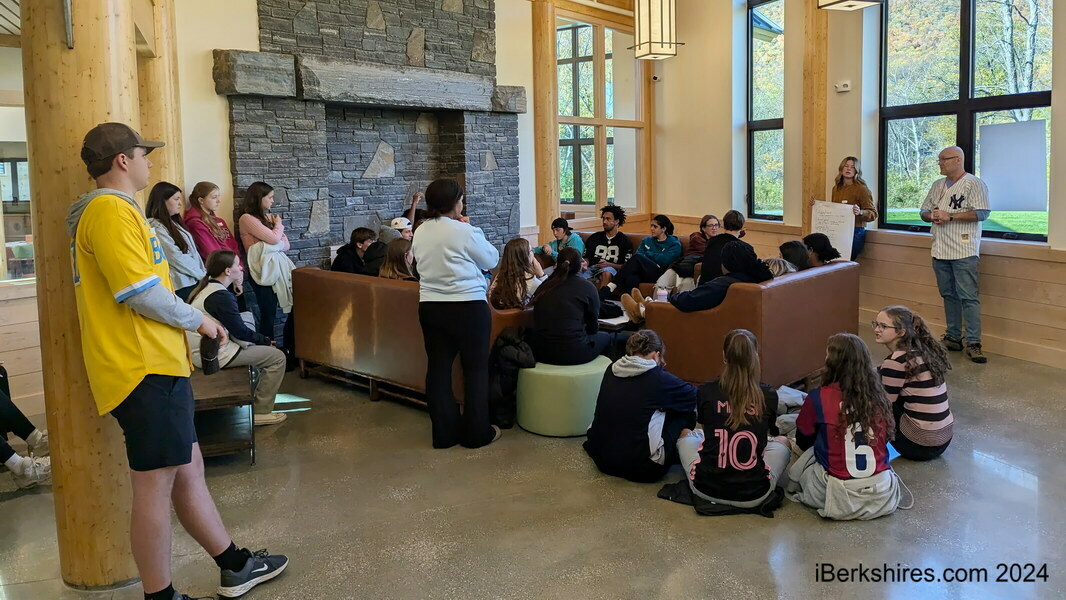
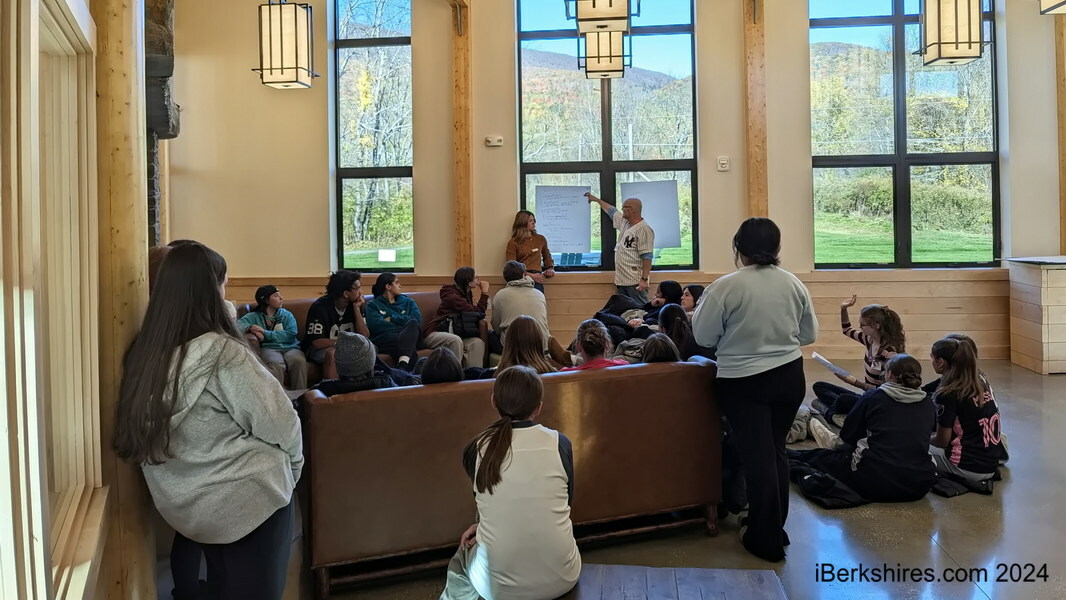
ADAMS, Mass. — The newly formed Student and Adult Advisory Board (SAAB) held its first meeting at the Greylock Glen Outdoor Center Thursday to structure the group they hope can drive meaningful change at Hoosac Valley.
 
"We are trying to create something out of nothing, well not nothing," said Keith Wright, group organizer and science teacher. "What they are doing this morning is looking at a whole bunch of data about Hoosac Valley based on what students have said as well as students' own passions. This is the birth of the organization."
 
The group of 50 or so will meet regularly to discuss different issues at the school as well as find ways to advocate for changes they want to see in the building. They will use a data to inform their discussions that they hope to be able to share with school leadership.
 
Wright said last year students in statistics class started looking at school data, essentially data indicating what students cared about. Students they later presented to the superintendent. It reminded Wright of a similar program he was part of at Monument Mountain High School.  
 
"There was a really active student voice component at work down there, and I wondered if we could do it here," he said. "The administrators said lets do it … Students bring a lot of expertise because they live it everyday. It is invaluable."  
 
An important aspect of the group is their interaction with adults. Four members of the Hoosac Valley community are part of SAAB and will help serve as the link between the group and the rest of the school as well as provide any needed support.
 
"Adults have a lot of experience in education and in life. What ends up surfacing is that there is not always time when I am teaching Stoichiometry in chemistry class to learn that there are students who are really concerned about their peer's mental health and well-being," he said. "So this gives us that space to have those conversations."
 
Friday's session was pretty open and students tried to pin down four broad categories that were all-encompassing of some of the topics they wanted to bring to SAAB as well as nuances they found in the data.
 
Each group, supported by an adult, will contain 10 or so students who will meet twice a month. Before lunch, the group tried to boil down topics including environment, celebration, student life, and academics, among others.
 
Students were not only passionate about the specific ideas but how to properly organize them to best address the array of topics. During the opening sessions, students patiently announced their ideas being sure to make room for new voices to speak out.
 
Teacher and SAAB supporter Lindsay McGinnis said she hopes that members of SAAB will eventually be able to meet with administrators as well as the school committee to make their case.
 
"This gives students a voice in the things the administrative really focus on like policy," she said. "Here they can talk about those changes or getting rid of some things that have been implemented that  they may not love."
 
She said students were interested in addressing a new bathroom policy, a new cellphone policy, and perhaps bringing back composting, among other things.
 
But before they can go before the school's policymakers, Wright told the students it will be about putting their time in as well as their due diligence
 
"Basically, we're going to become experts on the things that we're advocating for before we advocate," he said. "If you have to go to the school committee … you have got to have your stuff together. You need to know what's up, you need to know what other schools are doing, and you have to have data to support your argument. That is how change happens."
 
Wright said there are true lessons to be learned through this program, lessons sometimes challenging to teach in a typical classroom.
 
"The exciting thing about this is that it is all very academic in a way that is very real to life. It is civics, it is public speaking, it is making change," he said.
 
The group are the first to meet in the newly opened Outdoor Center. Wright said the space met their needs perfectly with plenty of different areas to hold collaborative break-out sessions
 
"I was just blown away by this place's beauty," he said. "It works really well for the whole group as well as small groups."

Tags: advisory committee,   HVRSD,   
If you would like to contribute information on this article, contact us at info@iberkshires.com.

State, Local Leaders Celebrate Funding Boost For Ashuwillticook Rail Trail Extension

By Sabrina DammsiBerkshires Staff

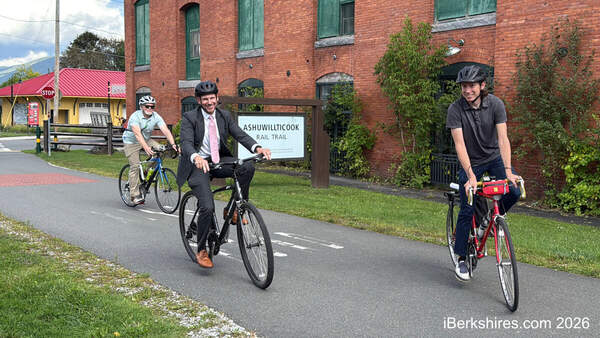
ADAMS, Mass. — State officials and local leaders kicked up their kickstands and took a ride along the final stretch of the Ashuwillticook Rail Trail on Thursday to celebrate new investments in rural communities.

Federal Funds and Infrastructure Office (FFIO) Director Quentin Palfrey joined local leaders, including State Rep. John Barrett III and Berkshire Regional Planning Commission (BRPC) Executive Director Laura Brennan, in Adams to highlight the newest round of FFIO funding. The grant will provide BRPC with $64,700 in state funds to help advance the Ashuwillticook Rail Trail expansion.

"When Governor Healey came into office, one of her big day-one commitments was to make sure that Massachusetts was fighting for every dollar possible coming out of Washington," Palfrey said, speaking about FFIO, a program created in 2023 to help the state aggressively pursue and coordinate federal funding opportunities.

This builds on a $17.3 million federal award secured last year for the project, dubbed the A2A project, which supports the design of a 9.3-mile shared-use path connecting the existing Ashuwillticook Rail Trail to the Williamstown Mohican Path.

"One of the things that she emphasized to me when we set up the Federal Funds and Infrastructure Office was that we need to make sure that these resources not only come into Massachusetts, but benefit all of Massachusetts," Palfrey added.

The additional $64,700 will allow BRPC to gather information about transportation needs in northern Berkshire County to help inform the design of the trail expansion. BRPC will partner with Williams College and Luminary Evaluation, LLC to use the University of Michigan's Transportation Security Index (TSI).

Brennan said BRPC will deploy a 16-question survey that will allow them "to research local and regional perspectives and surface the needs of our neighbors when it comes to transportation in the Berkshires."

"The best-case scenario would be if the survey turned up results that all needs are met and that everyone has access to the places and the things that they need to travel to – but we know that is not true," Brennan said. "We know that folks in Berkshire struggle to get to their place of employment, to be able to access important medical appointments, [and] other engagements. So, the transportation security index is going to help us really hone in on those specific needs, identify pockets of needs or areas where there is a strong concentration or depth of need."

She said FFIO's investment offers a "wonderful augmentation" to BRPC's current plans for the bike trail extension. It's also an investment that will make the region more competitive for other transportation opportunities.

"This is an incredibly multifaceted and valuable investment, and we deeply appreciate it," she said.

Barrett said these investments drive growth in the Berkshires.

"I've always found that if you're going to grow an area, you grow with what you have here to grow. You don't bring something in. We have a natural beauty. We have an environment that's second to none, and that's what we are going to grow on," he said.

Barrett said that in the First Berkshire District alone, 4,000 new people moved to the area.

"We're seeing that migration here. They're going to have activities. They're going to have jobs, and we're going to have a great educational system that goes with it with our two colleges that are here," he said.

Palfrey said it was clear during the initial creation of FFIO that federal funding often went to wealthier and more urban communities with larger planning departments and greater access to consultants. He added that FFIO helps reverse this trend and get projects in rural communities off the ground.

View Full Story

More Adams Stories