Williamstown Con Comm Clears Summer Street Subdivision
WILLIAMSTOWN, Mass. — The Conservation Commission last week gave its approval for a four-home subdivision on a town-owned parcel on Summer Street.
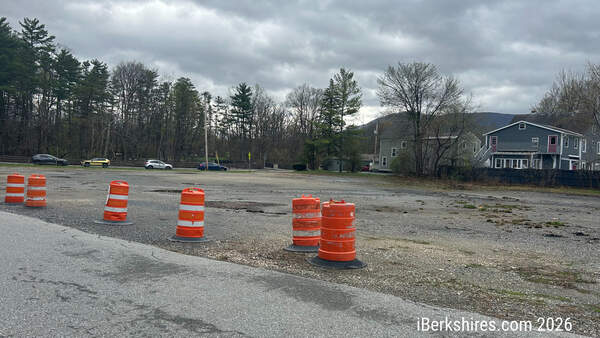
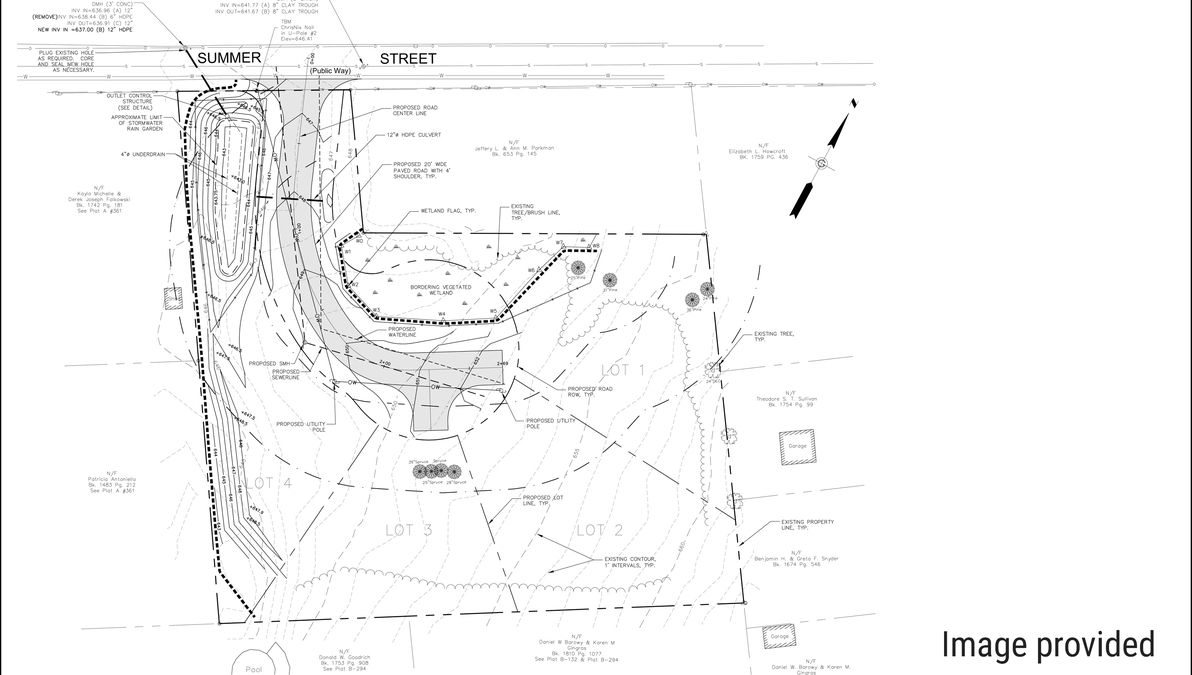
Northern Berkshire Habitat for Humanity was before the board with a notice of intent to build a 260-foot road with four associated building lots on a parcel currently owned by the town's Affordable Housing Trust.
The road and some of the home lots are planned in the buffer zone of a bordering vegetated wetland on the lot currently known as 0 Summer St.
Habitat plans to build four single-family, one-story homes priced for residents making up to 60 percent of the area median income on the parcel. The non-profit hopes the town will accept the road and associated infrastructure as a town road once it is built.
In addition to determining that the construction would minimize impact on the buffer zone, the commissioners Thursday reviewed the stormwater management plan for the site — an aspect that has been a sticking point for nearby residents who say drainage problems are a long-standing concern in the area.
Charlie LaBatt of Guntlow and Associates civil engineering took the lead on walking the commission through the plan to handle stormwater runoff from the increased impervious surfaces in the planned subdivision.
"Proposed drainage improvements include a rain garden, which acts for filtering of TSS [total suspended solids] and detention and very little recharge — due to the site's soil constraints — and a culvert that helps allow in one portion of this [parcel] the watershed to make it to that rain garden," LaBatt said. The rain garden and the stormwater management infrastructure has been sized anticipating the development of the four lots.
"It doesn't include impervious areas just for the road, it includes impervious areas for all of the four lots — buildings, roads, everything."
LaBatt further explained that grading along the boundary of the property will help direct water into the rain garden and the garden itself will have an underdrain to prevent it from becoming a pond.
Kayla Falkowski of 11 Summer St., whose home is due south and downhill of the subdivision site, said she was still concerned about the rain garden being overwhelmed and ponding.
LaBatt told the commission that the rain garden will have an outlet structure that will pipe excess water into existing municipal infrastructure on Summer Street.
"Once water comes above the bottom crest of the weir, water can go directly out of the detention pond and into the pipe system that goes out," LaBatt said. "The size and height and width of those weirs, as well as the size of the rain garden is what is modeled to create a system that gets peak runoff from post-development to be at or below pre-development runoff conditions.
"As described in the stormwater narrative [of the NOI submission], we have a table that shows you what the 2-, 10- and 100-year post-development storm rates are for this and how we've reduced [runoff] for all storm events."
Falkowski noted that she appreciated that the final plans for the rain garden include a fence around the feature, which is planned for the southwest corner of the parcel, bordered by Summer Street, the new road and her property.
But residents who addressed the commission at Thursday's meeting continued to express concern about the plan, including how the rain garden will be maintained after the subdivision is built and the homes are occupied.
LaBatt explained that, typically, such infrastructure would be owned by the developer (in this case, Northern Berkshire Habitat for Humanity) until homes are sold, at which time it would be transferred to an homeowners association and often, at some point, a municipality. The non-profit, which does not want to saddle its homeowners with the responsibility of an HOA, is trying to track the process of town acceptance, LaBatt said.
Critics of the subdivision plan pointed to a letter from Williamstown's director of public works that cast doubt on whether the town would be amenable to that acceptance.
"Although we currently do not have specific language on rain gardens in the Town Code, it is my position that rain gardens should be classified as a type of detention basin and not accept ownership or maintenance thereof," Craig Clough wrote in a May 3 letter to the Planning Board, which, at the time, was considering a preliminary development plan for the subdivision.
Donald Dubendorf, a volunteer with Northern Berkshire Habitat for Humanity and retired attorney with experience representing clients before town boards and committees, told the Con Comm that the issue of who owns the rain garden going forward was not before the body.
"These plans before the commission make no representation of who owns the rain garden," Dubendorf said. "They simply say this is where it's going to be. It may be the case that, if we have to, we carve out a piece of that [property] and give the Affordable Housing Trust an easement to manage it until such time as it's taken over [by the town].
"But we've had extensive discussions with Craig Clough, the town manager and others about taking over, and I think we're making progress on that. So, at the end of the day, [the ownership issue] seems a bit of a red herring."
In the end, the Con Comm added stipulation to its approval that, "The operation and maintenance plan for the proposed rain garden shall be a continuing condition."
That was one of four conditions specific to the project that the commission added to its approval, along with the standard 25 local and state-mandated conditions for work near a water resource area.
After a unanimous vote to set the conditions and, thus, approve the project, an attendee at the meeting asked how the commission's decision could be appealed. Conservation agent Andrew Groff referred them to the commonwealth's Department of Environmental Protection regional office in Springfield.
The proposed subdivision still has a major regulatory hurdle to clear before it goes forward: a return trip to the Planning Board for a review of the final development plan.
In other business on Thursday, the Conservation Commission:
• Cleared the Massachusetts Department of Transportation's plan to resurface Route 7 from the Five Corners intersection south to the New Ashford line.
• OK'd work near an unnamed perennial stream on a property at 1382 Cold Spring Road.
• And reviewed the town's plan to stabilize the bank of the Hoosic River near the intersection of North Street (Route 7) and Syndicate Road. The town is waiting on approval from Mass DEP and the Natural Heritage and Endangered Species Program, but Groff asked the local body also weigh in during that review. The five commissioners at Thursday's meeting gave their informal support to the plan.
Tags: conservation commission, habitat for humanity, housing, stormwater,