image description
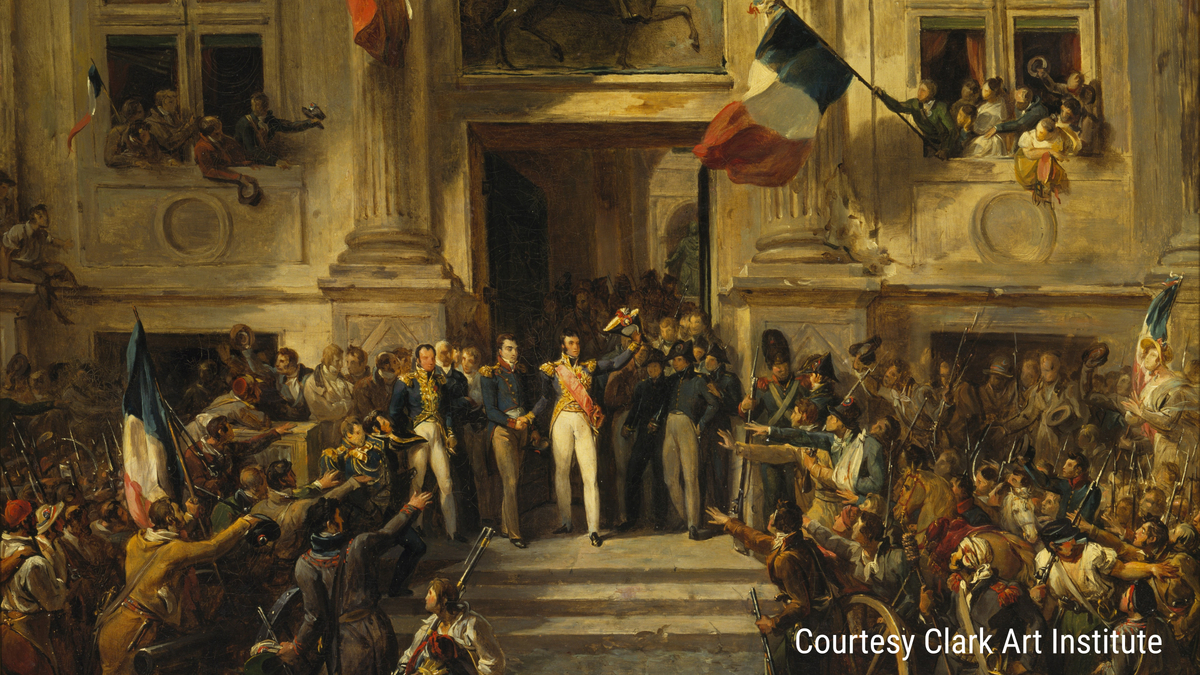
'Lafayette Introducing Louis-Philippe to the People of Paris,' by Guillaume Lethiere. Works by the influential French painter are on exhibit at the Clark Art through October.
image description
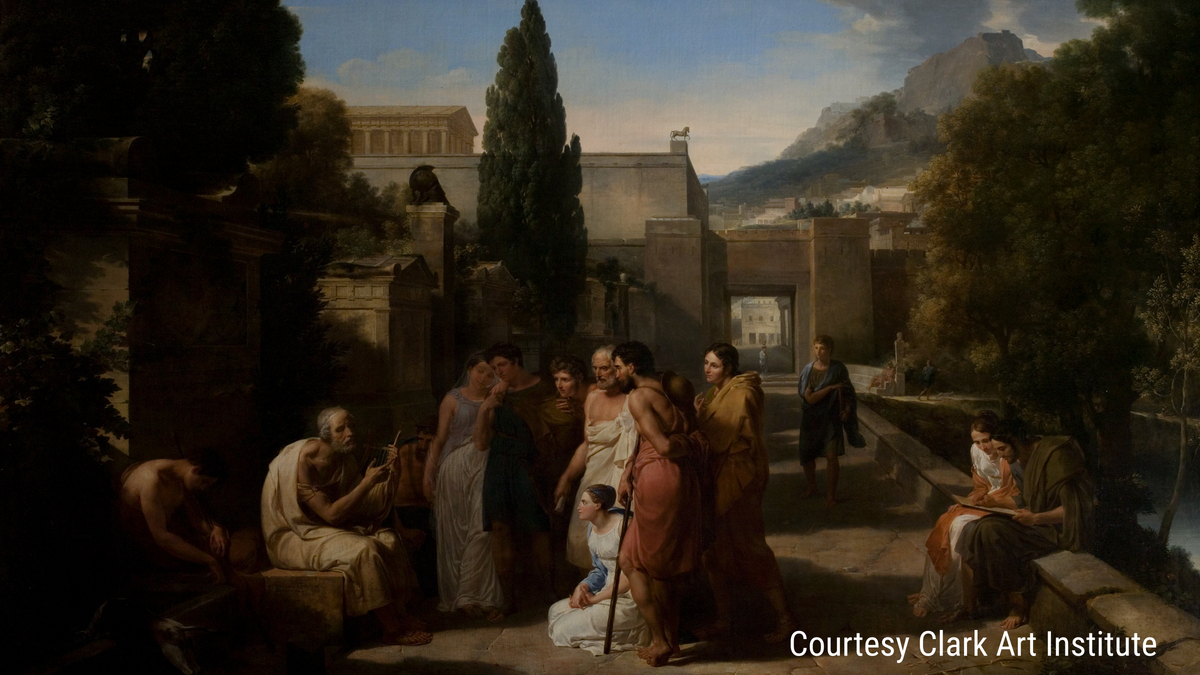
'Homer Singing His Iliad at the Gates of Athens' by Guillaume Lethiere.
image description
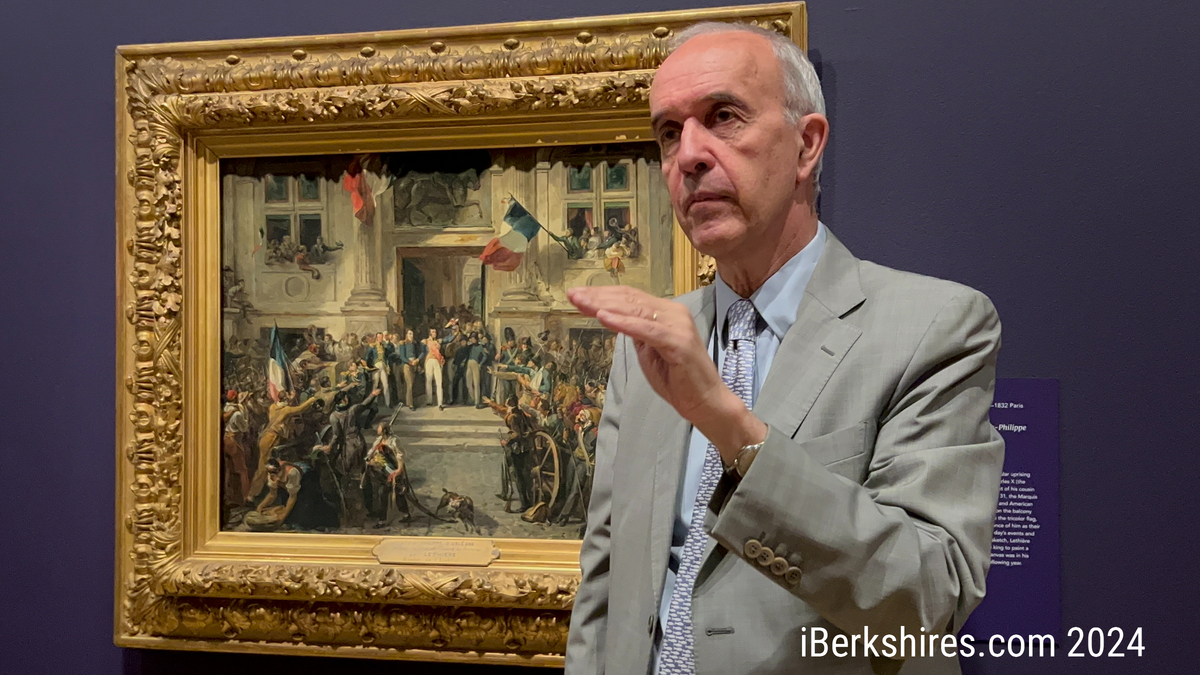
Clark Art Director Olivier Meslay discusses Guillaume Lethiere's 'Lafayette Introducing Louis-Philippe to the People of Paris.'

Clark Highlights Work, Revolutionary Spirit of Underappreciated Master
By Stephen DravisiBerkshires Staff
Print Story | Email Story

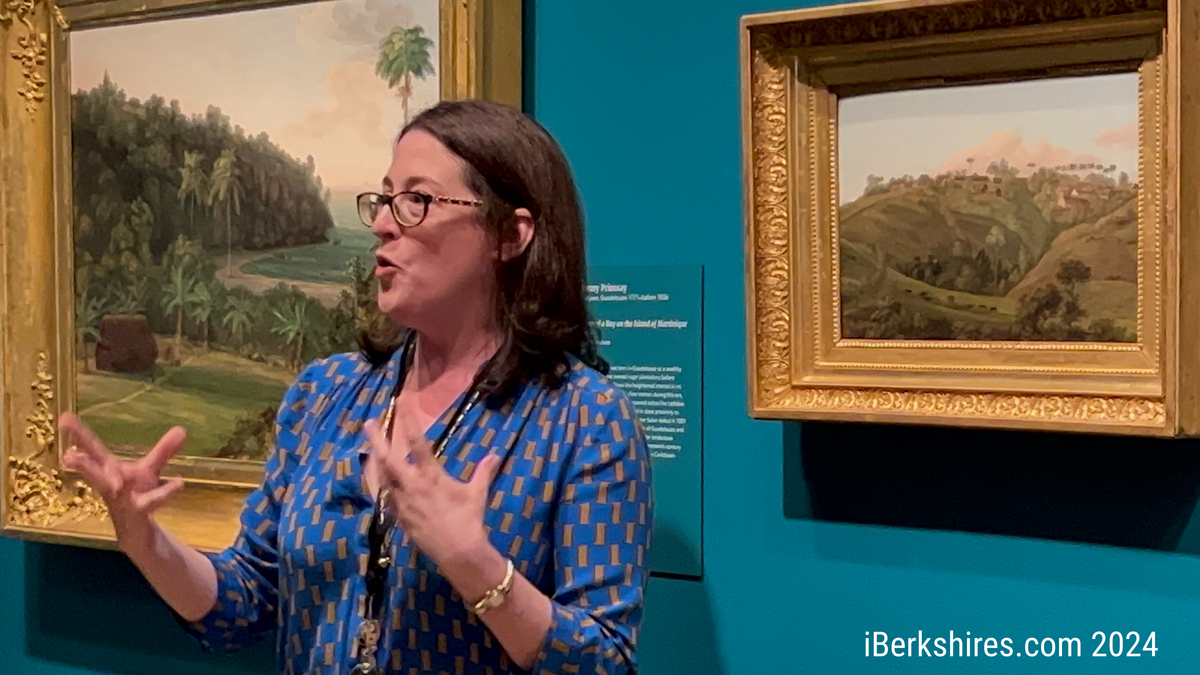
Clark Art Institute Deputy Director Esther Bell discusses the exhibition 'Guillaume Lethiere,' a partnership of the Clark and the Louvre in Paris.
 
WILLIAMSTOWN, Mass. — Favorite artist of Napoleon's brother, director of the Academy of France in Rome, friend to the novelist Alexandre Dumas and revolutionary Marquis de Lafayette, Guillaume Lethiere was a prolific and influential painter who cast a long shadow over the art world in Paris in the first decades of the 19th century.
 
Since then, Lethiere's own legacy largely has been overshadowed.
 
This summer, the Clark Art Institute is doing its part to bring Lethiere to light.
 
"Guillaume Lethiere" opens Saturday at the South Street venue. The exhibition runs through Oct. 14 before crossing the Atlantic for a three-month run at the Musee de Louvre, which partnered with the Clark on the show.
 
Although Lethiere's name may not be well known, even to art aficionados, his art is far from obscure.
 
"Lethiere is a good example of being obscurity when you are still in plain sight," Clark Director Olivier Meslay said during a press preview of the exhibition on Thursday morning.
 
"The two big paintings … the [‘Brutus Condemning his Sons to Death' and ‘Death of Virginia'], which are 25 feet long [each] are standing in the next room to the Mona Lisa since 1832. Never went in storage. But nobody was looking at it.
 
"It's very difficult to understand why this sort of trajectory happened. I'm sure that after this exhibition it's not going to continue. I think it's obvious when you look at what you see that he's a great painter. He's a very important figure. He's a painter who was one of the most looked at during his life, and then, after that, he disappeared."
 
Lethiere's life began on the Caribbean island of Guadalupe, where he was born in 1760 to Marie-Francoise Pepeye, an enslaved woman of mixed race, and Pierre Guillon, a French colonial administrator and plantation owner.
 
The eponymous exhibition traces Lethiere's career from a red chalk study of a nude figure he did at 16 in 1776 to 1831's "Lafayette Introducing Louis-Philippe to the People of Paris."
 
The show also highlights a number of Lethiere's contemporaries and students, in particular the women he encouraged to pursue their art and others, like him, who had roots in the Caribbean.
 
The exhibition also explores the ways that Lethiere navigated the turbulent period of the French Revolution, which shook the nation for more than decade as he was hitting the prime of his career in his 30s.
 
"Lethiere had to work for Napoleon, and he was asked to do a certain number of paintings," Meslay said. "He was asked to do Joesphine's portrait, which you see here, which was supposed to be hanging in the [National Assembly]. This is also an official portrait he was asked to do of Elisa, Napoleon's sister.
 
"For this reason, you think, ‘He's really part of the system and a guy who was working with Napoleon.' Not exactly."
 
In fact, the exhibition demonstrates how Lethiere aligned himself with Republicans and abolitionists and Paris' Caribbean community, like the mixed-race General Thomas-Alexandre Dumas, father of the novelist, who also became close with the painter.
 
And while Lethiere was commissioned to do a large portrait of Napoleon's wife, Josephine, that is included in the exhibition on loan from Versailles, Lethiere was closer to Napoleon's brother, Lucien, who is depicted in "Lucien Bonaparte Contemplating Alexandrine de Bleschamp Jouberthon."
 
"At the end of his career during the Napoleonic period, Lathiere made a depiction of Lucien, when Lucien was exiled by his brother," Meslay said. "There is a complicated relationship between the two brothers. Lethiere always stood for his friend Luciere, even though it was probably damaging his own career."
 
Clark Deputy Director Esther Bell, who led the Clark's curatorial effort with Meslay, pointed out other examples of how Lethiere's anti-authoritarian sentiments show in his work: engravings of four historical revolutionaries — Brutus, William Tell, Benjamin Franklin and Jean-Jacques Rousseau — on loan for the exhibition from the National Library of France.
 
"Lethiere obviously admires these men," Bell said. "He portrays them in strong profiles, surrounded by laurel leaves.
 
"It's a little bit difficult to put a finger on Lethiere's politics exactly throughout his life as he successfully navigated the tumultuous politics of his time and the various regime changes. But I think in his various works, whether it's 'Brutus Condemning His Sons to Death' or these [engravings] that he was invested in the fight against tyranny. And all of these men fought against tyranny in their own time."
 
The massive "Brutus Condemning His Sons to Death" remains in the Louvre, but the exhibition at the Clark does include a number of smaller studies from the Clark's collection.
 
"Brutus" in Lethiere's time, became an exemplar for French revolutionaries. It depicts the moment when the founder of the Roman republic makes a personal sacrifice to execute his own sons for attempting to restore the monarchy.
 
Perhaps Lethiere's most overtly political work, "Oath of the Ancestors," was to have been loaned to the Clark by the National Pantheon Museum in Port-au-Prince, Haiti, but could not leave the country safely due to the current political turmoil in the island nation.
 
"Oath of the Ancestors" depicts the alliance of two of Haiti's founding revolutionaries, Alexandre Petion and Jean-Jacque Dessalines. Lethiere's heroic depiction of the pair is represented at the Clark in an illuminated reproduction.
 
"They're embracing one another, shackles at their feet, war happening behind them, and they're making an allegiance that never again will they allow their country to be ruled by colonial oppressors," Bell explained. "[Haiti] is the first freed nation in the Caribbean. And here, Lethiere signs the painting, 'Guillaume Lethiere, nee a Guadalupe,' born in Guadalupe. So he's asserting his origins and his allegiance to Haiti and the people of the Caribbean.
 
"This was a very risky undertaking, to paint such a politically charged image at a time when slavery had been reinstated in France. So he was putting himself at great risk to paint such a thing."
 
"Guillaume Lethiere" opens at the Clark Art Institute on Saturday, June 15, and runs through Oct. 14. There is an opening lecture free to the public on Saturday at 11 a.m. at the museum's Manton Research Center.

Tags: art exhibit,   Clark Art,   
If you would like to contribute information on this article, contact us at info@iberkshires.com.

Puppets Teach Resilience at Lanesborough Elementary School

By Breanna SteeleiBerkshires Staff

The kids learned from puppets Ollie and a hermit crab.

LANESBOROUGH, Mass. — Vermont Family Network's Puppets in Education visited the elementary school recently to teach kids about being resilient.

Puppets in Education has been engaging with young students with interactive puppets for 45 years.  

The group partnered again with Bedard Brothers Chevrolet, which sponsored the visit. 

Classes filtered through the music class Thursday to learn about how to be resilient and kind, deal with change and anxiety, and more.

"This program is this beautiful blending of other programs we have, which is our anxiety program, our bullying prevention and friendship program, but is teaching children the power of yet and how to be able to feel empowered and strong when times are challenging and tough," said program manager Sarah Vogelsang-Card.

The kids got to engage with a "bounce back" song, move around, and listen to a hermit crab deal with the change of needing a new shell.

"A crab that is too small or too big for its shell, so trying to problem solve, having a plan A, B and C, because it's a really tough time," Vogelsang-Card said. "It's like moving, it's like divorce of parents, it's changing schools. It's things that children would be going through, even on a day to day basis, that are just things they need to be resilient, that they feel strong and they feel empowered to be able to make these choices for themselves."

The resiliency program is new and formatted little differently to each of the age groups.

"For the older kids. We age it up a bit, so we talk about harassment and bullying and even setting the scene with the beach is a little bit different kind of language, something that they feel like they can buy into," she said. "For the younger kids, it's a little bit more playful, and we don't touch about harassment. We just talk about making friends and being kind. So that's where we're learning as we're growing this program, is to find the different kinds of messaging that's appropriate for each development level."

This programming affirms themes that are already being discussed in the elementary school, said school psychologist Christy Viall. She thinks this is a fun way for the children to continue learning. 

"We have programs here at the school called community building, and that's really good. So they go through all of these strategies already," she said. "But having that repetition is really important, and finding it in a different way, like the puppets coming in and sharing it with them is a fun way that they can really connect to, I think, and it might, get in a little more deeply for them.

Vogelsang-Card said its another space for them to be safe and discuss what's going on in their life. Some children are afraid because maybe their parents are getting divorced, or they're being bullied, but with the puppets, they might open up and disclose what's bothering them because they feel safe, even in a larger crowd. 

"When we do sexual abuse awareness that program alone, over five years, we had 87 disclosures of abuse that were followed up and reported," she said. "And children feel safe with the puppets. It makes them feel valued, heard, and we hope that in our short time that we're together, that they at least leave knowing that they're not alone."

Bedard Brothers also gave the school five new puppets to use. Viall said the puppets are a great help for the students in her classroom, especially in the younger grades. 

"Every year, I've been giving the puppets to the students. And I also have a few of the puppets in my classroom, and the students use them in small groups to practice out the strategies with each other, which is really helpful," she said. "Sometimes the older students, like sixth graders, will put on a puppet show. They'll come up with a whole theme and a whole little situation, and they'll act it out with the strategies for the younger students. It's really cute, they've done it with kindergarteners, and the kids really like it."

Vogelsang-Card said there are 130 schools in Vermont that are on the waiting list for them to come in. Lanesborough Elementary has been the only Massachusetts school they have visited, thanks to Bedard Brothers. 

"These programs are so critical and life-changing for children in such a short amount of time, and we are the only program in the United States that does what we do, which is create this content in this enjoyable, fun, engaging way with oftentimes difficult subjects," she said. "Vermont is our home base, but we would love to be able to bring this to more schools, and we can't do this without the support of community, business funders or donors, and it really makes a difference for children."

The fourth-grade students were the first class to engage with the puppets and a lot of them really connected with the show.

"I learned to never give-up and if you have to move houses, be nervous, but it still helps," said William Larios.

"I learned to always add the word 'yet' at the end," said Sierra Kellogg, because even if she can't do something now, she will be able to at some point.

Samuel Casucci was struck by what one of the puppets talked about. "He said some people make fun of him if he dresses different, come from different place, brings home lunch, it doesn't matter," Samuel continued. "We're all kind of the same. We're all kind of different, like we have different hairstyles, different clothes. We're all the same because we're all human."

"I learned how to be more positive about myself and like, say, I can't do this yet, it's positive and helpful," said Liam Flaherty.

The students got to take home stickers at the end of the day with contact information of the organization.

View Full Story

More Williamstown Stories