Flag Meant to Represent Inclusion Sparks Debate in Williamstown
WILLIAMSTOWN, Mass. — One of the authors of a proposed bylaw amendment to allow the display of the Progress Pride on town flag poles said he welcomes more dialogue about the proposal.
"It's been a good learning experience through all of this," Mount Greylock Regional School sophomore Jack Uhas said last week.
"Any attempt to hinder a conversation in our community would be disappointing to me. I'm excited to hear what people have to say."
Uhas is the vice president of the middle-high school's Gender Sexuality Alliance, which developed the bylaw proposal that will be before Thursday's annual town meeting at Mount Greylock.
The advocacy group has been talking for some time about how to foster a public display of support for the LGBTQ-plus community.
"Last [school] year, we started thinking of ways we could make an impact in the wider community beyond Mount Greylock," Uhas said. "We talked about doing something like painting a crosswalk like they do in other communities.
"[Select Board member Randal Fippinger], who was the father of the GSA president last year, came in and talked to us. And, apparently, there were some Department of Transportation regulations that meant it wasn't feasible [to paint a crosswalk]. We pivoted to other strategies."
The student group talked a public flag display, identifying as one possible location the Field Park rotary at the junction of Routes 2 and 7 as a highly visible location for the town to make such a statement.
But last May, the annual town meeting passed a bylaw that limited "flags, signs and banners" affixed to municipal buildings and flag poles to three specific flags: the American Flag, the flag of the commonwealth and the POW/MIA flag recognized by Congress.
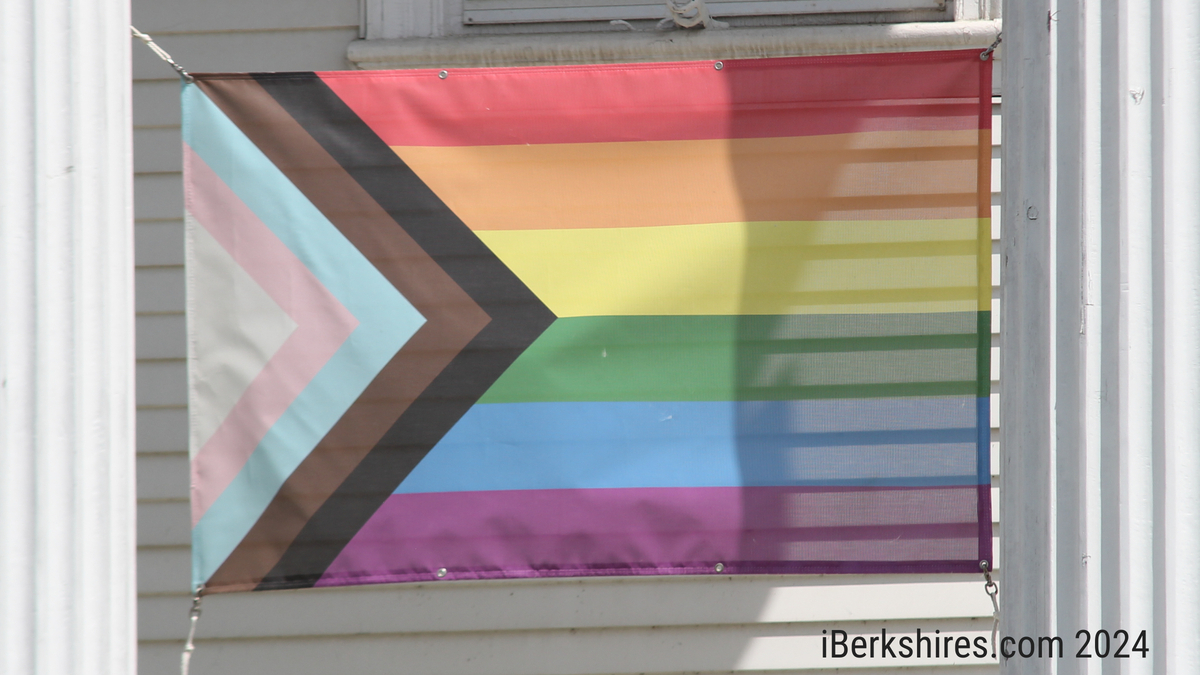
The GSA now hopes the meeting will add a fourth flag to that list, the Pride Progress Flag designed by artist Daniel Quasar.
Quasar in 2018 created a flag that incorporates the more traditional "rainbow" flag of the LGBT rights movement with a chevron on the "hoist" side of the flag that includes black, brown, light blue and pink, representing people lost during the AIDS crisis, people of color and transgendered people.
"The trans flag stripes and marginalized community stripes were shifted to the hoist of the flag and given a new chevron shape," according to the website of the Progress Initiative. "The arrow points to the right to show forward movement, while being along the hoist edge shows that progress still needs to be made."
The members of the GSA are hoping that the members of the town meeting will embrace that progress.
But not everyone in town thinks that the public display of a flag on town property is the way to go about that.
Last week, a thread on a widely used Facebook group for residents featured several objections to the bylaw with people arguing that the bylaw amendment, Article 41 on a 42-article meeting warrant, should be voted down.
One resident, Ralph Hammann, called the Pride Progress Flag, "an infantilizing insult to the intelligence of the people it represents as well as a piece of empty virtue signaling."
"I have spoken to such people and this is a view not just particular to me," Hammann continued. "A town that needs to state the obvious with regards to its acceptance of all strikes me as suspect. From others to whom I've spoken, it would seem that this action may even create division."
Another resident, Donna Wied, commented extensively on the proposed bylaw amendment, posting, at one point, "The town has neither the right nor the responsibility to assume the role of moral compass for its people."
Hammann echoed the point.
"Reserve Town Meeting for the business of the town, not a governance by its morality police," he wrote. "Williamstown IS a most welcoming town; it doesn't need Big Brother to watch over it."
Uhas said he was aware of the social media pushback, and he did leave a comment on the thread inviting opponents to reach out to him personally for a dialogue.
In an interview on Wednesday, he agreed that opposition to the flag bylaw amendment might show that the town is not as "welcoming" as those opponents claim.
"Some people say it's obvious that Williamstown is accepting and there's no need [for a flag]," he said. "They also, in the same post, say the flag is divisive and controversial. Well, which is it?
"You can say this isn't about the flag and that it's about flags in general. But I think we all know it's not. Only people who have a problem with this flag are going to make that argument. And it's your right to be upset about [the Progress Pride Flag]. But I don't appreciate the veiling."
Uhas likened the occasional display of a Progress Pride Flag on town property — likely during Pride Month in June — to the small rainbow stickers that many Mount Greylock Regional School teachers have placed in their classrooms.
"It's not something you notice consciously," he said of the stickers. "But you're more unconsciously comfortable in a space where you know you're not going to be judged or hated for that."
He said Mount Greylock is "a very accepting school" compared to some other high schools, but, even there, he occasionally hears students, for example, referring to things they don't like as "gay."
"Not all homophobia needs to be physical," Uhas said. "There definitely are levels. Greylock has put forth positive initiatives toward inclusivity."
Michael Taylor, the president of Berkshire Pride, agreed with Uhas that public displays of the Progress Pride Flag can foster a more welcoming environment for all residents.
"Our mission is creating safe and welcoming spaces," Taylor said last week. "By having this flag being flown proudly at a major institution in [Pittsfield], our city government, that is signaling, 'You're welcome here. We're here for you.'
"That's pretty much the messaging. We've always had that feeling previously with Mayor [Linda] Tyer and now with Mayor [Peter] Marchetti. It's sending a signal that your city government is here for you, and you're safe here.
"We know what the national climate is and the attacks around this [LGBTQ+] community. One thing I'll be stressing in my [Pride Day] comments is the importance of allyship. That's what the flag is representing."
Longtime Select Board member Jane Patton, who is married to a woman and has two daughters in the public school system, said she has been doing a lot of thinking about the flag bylaw issue. And last week, she said she likely will vote against it at Thursday's town meeting.
"The reason behind stating that town flag poles would simply have the American Flag, state flag and POW/MIA flag was precisely because the flag poles cannot be all things to all people," Patton said. "They need to be inclusive. Honestly [the bylaw amendment] drives to more exclusivity than I think people intend."
Patton said she applauded the high school students for taking the initiative to create a citizens petition that many of them were too young to sign and too young to vote on at the annual town meeting. And she said she would not be opposed to representation of the LGBTQ-plus cause in public places, like flags on Spring Street.
"But, from a town perspective, where we cannot be exclusive, I think our measured approach of the three flags we chose [at the 2023 annual town meeting] is the most inclusive at the end of the day," Patton said.
As for the argument that a town display of the Progress Pride Flag would be "infantalizing" to members of the LGBTQ-plus community, neither Patton, Taylor nor Uhas said they had independent knowledge of that sentiment among members of that community.
"I'm not aware of people being offended by it," Patton said. "I don't personally love the image myself from a design aesthetic, but I have no idea of anybody who is offended by it."
"If someone from our community feels somehow it's virtue signaling and harmful, I'd love to know more about that perspective," Taylor said. "I don't see it. I don't know where they're coming from and what I may be missing."
Uhas agreed, and, just like with the proposed flag bylaw itself, he said he welcomes dialogue.
"I can understand the perspective of people who might say [it is virtue signaling]," he said. "But I'd also say that this is an effort from the GSA, which is filled with people in the LGBTQ-plus community who are very supportive of this."
Tags: annual town meeting, flags, pride,