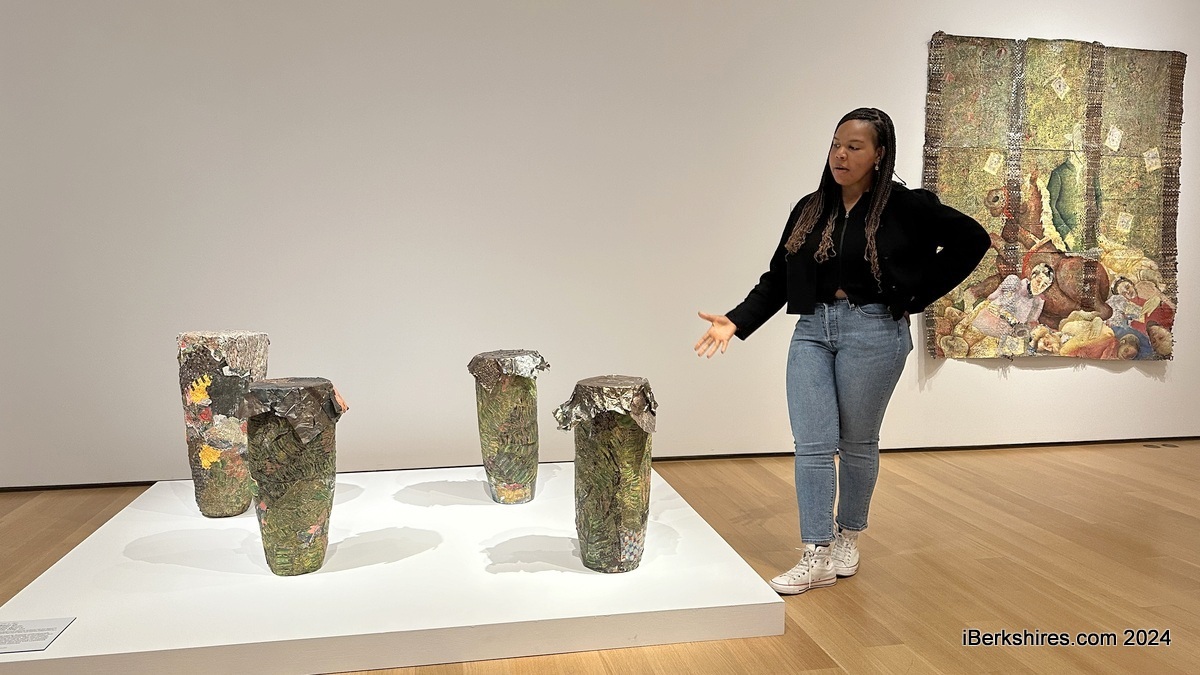
Artist Kathia St. Hilaire uses mixed mediums, including printmaking, painting, collage, and weaving, to explore her lost Haitian history and culture. Her works are on exhibit in 'Invisible Empires' through September.
St. Hilaire with 'Mamita Yunai' on view at Stone Hill.
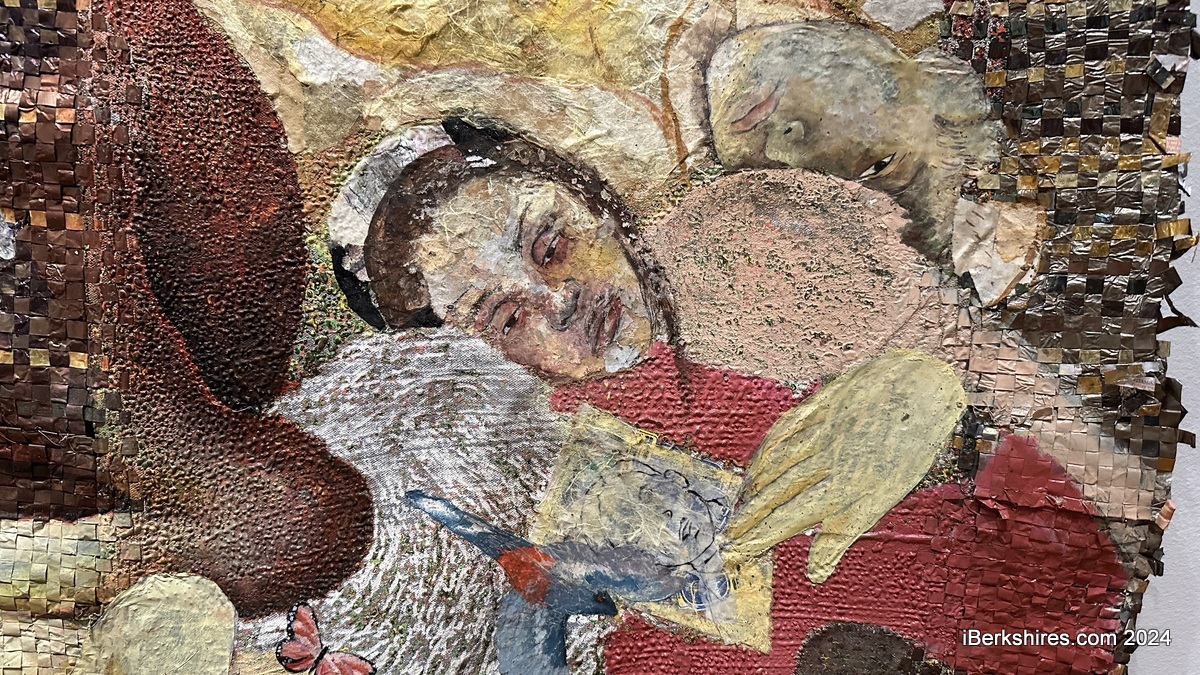
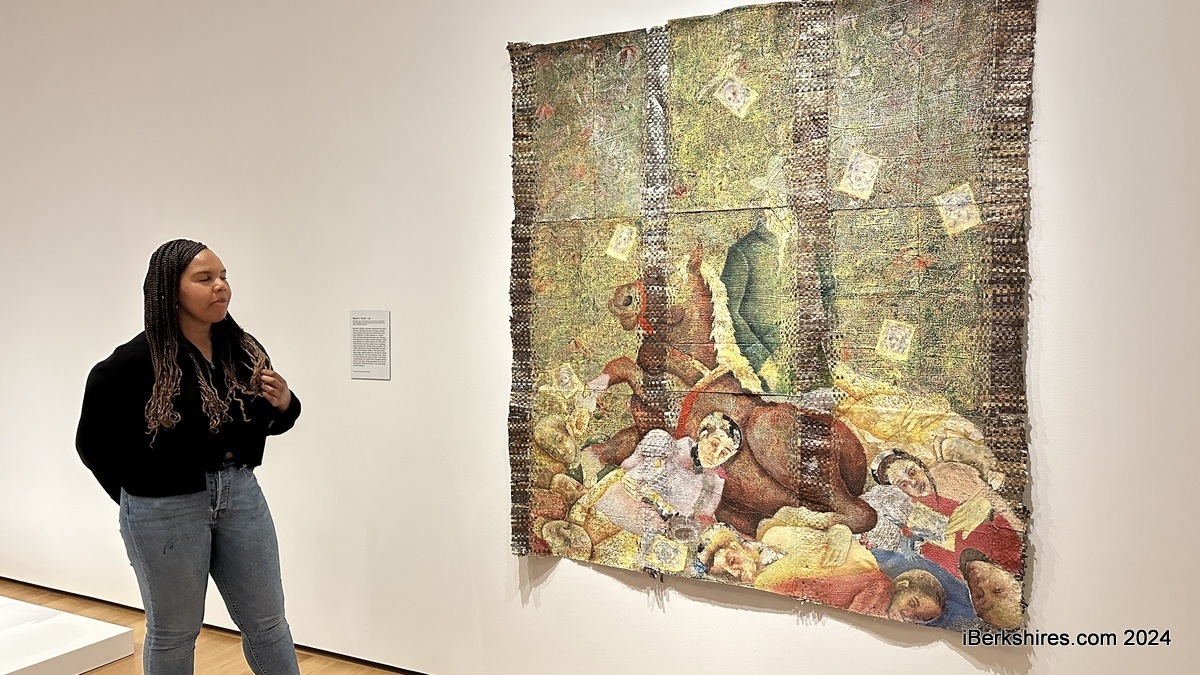
A close-up of Kathia St. Hilaire's 'Mamita Yunai,' the aftermath of the massacre of striking United Fruit Co. workers by Colombian soldiers.
WILLIAMSTOWN, Mass. — The Clark Art Institute's newest exhibition "Invisible Empires" will run through Sept. 22 in the galleries of the Lunder Center at Stone Hill.
Artist Kathia St. Hilaire uses mixed mediums, including printmaking, painting, collage, and weaving, to explore the lost Haitian history and culture she has heard as tales told by her parents and investigates how imperialism persists today in subtler forms.
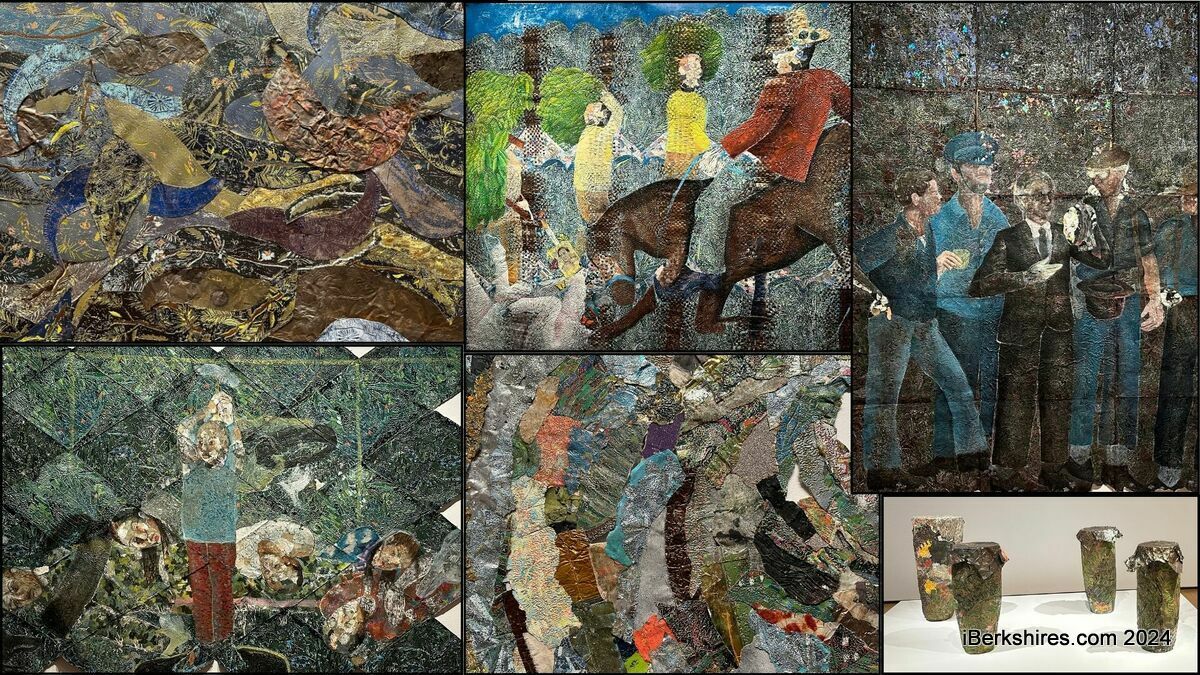
In her work, St. Hilaire uses various materials, including "beauty products," such as skin lighteners, industrial metal, fabric, and tires. She brings to life the lost history while drawing inspiration from Haitian vodou flags.
St. Hilaire is informed from her experiences growing up in Caribbean and African American neighborhoods in South Florida and being raised by parents who immigrated to the United States from Haiti.
Her work depicts historical moments, including the Haitian revolution, French colonialism, foreign interventions in the Caribbean, and the banana massacre in , and brings to life forgotten historical figures, including Rosalvo Bobo, Benoît Batraville, and Charlemagne Péralte, and integrates them with legends of Haiti's leaders.
The stories that St. Hilaire tells are personal, "familial about the diasporic communities in which she was raised," and national "about the first free black Republican world, Haiti, and they are international pertaining to the "wider region, the Caribbean, Latin America, areas in which the United States has taken a great interest in, to put it lightly in historical terms," curator Robert Wiesenberger said.
The way she narrates these stories together and depicts the effect they have on the present is an "unbelievable craft," he said.
During these historical events, history was "slowly happening at the simultaneously," and through these decisions viewers can see how intervention plays again in today's society, St. Hilaire said.
She uses her work to show how stories of the past have become incomplete with time. Wiesenberger point's out how in the piece "Mamita Yunai" (the nickname Haitians had for United Fruit Co.) the woven edges are incomplete and pieces are woven together, showing how this oral history is incomplete.
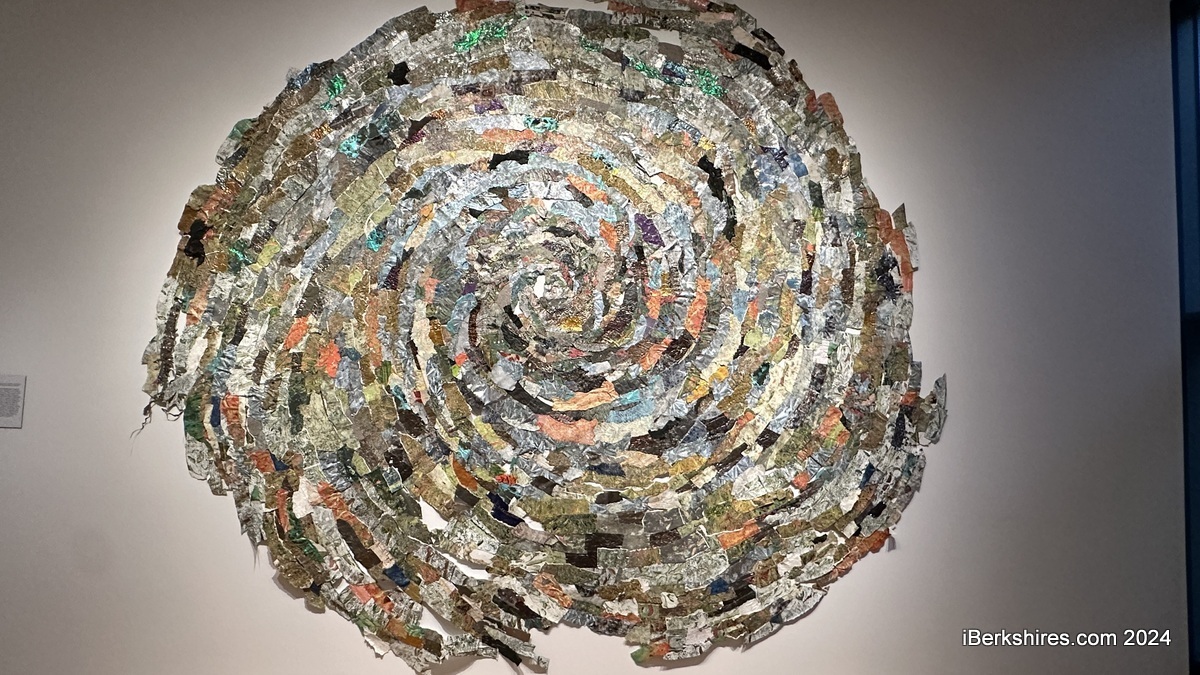
"Mamita Yunai" was once part of her other artwork "David," which is named after a hurricane that her mother experienced in the 19 70s while she was in Haiti. "David" was created first as a way to experiment with different textures and attempt to bring them together, in addition to it being a creative way clean up her studio floor. It is made up of the scrap pieces from her other works of art.
The piece demonstrates how you do not have to always look for something new but can reuse items and how these items can interestingly connect to the past even though it was not directly related to the moment in history, she said.
After reading the book "One Hundred of Solitude" by Gabriel García Márquez, she combined the two pieces as a metaphor for imperialism, similar to the storm within the story.
The past informs the present yet these historical moments have been lost to time and represent themselves in subtler forms, St. Hilaire said.
A piece that strongly shows this is her piece "Skin Lightening $2.19" which shows how the Latin Americans, Middle Eastern, and African American people are still experiencing the impact of imperialism through the utilization of skin lighteners.
It is not about how skin lighters are a way of self hate, rather it is seen as way of beautifying yourself, St. Hilaire said. There is this idea of a "black revolution" but then there are these conflicting products that are being used, repeating history in a subtler way.
The artist's work not only reflects historical events but also shows St. Hilaire's personal journey of self-introspection.
From the subtle homage to the flowers that grow in her parents' garden, to the utilization of the skin lightener that her family uses, to the stories told by her parents, and to the connections from Márquez's book, St. Hilaire's biographical experiences shine through in her works.
St. Hilaire took a year to read "One Hundred Years of Solitude," taking the time to unravel the book and search for the overall message but instead finding a combination of messages that deeply resonated with her. Underneath each message a new one appears, almost like a literal matryoshka doll, she said.
Prior to reading the novel of a family haunted by and repeating its past, she did not realize the importance of oral history and how prevalent it is in Latin American and African cultures, thinking it was something that only her parents told her.
Now when she listens to her father tell her a tale from history she will "be more privy to it because you don't know if it's really documented," she said.
Through the nearly 20 works St. Hilaire has developed between 2018 and 2023, she aims to memorialize these untold stories. She strives to create a space for these communities to reflect on how this oral history was passed down and connect with each other through mutual understanding.
It would be interesting to hear from others on what they think of and how they were told this similar oral history, St. Hilaire said.
Experiencing these other perspectives adds more weight to the history she has heard her whole life, she said.
If you would like to contribute information on this article, contact us at info@iberkshires.com.
Your Comments
iBerkshires.com welcomes critical, respectful dialogue. Name-calling, personal attacks, libel, slander or foul language is not allowed. All comments are reviewed before posting and will be deleted or edited as necessary.
No Comments
Puppets Teach Resilience at Lanesborough Elementary School
By Breanna SteeleiBerkshires Staff
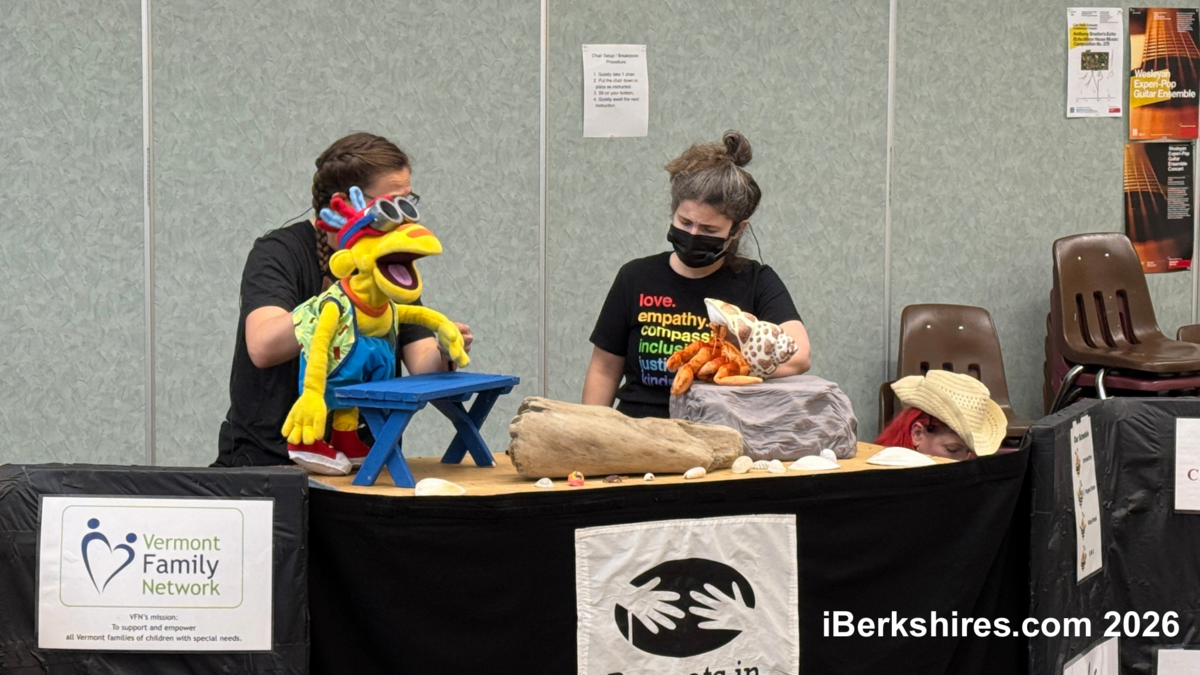
The kids learned from puppets Ollie and a hermit crab.
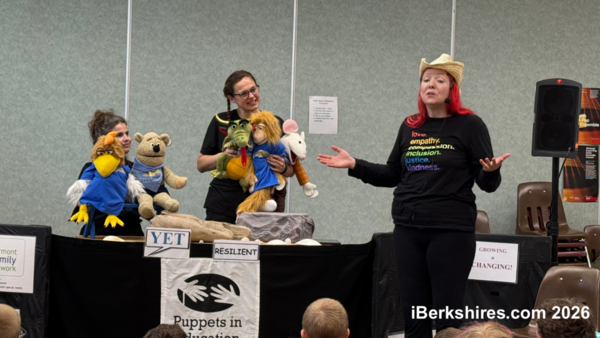
LANESBOROUGH, Mass. — Vermont Family Network's Puppets in Education visited the elementary school recently to teach kids about being resilient.
Puppets in Education has been engaging with young students with interactive puppets for 45 years.
Classes filtered through the music class Thursday to learn about how to be resilient and kind, deal with change and anxiety, and more.
"This program is this beautiful blending of other programs we have, which is our anxiety program, our bullying prevention and friendship program, but is teaching children the power of yet and how to be able to feel empowered and strong when times are challenging and tough," said program manager Sarah Vogelsang-Card.
The kids got to engage with a "bounce back" song, move around, and listen to a hermit crab deal with the change of needing a new shell.
"A crab that is too small or too big for its shell, so trying to problem solve, having a plan A, B and C, because it's a really tough time," Vogelsang-Card said. "It's like moving, it's like divorce of parents, it's changing schools. It's things that children would be going through, even on a day to day basis, that are just things they need to be resilient, that they feel strong and they feel empowered to be able to make these choices for themselves."
The resiliency program is new and formatted little differently to each of the age groups.
"For the older kids. We age it up a bit, so we talk about harassment and bullying and even setting the scene with the beach is a little bit different kind of language, something that they feel like they can buy into," she said. "For the younger kids, it's a little bit more playful, and we don't touch about harassment. We just talk about making friends and being kind. So that's where we're learning as we're growing this program, is to find the different kinds of messaging that's appropriate for each development level."
This programming affirms themes that are already being discussed in the elementary school, said school psychologist Christy Viall. She thinks this is a fun way for the children to continue learning.
"We have programs here at the school called community building, and that's really good. So they go through all of these strategies already," she said. "But having that repetition is really important, and finding it in a different way, like the puppets coming in and sharing it with them is a fun way that they can really connect to, I think, and it might, get in a little more deeply for them.
Vogelsang-Card said its another space for them to be safe and discuss what's going on in their life. Some children are afraid because maybe their parents are getting divorced, or they're being bullied, but with the puppets, they might open up and disclose what's bothering them because they feel safe, even in a larger crowd.
"When we do sexual abuse awareness that program alone, over five years, we had 87 disclosures of abuse that were followed up and reported," she said. "And children feel safe with the puppets. It makes them feel valued, heard, and we hope that in our short time that we're together, that they at least leave knowing that they're not alone."
Bedard Brothers also gave the school five new puppets to use. Viall said the puppets are a great help for the students in her classroom, especially in the younger grades.
"Every year, I've been giving the puppets to the students. And I also have a few of the puppets in my classroom, and the students use them in small groups to practice out the strategies with each other, which is really helpful," she said. "Sometimes the older students, like sixth graders, will put on a puppet show. They'll come up with a whole theme and a whole little situation, and they'll act it out with the strategies for the younger students. It's really cute, they've done it with kindergarteners, and the kids really like it."
Vogelsang-Card said there are 130 schools in Vermont that are on the waiting list for them to come in. Lanesborough Elementary has been the only Massachusetts school they have visited, thanks to Bedard Brothers.
"These programs are so critical and life-changing for children in such a short amount of time, and we are the only program in the United States that does what we do, which is create this content in this enjoyable, fun, engaging way with oftentimes difficult subjects," she said. "Vermont is our home base, but we would love to be able to bring this to more schools, and we can't do this without the support of community, business funders or donors, and it really makes a difference for children."
The fourth-grade students were the first class to engage with the puppets and a lot of them really connected with the show.
"I learned to never give-up and if you have to move houses, be nervous, but it still helps," said William Larios.
"I learned to always add the word 'yet' at the end," said Sierra Kellogg, because even if she can't do something now, she will be able to at some point.
Samuel Casucci was struck by what one of the puppets talked about. "He said some people make fun of him if he dresses different, come from different place, brings home lunch, it doesn't matter," Samuel continued. "We're all kind of the same. We're all kind of different, like we have different hairstyles, different clothes. We're all the same because we're all human."
"I learned how to be more positive about myself and like, say, I can't do this yet, it's positive and helpful," said Liam Flaherty.
The students got to take home stickers at the end of the day with contact information of the organization.
Students got to showcase their art at the Clark Art Institute depicting their relationship with the Earth in the time of climate change. click for more
The 100th annual meeting will be held on March 10, 2027, the Community Chest's birthday (there will be cake, he promised) and a gala will be held at the Clark Art Institute on Sept. 25, 2027.
click for more