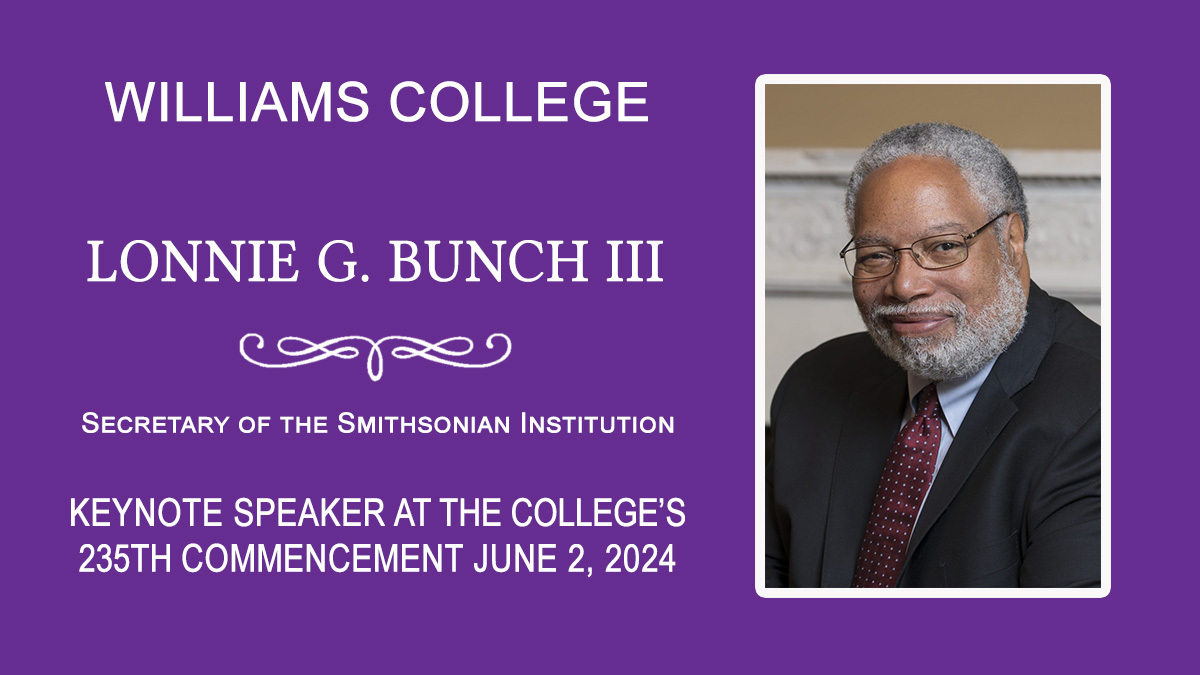
WILLIAMSTOWN, Mass. — Secretary of the Smithsonian Institution Lonnie G. Bunch III will be the principal speaker at Williams College's 235th commencement exercise on Sunday, June 2.
The day before, Dr. Siddhartha Mukherjee, a pioneering physician, oncologist and award-winning author, will deliver the college's baccalaureate lecture. Liz Robinson is a 1990 graduate and chair of the college's board of trustees who also serves as director and adviser to for-profit and nonprofit organizations around the country, and Rick Trainor, rector of Exeter College at the University of Oxford, will each receive honorary degrees during the commencement ceremony.
Lonnie Bunch III
Bunch is the 14th secretary of the Smithsonian Institution, where he oversees 21 museums, 21 libraries, the National Zoo, numerous research centers and several education units and centers. He was previously founding director of the Smithsonian's National Museum of African American History and Culture, a position he assumed before the museum site had been chosen. He has been named one of the 100 most influential museum professionals of the 20th century by the American Association of Museums.
A widely published author, Bunch has written on topics including the Black military experience, the American presidency and African American history in California, diversity in museum management and the impact of funding and politics on American museums.
Bunch has previously served in various roles at major museums and historical institutions, produced historical documentaries for public television and taught at American University, the University of Massachusetts at Dartmouth and George Washington University, among other institutions. President George W. Bush appointed him to the Committee for the Preservation of the White House and he was later reappointed by President Barack Obama. He is a recipient of the Roosevelt Institute's Freedom Medal for contributions to American culture as a historian and storyteller; the W.E.B. Du Bois Medal from the Hutchins Center at Harvard University; and the NAACP's Legal Defense Fund's National Equal Justice Award. The Society of American Historians awarded him its Tony Horwitz Prize honoring distinguished work in American history of wide appeal and enduring public significance, and its David McCullough Award for outstanding work in public history. Other honors include lifetime achievement awards from both the American Alliance of Museums and the African American Association of Museums, and the Congressional Black Caucus's Chairman's Award. In 2021, the French government awarded Bunch the Legion of Honor, the country's highest honor.
Dr. Siddhartha Mukherjee
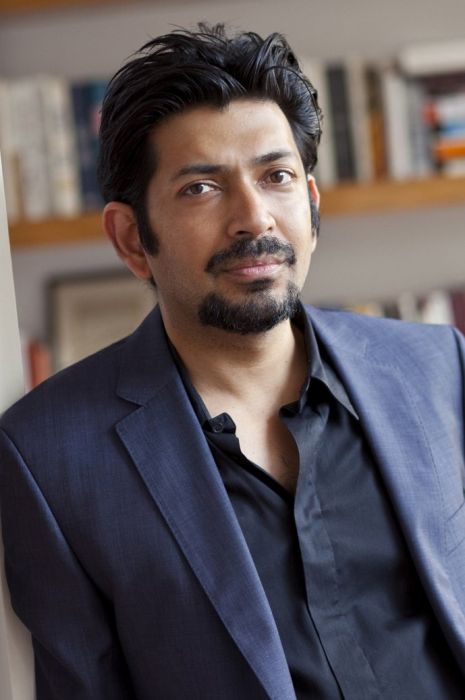
Mukherjee has redefined the public discourse on human health, medicine and science. An influential voice in the scientific community, he is best known for his books, "The Emperor of All Maladies: A Biography of Cancer," which earned him the 2011 Pulitzer Prize, and "The Gene: An Intimate History," which won international awards and was recognized by The Washington Post and The New York Times as one of the most influential books of 2016. "The Emperor of All Maladies" has been adapted into a documentary by filmmaker Ken Burns, and was included among Time magazine's 100 best nonfiction books of the past century. Exploring the essence of humanity, "The Song of the Cell," his third title, became a New York Times best-seller.
Mukherjee's achievements as a writer and educator build upon his career as a renowned medical scholar. His groundbreaking studies into the composition and behavior of cancer cells have pushed the boundaries of modern medicine. His innovative research signals a paradigm shift in cancer pathology, and has enabled the development of treatments that reach beyond current pharmaceutical models toward new biological and cellular therapies. Serving as a professor of medicine at Columbia University and as a staff cancer physician at the university's medical center, Mukherjee has brought hope to patients and families around the world, while revolutionizing society's blueprint for healing. He writes for the New Yorker, The New York Times Magazine and many other publications, has received numerous awards for his scientific work, has published his original research and opinions in journals such Nature, Cell and the New England Journal of Medicine. He lives in New York City with his wife and daughters.
Elizabeth 'Liz' Beshel Robinson
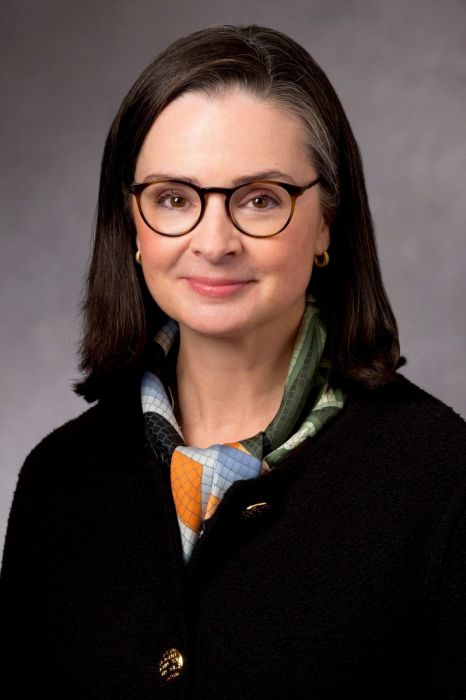
Liz Robinson
Robinson, a native of Chicago, applied to Williams after seeing a reference to the Williams-Amherst rivalry in Amherst's recruitment materials. Making the right choice, she attended Williams and majored in economics, served as a junior adviser and sampled a wide variety of courses, discovering a passion for art history in the process.
After graduation she joined the financial institutions group in the investment banking division of Goldman Sachs, earning an master in business administration from Columbia University's Executive MBA Program at the same time. She later transferred to the firm's corporate treasury department and was named global treasurer in 2005, and partner a year later. During this time she was an integral part of the team that executed Goldman's IPO and navigated the company through the 2008 global financial crisis. She also recruited many Williams graduates into the company before retiring from Goldman in 2016.
Robinson is now a director and adviser to for-profit and nonprofit organizations around the country. She sits on the boards of The Bank of New York Mellon Corp. and The Travelers Companies, as well as Every Mother Counts, Blair Academy in New Jersey, and St. Luke's University Health Network in Pennsylvania.
At Williams, in addition to her board service, Robinson was a member of the presidential search committee that selected President Mandel in 2018 and has been an important volunteer as associate agent for the Class of 1990 and committee member for that class's 25th Reunion Fund.
Sir Rick Trainor

Sir Rick Trainor
Trainor is rector (equivalent of president) of Exeter College at the University of Oxford, where he is Williams' chief partner for the Williams-Exeter Programme at Oxford. His scholarship focuses on the economic and social history of modern Britain and continental Europe, and has published extensively on the social history of British elites, especially the origins and impact of the leaders of industrial towns and cities.
Trainor began his academic career at the University of Glasgow, where he was later appointed dean of the faculty of social sciences and vice principal. He has also been vice chancellor of the University of Greenwich and principal and professor of social history at King's College London, which established the Professor Sir Richard Trainor Postgraduate Research Scholarship in his honor. He has remained active in research during his administrative career, and served terms as president of the Economic History Society and chair of the Institute for Historical Research's Advisory Committee.
Raised in New Jersey and Maryland, Trainor earned his undergraduate degree from Brown University. He was then a Rhodes Scholar, completing a second bachelor's at Merton College Oxford. Subsequently he was a graduate student in history at Princeton and at Nuffield College Oxford, completing his doctorate in British social history at Oxford, where he was also a Junior Research Fellow at Wolfson College and a lecturer at Balliol College.
Trainor is a fellow of the Academy of Social Sciences and the Royal Historical Society, and past president of Universities UK, the organization representing the heads of all universities in the United Kingdom. He is an honorary fellow of Merton College, Oxford; Trinity College of Music; the Royal Academy of Music; and the Institute of Historical Research, and a patron of the Anglo-American Fulbright Commission. He holds honorary degrees from the University of Kent, the Rosalind Franklin University of Medicine and Science, the University of Glasgow and the University of Greenwich. He is a citizen of both the United States and the UK.
If you would like to contribute information on this article, contact us at info@iberkshires.com.
Your Comments
iBerkshires.com welcomes critical, respectful dialogue. Name-calling, personal attacks, libel, slander or foul language is not allowed. All comments are reviewed before posting and will be deleted or edited as necessary.
No Comments
Puppets Teach Resilience at Lanesborough Elementary School
By Breanna SteeleiBerkshires Staff
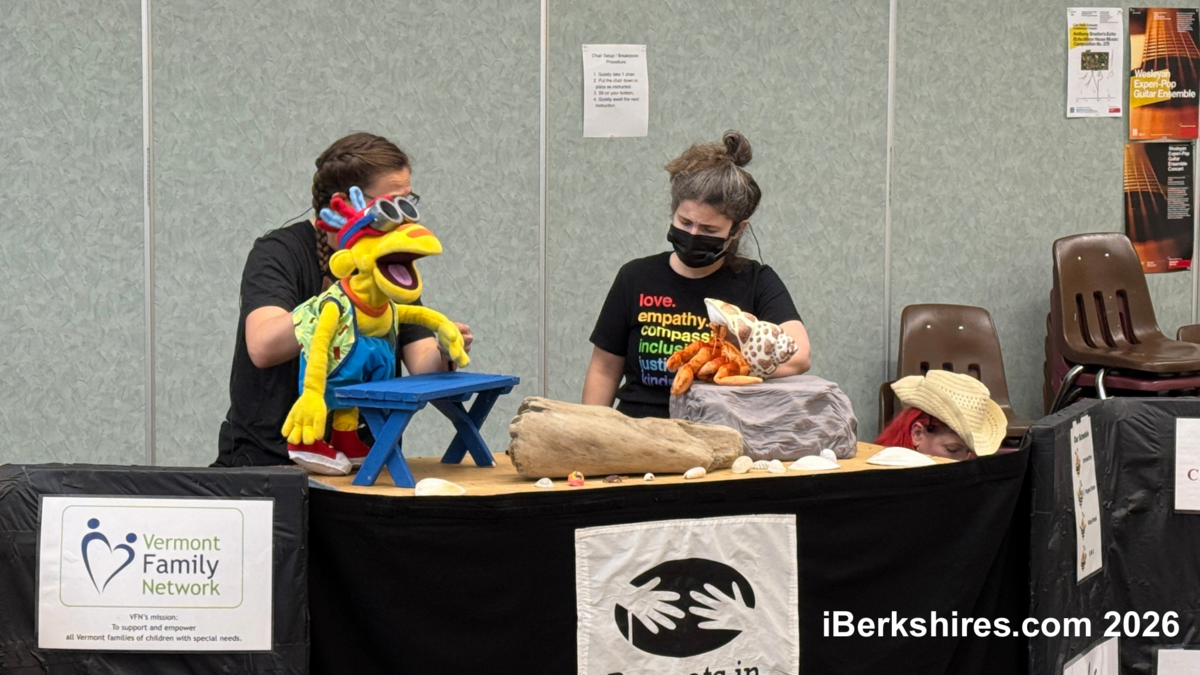
The kids learned from puppets Ollie and a hermit crab.
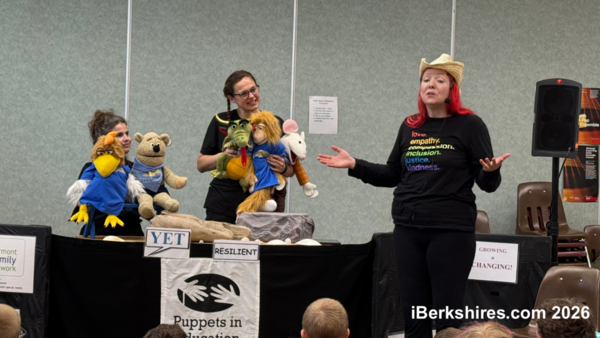
LANESBOROUGH, Mass. — Vermont Family Network's Puppets in Education visited the elementary school recently to teach kids about being resilient.
Puppets in Education has been engaging with young students with interactive puppets for 45 years.
Classes filtered through the music class Thursday to learn about how to be resilient and kind, deal with change and anxiety, and more.
"This program is this beautiful blending of other programs we have, which is our anxiety program, our bullying prevention and friendship program, but is teaching children the power of yet and how to be able to feel empowered and strong when times are challenging and tough," said program manager Sarah Vogelsang-Card.
The kids got to engage with a "bounce back" song, move around, and listen to a hermit crab deal with the change of needing a new shell.
"A crab that is too small or too big for its shell, so trying to problem solve, having a plan A, B and C, because it's a really tough time," Vogelsang-Card said. "It's like moving, it's like divorce of parents, it's changing schools. It's things that children would be going through, even on a day to day basis, that are just things they need to be resilient, that they feel strong and they feel empowered to be able to make these choices for themselves."
The resiliency program is new and formatted little differently to each of the age groups.
"For the older kids. We age it up a bit, so we talk about harassment and bullying and even setting the scene with the beach is a little bit different kind of language, something that they feel like they can buy into," she said. "For the younger kids, it's a little bit more playful, and we don't touch about harassment. We just talk about making friends and being kind. So that's where we're learning as we're growing this program, is to find the different kinds of messaging that's appropriate for each development level."
This programming affirms themes that are already being discussed in the elementary school, said school psychologist Christy Viall. She thinks this is a fun way for the children to continue learning.
"We have programs here at the school called community building, and that's really good. So they go through all of these strategies already," she said. "But having that repetition is really important, and finding it in a different way, like the puppets coming in and sharing it with them is a fun way that they can really connect to, I think, and it might, get in a little more deeply for them.
Vogelsang-Card said its another space for them to be safe and discuss what's going on in their life. Some children are afraid because maybe their parents are getting divorced, or they're being bullied, but with the puppets, they might open up and disclose what's bothering them because they feel safe, even in a larger crowd.
"When we do sexual abuse awareness that program alone, over five years, we had 87 disclosures of abuse that were followed up and reported," she said. "And children feel safe with the puppets. It makes them feel valued, heard, and we hope that in our short time that we're together, that they at least leave knowing that they're not alone."
Bedard Brothers also gave the school five new puppets to use. Viall said the puppets are a great help for the students in her classroom, especially in the younger grades.
"Every year, I've been giving the puppets to the students. And I also have a few of the puppets in my classroom, and the students use them in small groups to practice out the strategies with each other, which is really helpful," she said. "Sometimes the older students, like sixth graders, will put on a puppet show. They'll come up with a whole theme and a whole little situation, and they'll act it out with the strategies for the younger students. It's really cute, they've done it with kindergarteners, and the kids really like it."
Vogelsang-Card said there are 130 schools in Vermont that are on the waiting list for them to come in. Lanesborough Elementary has been the only Massachusetts school they have visited, thanks to Bedard Brothers.
"These programs are so critical and life-changing for children in such a short amount of time, and we are the only program in the United States that does what we do, which is create this content in this enjoyable, fun, engaging way with oftentimes difficult subjects," she said. "Vermont is our home base, but we would love to be able to bring this to more schools, and we can't do this without the support of community, business funders or donors, and it really makes a difference for children."
The fourth-grade students were the first class to engage with the puppets and a lot of them really connected with the show.
"I learned to never give-up and if you have to move houses, be nervous, but it still helps," said William Larios.
"I learned to always add the word 'yet' at the end," said Sierra Kellogg, because even if she can't do something now, she will be able to at some point.
Samuel Casucci was struck by what one of the puppets talked about. "He said some people make fun of him if he dresses different, come from different place, brings home lunch, it doesn't matter," Samuel continued. "We're all kind of the same. We're all kind of different, like we have different hairstyles, different clothes. We're all the same because we're all human."
"I learned how to be more positive about myself and like, say, I can't do this yet, it's positive and helpful," said Liam Flaherty.
The students got to take home stickers at the end of the day with contact information of the organization.
Students got to showcase their art at the Clark Art Institute depicting their relationship with the Earth in the time of climate change. click for more
The 100th annual meeting will be held on March 10, 2027, the Community Chest's birthday (there will be cake, he promised) and a gala will be held at the Clark Art Institute on Sept. 25, 2027.
click for more