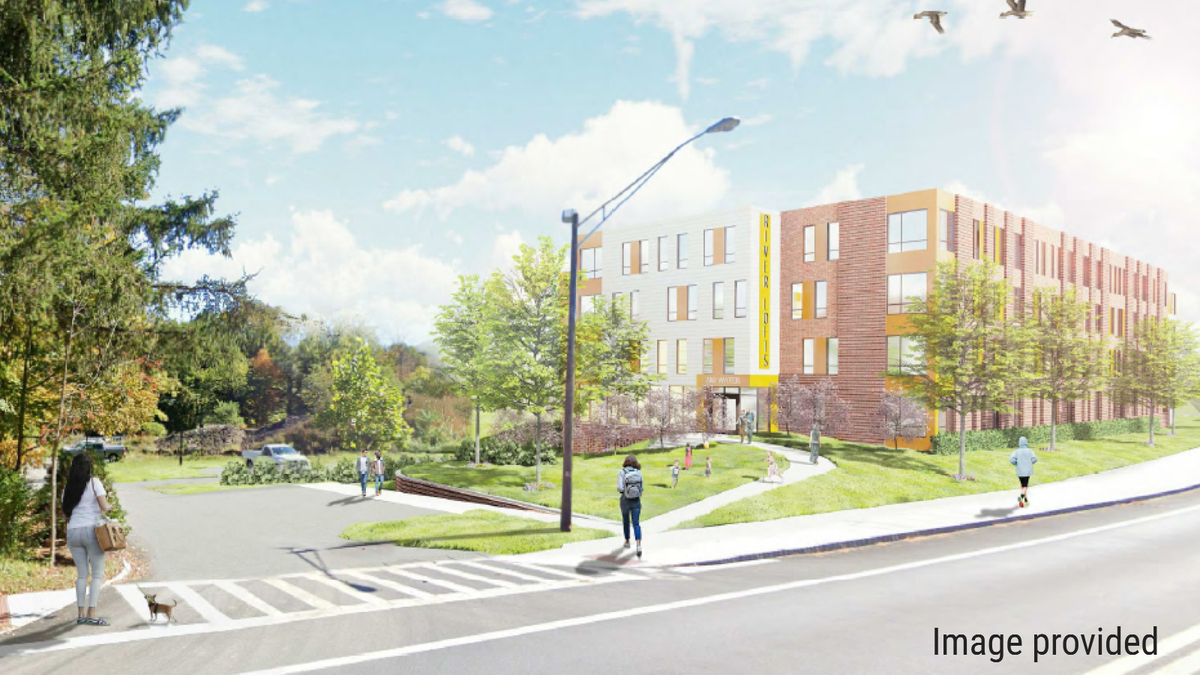
Williamstown Housing Trust Commits $80K to Support Cable Mills Phase 3
WILLIAMSTOWN, Mass. — The board of the town's Affordable Housing Trust last week agreed in principle to commit $80,000 more in town funds to support the third phase of the Cable Mills housing development on Water Street.
Developer David Traggorth asked the trustees to make the contribution from its coffers to help unlock an additional $5.4 million in state funds for the planned 54-unit apartment building at the south end of the Cable Mills site.
In 2022, the annual town meeting approved a $400,000 outlay of Community Preservation Act funds to support the third and final phase of the Cable Mills development, which started with the restoration and conversion of the former mill building and continued with the construction of condominiums along the Green River.
The town's CPA funds are part of the funding mix because 28 of Phase 3's 54 units (52 percent) will be designated as affordable housing for residents making up to 60 percent of the area median income.
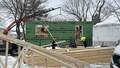
Traggorth said he hopes by this August to have shovels in the ground on Phase 3, which has been delayed due to spiraling construction costs that forced the developer to redo the financial plan for the apartment building.
He showed the trustees a spreadsheet that demonstrated how the overall cost of the project has gone up by about $6 million from the 2022 budget.
"Most of that is driven by construction costs," he said. "Some of it is caused by the increase in interest rates. If it costs us more to borrow, we can't borrow as much."
Traggorth said he has discussed the cost escalation with state officials who have agreed to increase the commonwealth's financial support for Phase 3 — with a catch.
"Overall, the message from the state was, 'We understand the problem. You're not the only one,' " he said. "One of the things they require is, if you're going to come to [the state] and ask for more money, you also need to make sure the town of Williamstown is A) still on board with the project and B) can contribute their share of an additional amount."
Traggorth said his firm, Causeway Development, also is working to close the gap between the 2022 and 2024 construction cost by deferring some of its fee.
The additional $80,000 from the town represents 20 percent of its original, 2022 contribution and is proportional to both the increased construction cost and the expected increase in state support.
"[The town's contribution] was $400,000 out of a $31 million project," Traggorth said. "Now it would be $480,000 out of a $36 million project, roughly."
The AHT board voted, 5-1, with one member, Daniel Gura, absent, to commit $80,000 to support Phase 3. The board will need to take a later vote, likely this spring or summer, to finalize the commitment and release the funds.
Board member Robin Malloy voted against making the commitment and, later in the meeting, explained that she thought the local housing trust could find better ways to utilize its funds.
"I feel like [the developer is] obviously making a lot of money on this project," Malloy said. "They're getting a lot more dense housing than they otherwise would be. I feel like we could use that $80,000 for entities that don't have other resources. I would rather use that money to give to people to help them buy those houses.
"Eighty-thousand dollars is not a lot for [Causeway Development] to pony up. It's more for us. I feel like we could make better use of the money."
The other five members of the AHT board in attendance appeared to accept the argument that a demonstration of local support is necessary to free up additional state financing, which is how the majority of affordable units in the commonwealth are funded. That is the same model the town used to support the Highland Woods senior apartments in 2016, the first phase of Cable Mills in 2016, 300 Cole Ave. in 2021 and Phase 3 of Cable Mills the first time around in 2022.
Thomas Sheldon, one of the founding members of the Affordable Housing Trust board, pointed out that the additional $80,000 in trust funds to enable the construction of 28 affordable units is "a bargain" for the trust.
"I think those units would still get built, regardless," Malloy replied.
"That's an assumption," Sheldon said. "We don't know that for sure. We didn't know that when we gave the money to Highland Woods that it would make a difference. But it happened. It's been an article of faith between towns and the state for a long time in terms of this kind of situation."
While he appeared virtually before the AHT board, Traggorth provided some updates on the 13 affordable units in the 61-unit Phase 1 of Cable Mills.
The developer said all 13 units currently are occupied and, like the rest of Cable Mills, are being converted from rentals to condos. Like the rental units, the ownership units will continue to be affordable in perpetuity.
The affordable units are being marketed for between $155,000 and $180,000, depending on size. The average sales price for the other 48 units in Phase 1 is in the ballpark of $650,000, Traggorth said.
Traggorth said that, by right, people living in the Phase 1 units as rentals have five years from the date the condo conversion began to either buy or move. To date, at least one occupant of an affordable rental has purchased it as an affordable condominium, with help from the Affordable Housing Trust's DeMayo Mortgage Assistance Program; AHT board Chair Andrew Hogeland at the April 17 meeting said at least one more DeMayo MAP request for a Cable Mills condo is in the pipeline.
Traggorth said the tenants at Cable Mills have about 3 1/2 years left on the original five-year window. He said he hopes that Phase 3 will be built in time to allow them to move from the former mill building to the new apartments if they desire to stay in rental units.
Phase 3 — unlike Phase 1 — is planned to be permanent rental housing. And all 41 planned affordable units (13 in Phase 1, 28 in Phase 3) will be deed restricted as affordable, based on the AMI.
Tags: affordable housing, Cable Mills,