Columbia Climate Scientist to Explore Faith and Environmentalism at MCLA

Print Story | Email Story
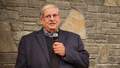
NORTH ADAMS, Mass. — Massachusetts College of Liberal Arts (MCLA) welcomes Dr. Alexander de Sherbinin, Director and Senior Research Scientist at Columbia Climate School's Center for Integrated Earth System Information (CIESIN), as part of its Green Living Seminar Series on Wednesday, Feb. 18, at 5:30 p.m.
 
Dr. de Sherbinin will present "How Religion Influences Our Relationship with the Environment," examining the complex connections between spiritual beliefs and environmental stewardship. The talk will explore how different faith traditions shape attitudes toward nature, conservation, and climate action.
 
According to a press release:
 
A geographer whose research focuses on climate-related mobility, climate vulnerability mapping, and population-environment interactions, Dr. de Sherbinin manages the NASA Socioeconomic Data and Applications Center (SEDAC) and leads the UN Global Centre for Climate Mobility's Global Knowledge Hub. His work integrates geospatial data to address critical questions about human dimensions of climate change. He holds a PhD in Geo-Information Science and Earth Observation from the University of Twente in the Netherlands and has served as an agricultural extension agent with the U.S. Peace Corps in Mauritania, West Africa.
 
All presentations take place Wednesdays at 5:30 p.m. in MCLA's Feigenbaum Center for Science and Innovation, Room 121, and will be recorded as podcasts available at mcla.edu/greenliving.
 
This event is free and open to the public.
 
MCLA's Green Living Seminar Series brings environmental experts to campus throughout the academic year to engage students and community members in conversations about sustainability, climate change, and ecological responsibility.

Tags: MCLA,   

If you would like to contribute information on this article, contact us at info@iberkshires.com.

Clarksburg Students Write in Support of Rural School Aid

By Tammy DanielsiBerkshires Staff

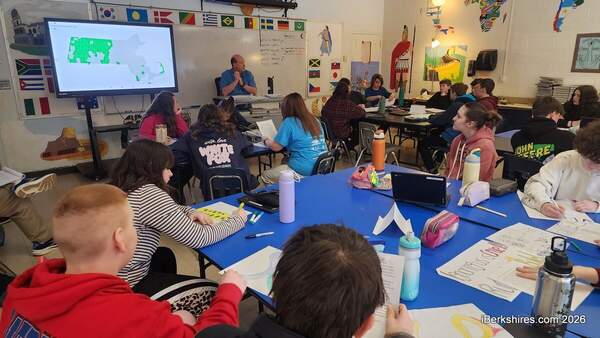
Mason Langenback calculated that Clarksburg would get almost $1 million if the $60 million was allocated equally.
CLARKSBURG, Mass. — Eighth-graders at Clarksburg School took a lesson in civic advocacy this week, researching school funding and writing letters to Beacon Hill that call for fully funding rural school aid. 
 
The students focused on the hardships for small rural schools and their importance to the community — that they struggle with limited funding and teacher shortages, but offer safe and supportive spaces for learning and are a hub for community connections.
 
"They all address the main issue, the funding for rural schools, and how there's a gap, and there's the $4 million gap this year, and then it's about the $40 million next year, and that rural schools need that equitable funding," said social studies teacher Mark Karhan.
 
A rural schools report in 2022 found smaller school districts cost from nearly 17 percent to 23 percent more to operate, and recommended "at least" $60 million be appropriated annually for rural school aid. 
 
Gov. Maura Healey has filed for more Chapter 70 school aid, but that often is little help to small rural schools with declining or static enrollment. For fiscal 2027, she's budgeted $20 million for rural schools, up from around $13 million this year but still far below the hoped for $60 million. 
 
Karhan said the class was broken into four groups and the students were provided a submission letter from Rural Schools Advocacy. The students used the first paragraph, which laid out the funding facts, and then did research and wrote their own letters. 
 
They will submit those with a school picture to the governor. 
 
View Full Story

More North Adams Stories