MCLA's Dual Enrollment, Early College Programs Reach Over 320 Students

Print Story | Email Story
NORTH ADAMS, Mass. — Massachusetts College of Liberal Arts (MCLA) is making higher education more accessible and affordable for regional students through expanded Dual Enrollment and Early College programs that have saved families more than $880,632 to date.
 
The college's two-pronged approach connects students with college-level coursework earlier in their academic careers while significantly reducing the financial burden of higher education. Between this summer and fall, more than 150 students have taken their first college course, earning 450 credits at a savings of $218,700 to families through MCLA's Dual Enrollment program, which has expanded outreach across the Commonwealth and neighboring states.
 
"These programs demonstrate MCLA's commitment to serving as a community anchor and making college accessible to students who might not otherwise have the opportunity," said President James Birge. "By reaching students earlier and reducing costs for families, we're investing in the future of the Berkshires and beyond."
 
The Dual Enrollment program reaches students MCLA hasn't traditionally interacted with, creating greater opportunities for counselors to connect with prospective students.
 
Through MCLA's Early College partnership with Drury High School, students can earn 30 or more college credits either concurrently during high school or on campus alongside MCLA's matriculated students. Through the spring 2025 semester, MCLA has successfully awarded 1,362 credits to 170 students, resulting in a savings of $661,932 for Drury High School students based upon MCLA's per credit tuition and fee rate.
 
Students and families interested in learning more about MCLA's Dual Enrollment and Early College programs are encouraged to attend the open house on Nov1. For more information, visit Plan Your Visit.

Tags: MCLA,   

If you would like to contribute information on this article, contact us at info@iberkshires.com.

Clarksburg Students Write in Support of Rural School Aid

By Tammy DanielsiBerkshires Staff

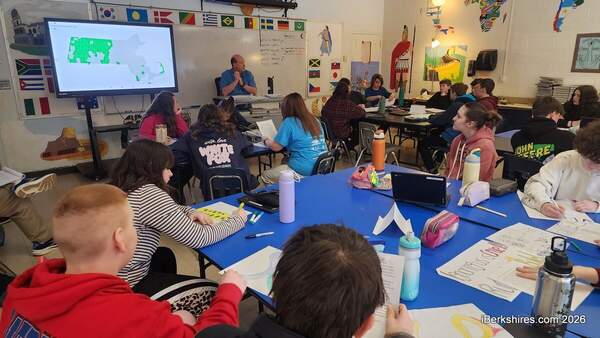
Mason Langenback calculated that Clarksburg would get almost $1 million if the $60 million was allocated equally.
CLARKSBURG, Mass. — Eighth-graders at Clarksburg School took a lesson in civic advocacy this week, researching school funding and writing letters to Beacon Hill that call for fully funding rural school aid. 
 
The students focused on the hardships for small rural schools and their importance to the community — that they struggle with limited funding and teacher shortages, but offer safe and supportive spaces for learning and are a hub for community connections.
 
"They all address the main issue, the funding for rural schools, and how there's a gap, and there's the $4 million gap this year, and then it's about the $40 million next year, and that rural schools need that equitable funding," said social studies teacher Mark Karhan.
 
A rural schools report in 2022 found smaller school districts cost from nearly 17 percent to 23 percent more to operate, and recommended "at least" $60 million be appropriated annually for rural school aid. 
 
Gov. Maura Healey has filed for more Chapter 70 school aid, but that often is little help to small rural schools with declining or static enrollment. For fiscal 2027, she's budgeted $20 million for rural schools, up from around $13 million this year but still far below the hoped for $60 million. 
 
Karhan said the class was broken into four groups and the students were provided a submission letter from Rural Schools Advocacy. The students used the first paragraph, which laid out the funding facts, and then did research and wrote their own letters. 
 
They will submit those with a school picture to the governor. 
 
View Full Story

More North Adams Stories