North Adams' Greylock School Project Estimated $1M Under Budget
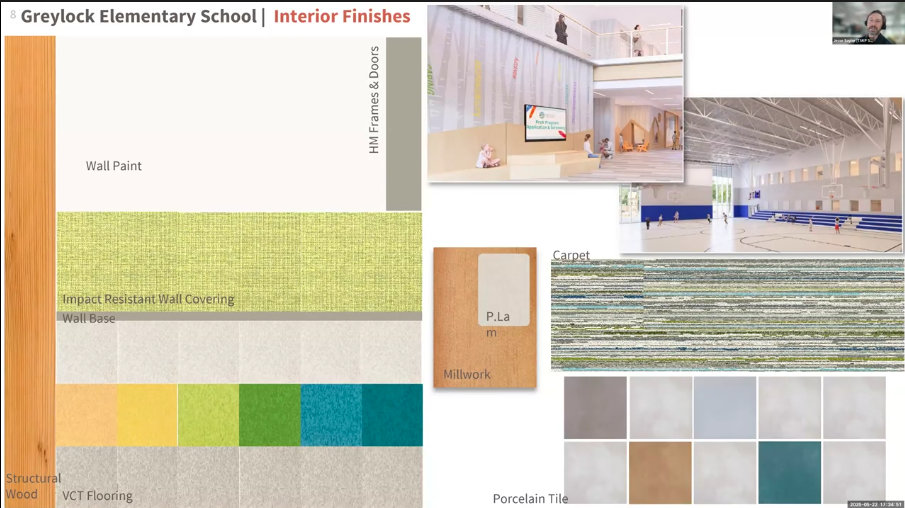
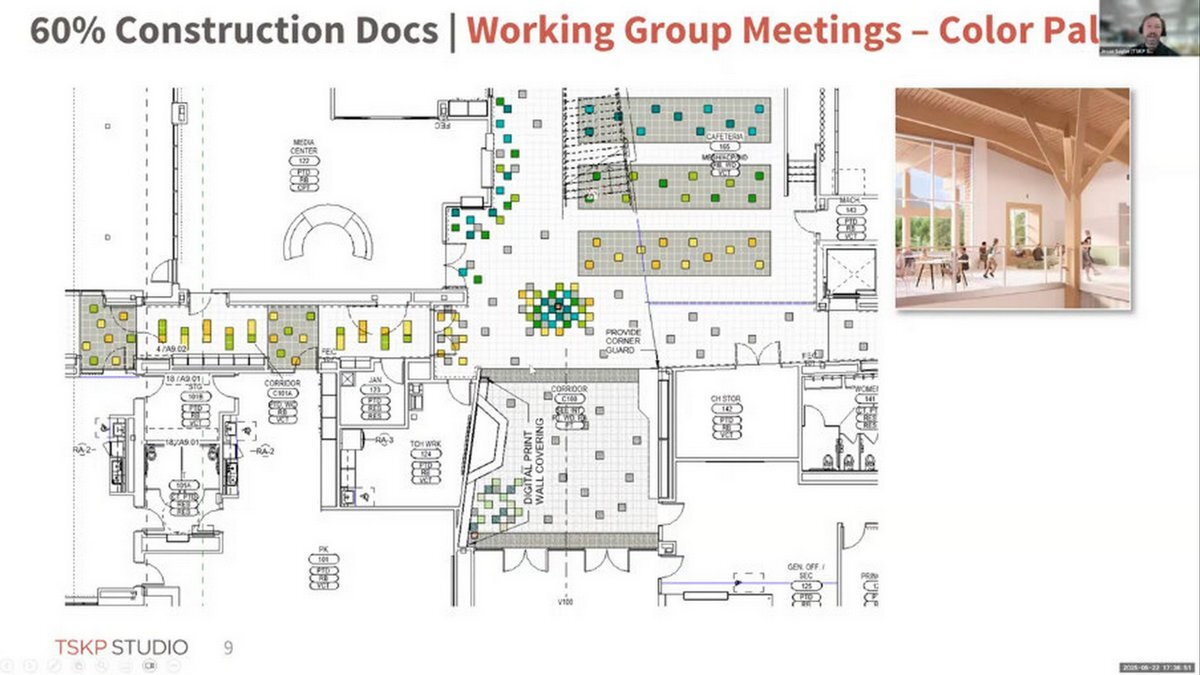
Accent color choices for the interior.
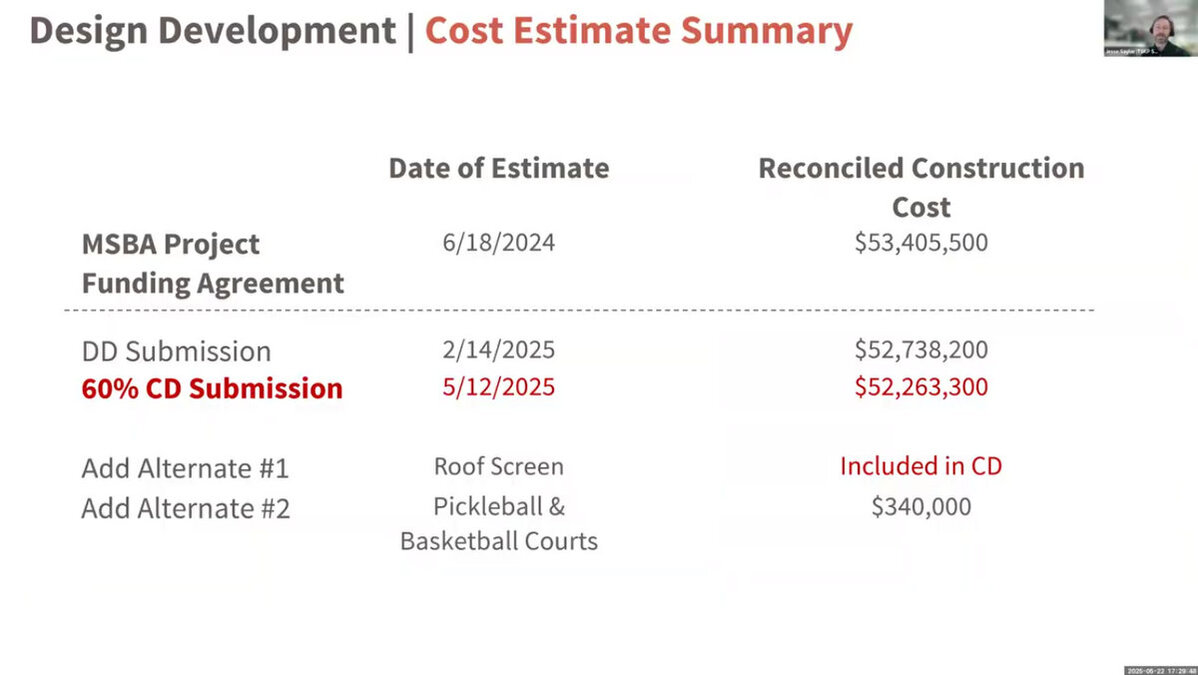
Last year's funding agreement with the Massachusetts School Building Authority estimated the cost of the building at $53,405,500, the majority of the $65.4 million project. (No funds have been borrowed for the project yet.)
Last month, the School Building Committee learned the estimate submitted to the MSBA with the 60 percent construction documents was at $52,263,300.
This figure includes screening for the mechanicals on the roof of the new school, an element that had been an alternative add-on
"There's some additional contingency there to protect the project against unforeseen items which could be tariffs," said Jesse Saylor of TSKP Studio, the project designer. "Project bids recently have been coming in below estimates and the frankly, the industry hasn't seen the escalation we had planned for back when we were putting together our project budget in June of last year.
"So that's a positive thing, and we hope it continues right through September."
Timothy Alix of Collier's International, the owner's project manager, noted that the independent estimators for the project "are very cognizant of what's going on" with commodities and what might be affected by tariffs.
He expanded on that at last week's meeting of the prequalification meeting — composed of himself, Saylor, Mayor Jennifer Macksey and Richard Alcombright.
A similar-value project, a fire station, in Central Mass saw a lot of interest and a bid that came in $6 million under budget, Alix said. That didn't guarantee that bids will come in cheaper when Greylock School goes out in September, but officials are taking it as a good sign.
Alcombright asked if company's are "hungry" for work; Alix thought it maybe a example of firms lining up work "in case things did go sideways" because of tariffs and a softening economy.
Required by state law, the prequalification committee will review submissions and score according to a matrix with requirements such as general contractors have worked on a public school project of a set value within the last decade, their financial health and assurances.
Firms will also have to be certified by the state Division of Capital Asset Management and Maintenance, which also set the requirements for the prequalification committee.
"This is where we really want to make sure we go through all the submissions carefully," said Alix. "We want to be as inclusive as possible and get as many bidders as we can."
Alcombright, former mayor, asked how these requirements would affect smaller contractors, "does that reduce our ability to promote jobs to local employment?" He noted that this had been priority during the Colegrove Park Elementary School project.
Alix said sub trades not on the DCAMM list that includes masonry, electrical, plumbing, etc., for certification would be selected by the general contractor and be included in its bid. This would provide local opportunities.
The prequalification documents are now available on ProjectDog, an online platform for construction projects. The request for qualifications is also posted on the school district website.
The deadline for RFQs is July 9 by 1 p.m.
The school project is now entering its 90 percent design phase, a period during which the construction documents will be filled out in detail and submitted to MSBA at the end of summer.
Saylor said working groups continue to meet to discuss everything from school security to kitchen layout to office needs.
"There's a lot of beind the scenes work that's happening now," he said.
One of those groups is working on interior colors, which was presented as natural palette with pops of color to indicate grade levels ranging from yellow in prekindergarten to deep blue and teal in Grade 2.
"One of the concepts is that accent colors in the building will help you understand where you are," said Saylor, who pointed two patterns — "fallen leaves" under the tree-like posts and stepping stones. "Kind of a confetti of colors against a neutral gray floor."
Macksey was not a fan of the yellow but Saylor said he could show her the whole presentation of how it would come together.
Last week's School Building Committee meeting was also the last for Superintendent Barbara Malkas, who is retiring at the end of June. Incoming Superintendent Timothy Callahan was voted to take her place on the committee.
(The composition of the School Building Committee is set by and approved by the MSBA.)
Malkas thanked the members of the committee for continuing the important work they are doing.
"I look forward to coming to the ground breaking and then eventually for the ribbon cutting," she said.
Tags: Greylock School Project,