MassWildlife: Avoid Decorating With Invasive Plants
During the holiday season, many people use plants to decorate their homes or businesses. If you wish to use plants in your decorations, be sure to select native species such as native pines, spruces, hemlock, American holly, mountain laurel, fir, or winterberry holly.
Avoid exotic, invasive plants like Oriental bittersweet (Celastrus orbiculatus) and multiflora rose (Rosa multiflora). These plants may have attractive berries, but they can cause severe damage to native plants, shrubs, and trees. Invasive plants can spread quickly in open fields, forests, wetlands, meadows, and backyards, crowding out native plants that provide valuable wildlife habitat. Oriental bittersweet can even kill mature trees. Cutting and moving these invasive plants to make wreaths or garland can spread their seeds even more. Birds may also feed on the fruits hung for decoration and further spread the digested but still-viable seeds. Both plants are extremely difficult to control; when cut, the remaining plant segment in the ground will re-sprout and grow quickly. It is illegal to import or sell bittersweet and Multiflora rose in any form (plants or cuttings) in Massachusetts.
Oriental bittersweet
Identification: A climbing deciduous, woody vine that can grow up to 60 feet long and up to 6 inches in diameter. It can also grow along the ground spreading orange-colored roots. Young stems are brown with warty lenticels (raised pores); bark of older plants appears gray. New twig growth is smooth and green. Leaves are rounded and are narrower at the base. Small greenish flowers bloom from May to June. Yellow-orange capsules are produced from July to October. Later in the fall, the seed covering splits open to reveal red-orange seeds.
Threat: Oriental bittersweet grows fast and wraps around nearby shrubs or trees. Native woody plants can be shaded out, strangled, or uprooted. It can reproduce by seed or through root suckers.
Multiflora rose
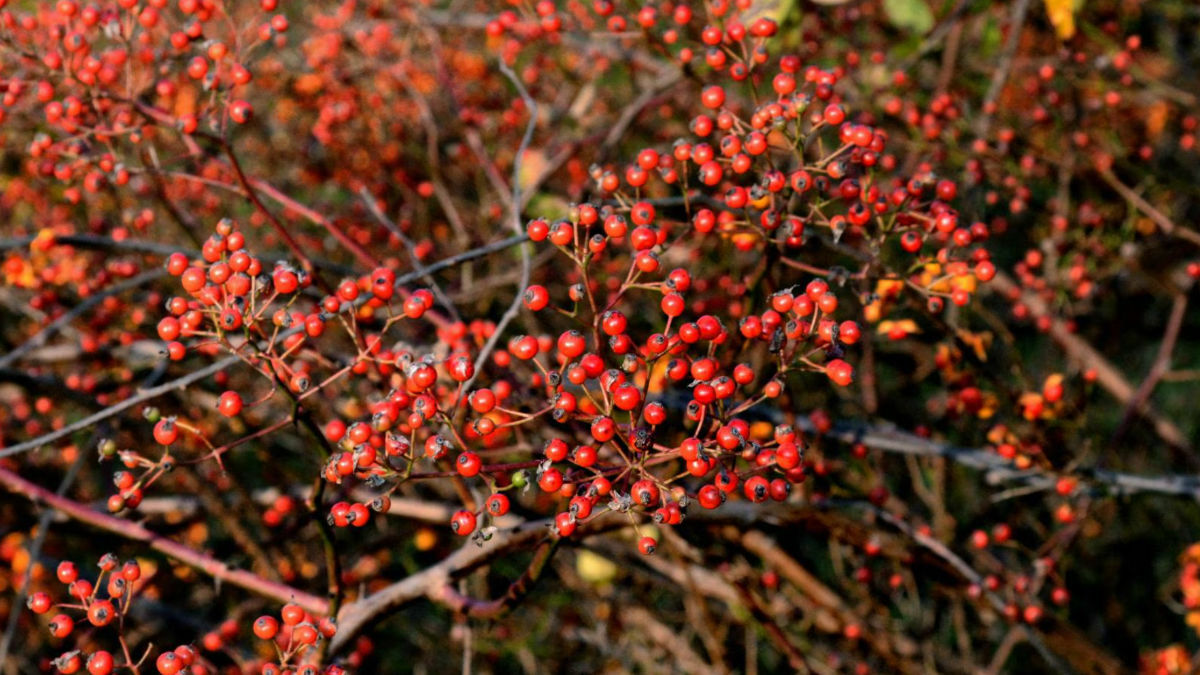
Identification: A deciduous shrub with arching and scrambling stems that may grow up to 10–15 feet tall. The stems are red to green with scattered, broad-based prickles. Each leaf has 5–11 elliptical leaflets with sharply serrated edges. After the flowers fade in late summer, rose hips (resembling leathery red berries) are left on the plant and remain throughout the winter.
Threat: Multiflora rose grows in dense thickets and quickly outcompetes other plants. It can completely dominate abandoned fields or pastures. Each plant can produce half a million seeds and these may remain viable in the soil for up to 20 years.
Tags: MassWildlife,