Hogeland Stepping Down from Williamstown Select Board
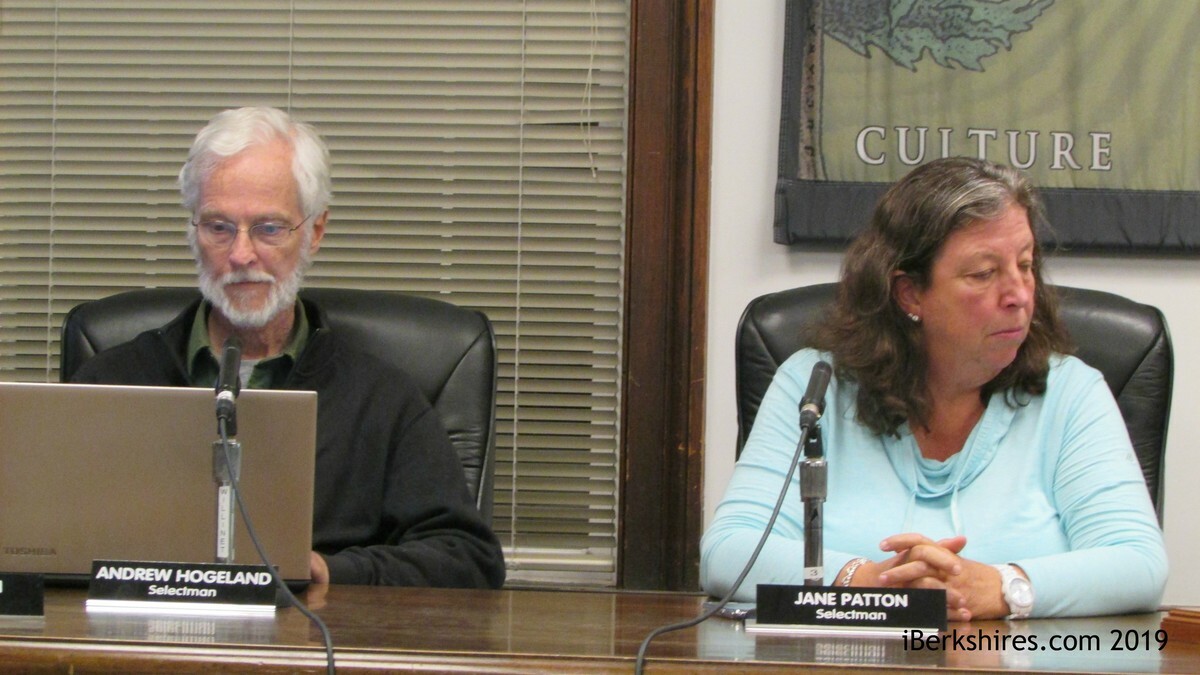
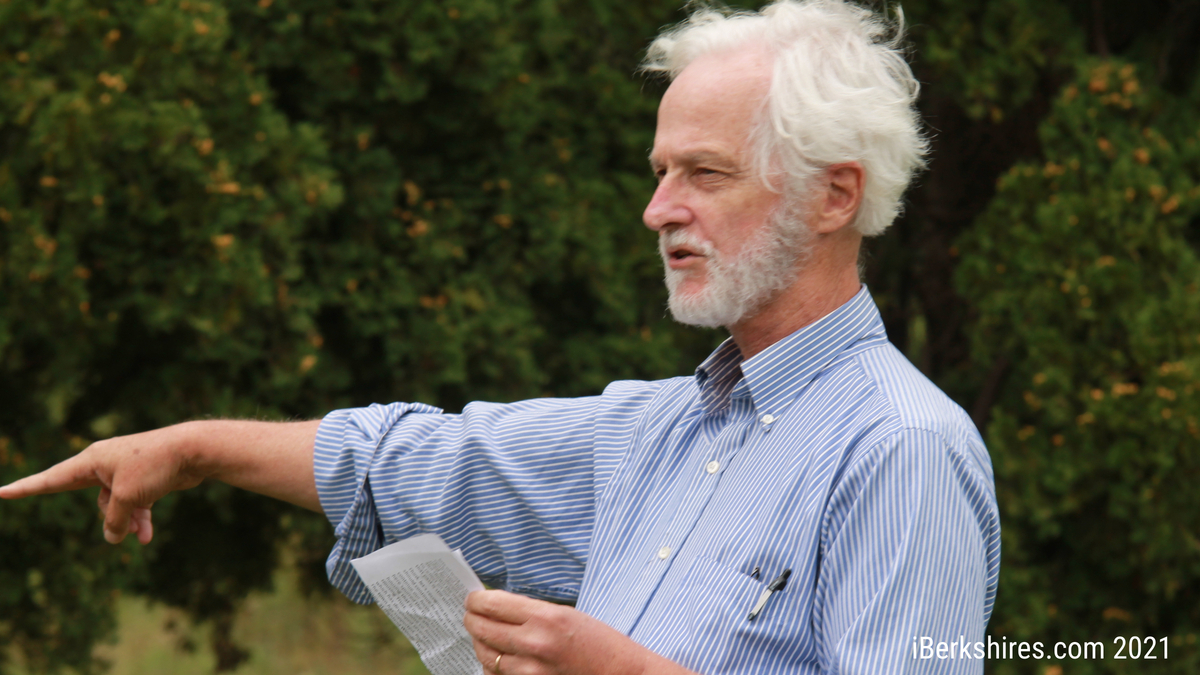
Andrew Hogeland with fellow board member Jane Patton in 2019.
It took an even greater commitment to lead him to end his time in town government.
"I think people recognize that grandchildren are very valuable things," Hogeland said Friday when asked about the reaction he's received to Thursday's announcement that he is resigning mid-term from the Select Board.
Hogeland posted Thursday on Facebook that he and his wife, Anne, are relocating to Connecticut later this year to be closer to family.
That means he will not be finishing the fourth consecutive three-year Select Board term he won in the town election in 2023.
Hogeland, who has called Williamstown home for 30 years, has served the town in various capacities for 19 of those years, including stints on the Planning Board, Conservation Commission and Finance Committee.
Although he is confident that he and Anne are making the right call, it was still a difficult decision, Hogeland said.
"My connections to Williamstown and how much town service has meant to me made it a hard thing to finally come around to deciding," he said. "There's a real sense of loss that I won't be doing it anymore."
For a decade, Hogeland has been a measured, principled, calming presence for the Select Board. His commitment to the principle that the local elected officials should not weigh in on matters they were not elected to consider has sometimes frustrated advocates for causes and even colleagues on the board.
But he points to one such instance as one of the most memorable moments on the board.
When asked to point to accomplishments he was most proud of in the last 10 years, he pivoted to two occasions that were, "not a matter of pride but a matter of learning."
One was last winter's appeals by residents both for and against the Select Board signing on to a resolution calling for a ceasefire in Gaza and a suspension of American military support to Israel.
"I think most of us were sympathetic to the need for a ceasefire," Hogeland said. "It was just very hard to listen to a lot of passionate, very emotional statements in terms of doing this and come up as best I could with a way of explaining why I don't think it's our job to do it.
"It was about making sure people knew they were heard even if we did not do the thing they wanted us to do."
In March, in front of a meeting room packed mostly with advocates for the resolution, Hogeland put it this way:
"It's a deeper philosophy about governance, about being mindful that there are limits to our duties and not letting our natural urges to be expansive in what our job is get out of hand," Hogeland said. "This table is not a pulpit. No one elected us to opine on Mideast politics, military strategy or the terms of prisoner exchanges."
It was the most recent and highly watched example of a principle that came to be associated with Hogeland: that the Select Board should "stay in its lane," when it came to matters not directly under its purview.
Hogeland's other answer to the question, "What are you most proud of?" pointed to a period when the Select Board grappled with an issue very much under its purview: supervision of the town manager, who, in turn, supervises the chief of police and operations at the Williamstown Police Department.
He called it a period that allowed him to "grow in different ways."
"It was a big lesson in learning how to listen and come up with an organized response," he said.
Both the WPD controversy — which played out in the immediate aftermath of the murder of George Floyd and a renewed national conversation on racial equity — and the Gaza ceasefire resolution debate occurred in the era of Zoom, which appeared to bring a different tenor to Town Hall discourse.
Hogeland said the advent of virtual meetings has presented a challenge and an opportunity.
"I think during the Police Department troubles, Zoom actually made communication much more difficult," he said. "It allowed people to speak to each other in ways they might not if they were in the same room.
"It's evolved to where it's just another way for people to watch what's going on, and it's convenient to people. You watch on Willinet or you watch on Zoom. And it's made being involved in government easier and a tad bit more accessible to people."
Hogeland called his involvement on the board of the town's Affordable Housing Trust one of his most rewarding experiences over the last two decades.
"Housing generally, in the last five or six years, has become more of an issue for me that we need to deal with at all levels of government," he said. "COVID brought out how so many lives are on the edge, and if you're out of work for two or three weeks things can fall apart.
"Most of the work the Trust is doing now is work that was set up before I got there, but I'm so happy to help people with their rent or with their mortgage. It's a nice intersection of being able to put together a government program that thinks through what needs to be done and having the money to do it."
The AHT — where Hogeland serves in a seat allocated to a member of the Select Board — also brings to mind one of his regrets as he sees his tenure come to an end.
"I would have enjoyed being able to get the Summer Street project all the way through permitting and transfer the property over," he said.
But that Trust initiative and several active projects before the Select Board still might benefit from Hogeland's expertise even after his departure from the board, currently planned for the end of September.
"I'm not dying yet," he said. "I'm available by phone or email. … My goal is to get things in as great an order as I can, but I'm happy to work on them even after I lose my formal title."
Hogeland has asked the Select Board to name his replacement by the end of next month, and the body has the replacement procedure on its agenda for this Monday's meeting. Per the town charter, the board can appoint someone to fill the seat through the next town election; in May, voters will decide who fills the remaining one year left on his term, which ends in May 2026.
That means at this time next year, as many as three seats on the five-person Select Board will have a new occupant.
Current Chair Jane Patton is on record saying she will not seek a fifth term in the seat she was re-elected to in 2022. Randal Fippinger, who was elected to his first term in 2022, confirmed to iBerkshires.com on Friday morning that he currently does not plan to seek a second term.
While change may be brewing at the elected level, Hogeland on Friday noted that the town benefits from continuity and professionalism in the staff that keeps the lights on at Town Hall.
"Part of the success of town government for me has been the quality of the Town Hall staff," he said. "They are a dedicated and knowledgeable group of people, and they're very service oriented. The town should be grateful that they have a Town Hall staff like that there."
Will some town in Connecticut have the benefit of a volunteer whose resume includes three decades as a practicing attorney, 19 years in town government and a stint as president of the Massachusetts Municipal Association?
Probably not any time soon.
"I'm not quite ready to make that leap yet," Hogeland said. "One of my initial thoughts was, 'I wonder how town government works in Connecticut?' But it might be better to keep to myself and do something new and different. I have no particular plans along those lines.
"I retired from my paying job 10 years ago without a clear plan of what to do. I'm in the same situation now, and it worked out fine last time."