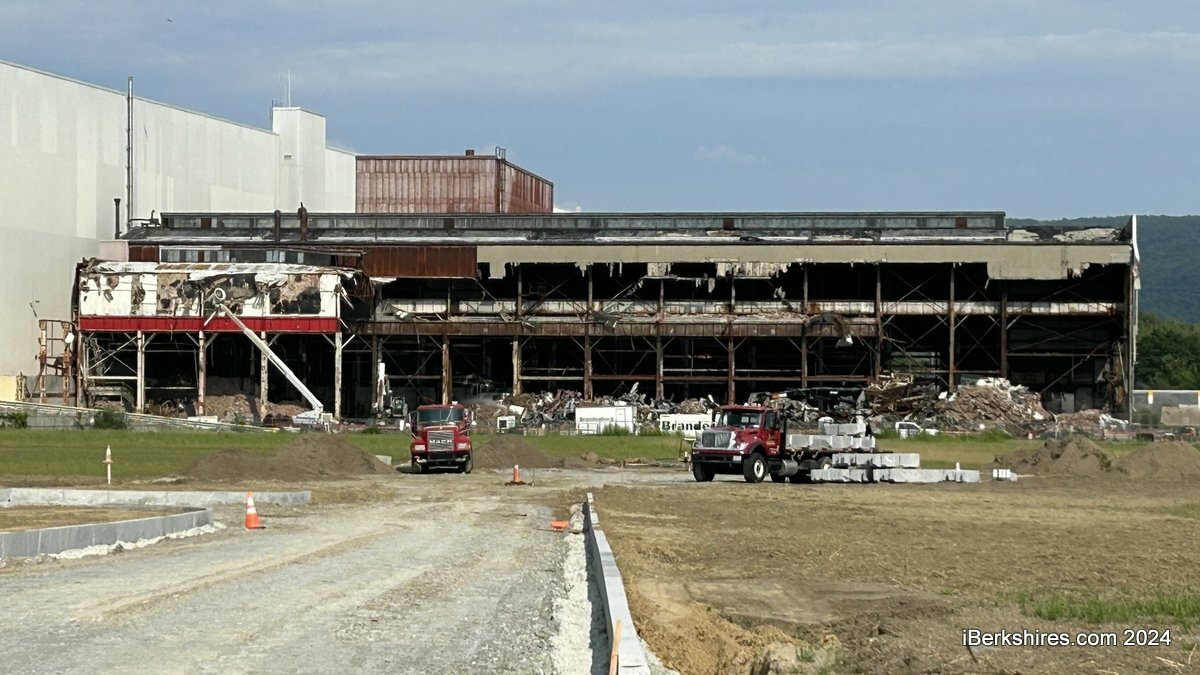
image description
Demolition of GE's Building 12 was halted last month after a single air sample found PCBs exceeding the 'action level.'

PCBs Detection Pauses GE Demolition
By Brittany PolitoiBerkshires Staff
Print Story | Email Story

GE says a stockpile of debris was within 50 feet of the air monitor, which is located along the boundary line with PEDA's property.

PITTSFIELD, Mass. — Elevated levels of PCBs in a single air sample have halted demolition work on the former General Electric site.

Authorities say the measurements are "conservative" and not a threat to public health.

The sample was taken between July 11 and July 12 and was received by the Pittsfield Economic Development Authority from an off-site laboratory on July 25. It was quickly forwarded to the U.S. Environmental Protection Agency on the same day and work stopped.

"The exceedance does not constitute a health threat to the public," a regional representative from the EPA wrote to iBerkshires in an email. "These action levels are very conservative and furthermore this monitor was not located adjacent to public areas."

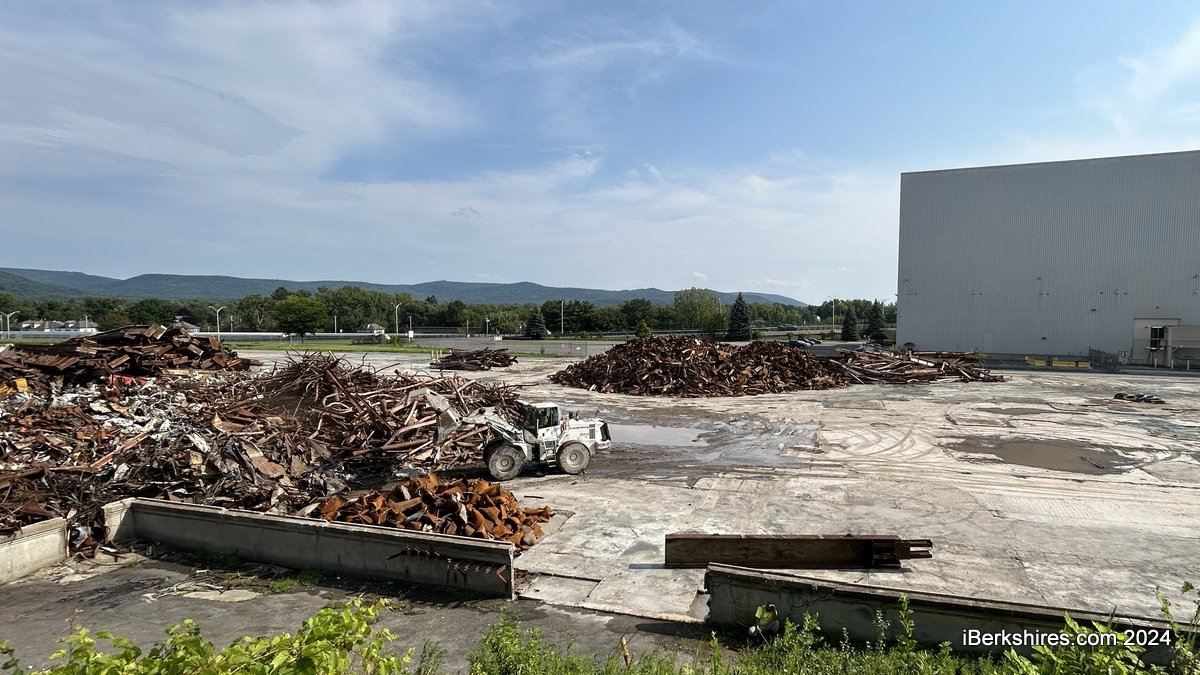
The higher levels of polychlorinated biphenyls in the sample is attributed to stockpiles of demolition debris from former GE buildings that were within 50 feet of the air sampling monitor, abutting the PEDA property. The EPA will evaluate PCB air data from sampling conducted the week of July 29 and decide if GE can resume operations, though PEDA has been given the OK to continue with backfill work on its property.

PEDA notified EPA and the Massachusetts Department of Environmental Protection of the detection found in a sampling round conducted over 24 hours from July 11 to 12. The economic development authority received information late on July 25 from the off-site commercial laboratory and it was reportedly forwarded out on the same day.

"This 13-day turnaround time for receipt of air data from an off-site laboratory is a typical duration for this type of sampling event," the EPA representative said.

"GE will implement additional actions and engineering controls as part of their building demolition activities. EPA and Mass DEP will continue to provide close oversight of the ongoing activities being conducted by PEDA and GE."

PEDA is currently working on a nearly $10 million redevelopment of Site 9 on the former GE property.  This included removing the existing concrete surface and placing a clean backfill on the property.


The monitor with the exceedance is located along the PEDA-GE property line. GE's activity on the adjacent parcel consists of the demolition of the Building 12 complex, which are buildings where GE manufactured and tested transformers that used PCBs as dielectric fluids.

"The concentration detected at S9-2 was 0.2324 µ/m3 [micrograms per cubic meter] and the Action Level is 0.10 µ/m3. EPA determined that the source of airborne PCBs is from GE's Building demolition activities, not PEDA's backfilling activities," the EPA reported.

Both parties stopped work to reassess the situation, the EPA reportedly discussing it with the city on July 26. This was not considered an emergency or health threat to the public because the monitor is "well away" from private property and that monitors close to the Tyler Street extension were below health-based action and notification levels.

MassDEP reviewed the information provided by PEDA and concurred with EPA that the strong likelihood is that the source of PCBs was not PEDA's activities, rather the source of airborne PCBs emanated from GE property associated with the building demolition activities, the EPA reported.

PEDA was permitted to resume backfill operations on July 29 and GE remains under a stop-work status.

On July 26, GE provided a summary of its evaluation and stated that one of the stockpiles of demolition debris was within 50 feet of the air sampling location that had the exceedance, according to the EPA.

Even though it was not GE's monitors with the exceedance, it was directed to temporarily stop work and assess the situation. On top of daily dust monitoring, GE's proposed response actions are:

  • Perform air sampling at six locations.
     
  • Add a new sample location on the PEDA property near the location with the exceedance but farther to the south and west to account for the potential irregular wind patterns and impacts from the elevated vehicle ramp and retaining wall.
     
  • Resume demolition work upon receipt of results from this sampling round indicating that all sampling locations are less than the air action level.
     
  • Conduct weekly PCB air sampling at these six locations for at least four weeks or until GE has achieved four consecutive weeks of results less than the Action Level, at which time GE can propose moving to monthly sampling, subject to EPA approval.
     
  • Once work has resumed, GE will employ additional engineering controls such as reducing the size of onsite stockpiles and keeping stockpiles further away from the property line.

The EPA approved this response and stipulated that work can continue if a sample result is above the air PCB Notification Level but below the Action Level. However, GE should evaluate conditions, consider additional engineering controls, and discuss its findings and potential additional actions with EPA. The agency also said that if any additional sample results are above the air Action Level, GE will immediately stop work and notify EPA of the results.


Tags: contamination,   demolition,   General Electric,   PCBs,   PEDA,   

If you would like to contribute information on this article, contact us at info@iberkshires.com.

BRTA Focuses on a New Run Schedule

By Breanna SteeleiBerkshires Staff

PITTSFIELD, Mass. — The Berkshire Regional Transit Authority is still working on maintaining its run schedules after dropping the route realignment proposal.

Last Thursday's meeting was Administrator Kathleen Lambert's first official meeting taking over the reins; retiring director Robert Malnati stayed during a transition period that ended last month.

Lambert is trying to create a schedule that will lessen cancellations. There was a two-hour meeting the week before with the drivers union to negotiate run bids and Lambert is working with the new operating company Keolis, which is taking over from Transdev.

The board spoke about anonymous emails from drivers, which Lambert said she has not seen. iBerkshires was not able to see those letters, but has received some. 

"They were lengthy emails from someone describing themselves as concerning BRTA employee, and there was a signed letter from a whole group of employees basically stating their concerns. So, you know, to me, it was a set of whistleblowers, and that, what my understanding is that this really triggers a need for some type of process to review the merits of these whistleblowers, not going to call them accusations, but basically expressions of concern," said member Stephen Bannon.

A letter iBerkshires received spoke of unhappy drivers who were considering quitting because of decisions being made without "input from frontline staff," frustration and falling morale, and the removal of the former general manager shortly after Lambert came in.

Lambert said it's difficult to navigate a new change. She also noted many drivers don't want to do Saturday runs and it has been hard negotiating with drivers on the new runs.

"I would like you all to keep in mind that the process of change is super difficult. Transdev has been here for 20 years, and some of these drivers have never known any other operating company, the way some of the operations have been handled has been archaic," she said. "So getting folks up to speed on how a modern transit system works is going to be painful for them. So I don't want to say that I'm unsympathetic, because I am sympathetic, but I am trying to coax people along with a system that's going to seem very strange to them."

The board spoke about better communication between them and Lambert, citing cooperation will be best moving forward.

"There's just a lot of stuff in the air right now, and there are a lot of fires to put out to make this a coordinated effort. And if we don't keep our communications open and be straightforward, then you get blindsided about how you know the input that you could get from us about your position, and how you know what's going on in your direction, and we get blindsided. And I think that we have to make sure that this is a collaboration," said member Sherry Youngkin.

"Both sides have responsibilities, because in the long run, this advisory board is going to have to make decisions as to how we brought forward and if we've gone forward in a fair and helpful way. And I think that's hopefully what everybody is looking for also." 

Transdev and Keolis held a three-day recruiting event interviewing almost 40 candidates and offering jobs to eight, but only three stayed on to start training. Lambert said it was disappointing but she will keep trying to retain more people.

In her first report to the board, she noted that ridership dipped a little over 10 percent, but still remains higher than last year, adding that was because of cancellations of services because of the lack of drivers.

Like the last meeting, some of the advisory board members were torn over the start of the Link413 service, worried that the start of the service took drivers away and the numbers of riders are low.

Lambert, however, said the ridership has doubled from last month.

"As I've spoken before, we have, generally, a six-month adoption for brand-new service before you can really go in and evaluate, are you being successful based on the grant that my predecessor wrote along with the team for PBTA and RTA, we are ahead of schedule, which is pretty good, so I'm hoping that will continue to improve," she said.

Member Renee Wood said the board never approved the service, adding the only thing she could find in the minutes was a vote to accept the equipment. She said it was supposed to be put on the agenda to discuss.

"The Link413 service has been three years in the making. It's been a grant that was accepted and has been working with our partners, PVTA and FRTA, to put into place. So I don't have the entire history of how that process worked, but it's been three years in the making, and did we not understand that once we accept that grant that we were going to put in new service?" Lambert said.

The board discussed if Title VI, the Civil Rights Act, was followed with an accurate review and accurate amount of time for public comment period on the service changes and if its attorney should review if the  grant conditions were properly followed.

Lambert said changes had the 60-day comment period included in the proposed route realignment packet, giving the opportunity for the community to respond to that as well but will look into the legality of the situation with their attorney.

View Full Story

More Pittsfield Stories