Hoosac Valley Teacher Nominated for Outstanding Educator Award
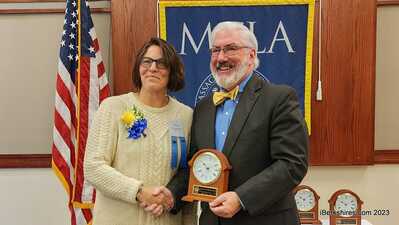 |
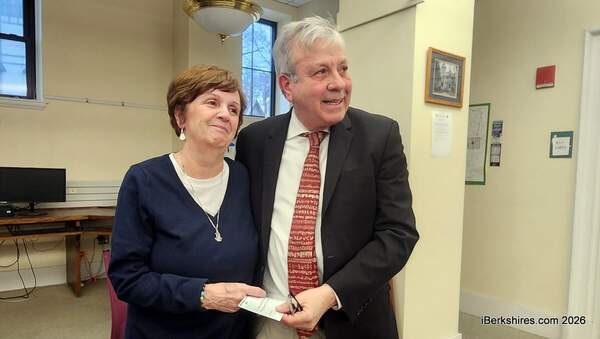
| Lindsay St. Pierre McGinnis is presented the Outstanding Educator Award in 2023 by MCLA President Jamie Birge. |
NORTH ADAMS, Mass. — MCLA alumna Lindsay St. Pierre-McGinnis has been nominated for the 2024 Outstanding Educator Award by the Massachusetts State University System to be presented at the State House on April 25.
St. Pierre-McGinnis joins eight other educators who will be recognized for their teaching excellence, especially in the face of challenging situations, as well as their contributions to the communities in which they live and work.
St. Pierre-McGinnis received her master of education in 2008 from Massachusetts College of Liberal Arts and earned a second master's degree in conservation biology from Antioch University. St. Pierre-McGinnis began her career as a conservation biologist and found her passion for teaching after becoming a middle school science/math educator at Gabriel Abbott Memorial School in the town of Florida.
During her time at Abbott, she designed an environmental/outdoor curriculum which included an outdoor classroom with raised garden beds and spearheaded the school's first soccer program.
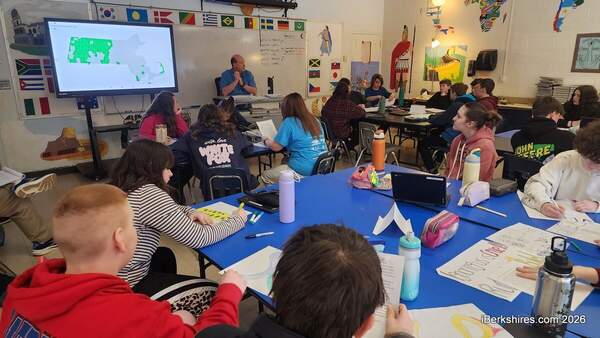
Currently, she shares her expertise and environmental activism with her students at Hoosac Valley Middle/High School in Cheshire. She has helped lead the establishment of a state Department of Elementary and Secondary Education Innovation Pathway designation in environmental studies, designing curriculum in outdoor leadership, conservation stewardship, food science, and outdoor adventure. She continues to work with MCLA, partnering with the Environmental Studies Department to offer her students college credit for her environmental sustainability course. She has teamed up with colleagues and was awarded a $25,000 grant from the Henry P. Kendall Foundation to establish a sustainable garden program for the high school. She received the MCLA Educator Alumni Award last year.
In 1839, Massachusetts became the first state to recognize the importance of teacher-preparation programs with the establishment of normal schools that were free of charge to students who committed to teaching in the commonwealth's schools. These institutions that were designed specifically to educate school teachers have grown to become comprehensive state universities. Today, nine-member institutions educate students in multiple disciplines beyond education from business, humanities, and social sciences, to natural, formal, and applied sciences. Even with this expanded mission, the State Universities continue to educate over one-third of public school teachers in Massachusetts.
Tags: MCLA, people in the news,