Clarksburg Meeting OKs All Articles on Warrant
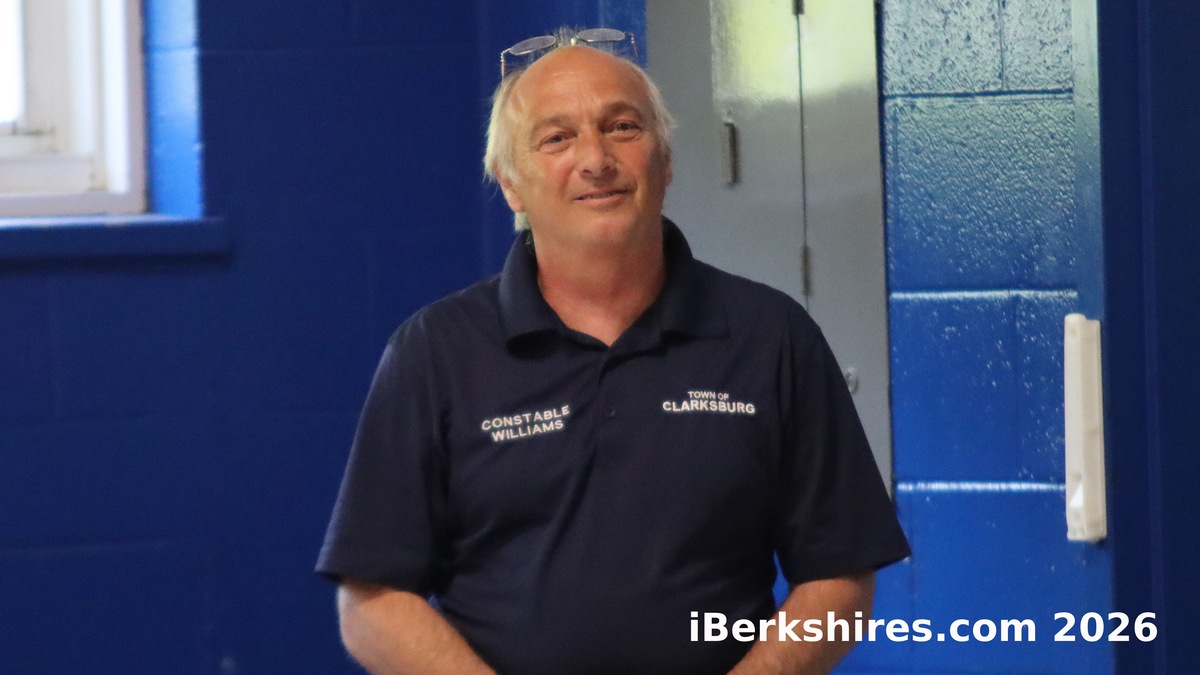
Police Chief Michael Williams was recognized at the annual town meeting. The chief has shifted into a part-time administrative role since the Police Department was shuttered last year.
But one item caught the eye of meeting members.
"Is this an increase from last year, and is there any way to compare it?" a resident asked when the meeting turned to the appropriation for the town's Sewer Enterprise Fund.
Yes, Moderator and Select Board member Seth Alexander informed the meeting, the requested appropriation for FY27 represents a 6.9 percent hike from the current year.
Higher costs are on the horizon, though.
"All the compost over [at the Hoosac Water Quality District], which they used to be able to sell, they're not going to be able to anymore," Boucher said. "They're looking at next year almost a 17 percent increase."
Clarksburg is the smallest member of the three-municipality solid waste district. The declining market for compost made from human waste because of per- and polyfluoroalkyl substances (PFAS) contamination has been a big topic in Williamstown, site of the HWQD treatment plant, for a couple of years.
The sewage conversation in Clarksburg branched off in a couple of different directions.
Fire Chief Carlyle "Chip" Chesbro asked why the Fire Department's bill was larger than the figure he was quoted when he checked with the water and sewer department in North Adams. Boucher explained that part of the fee goes toward maintenance and operation of the Clarksburg system, which flows into North Adams on its way west to the HWQD plant.
Joe Bushika pressed Boucher on the issue of delinquent ratepayers and whether their unpaid bills were being shifted to residents who do pay.
"No," Boucher replied. "We get the money one way or another. You're not paying more."
After all the questions were fielded, the FY27 water and sewer rate was approved on a unanimous vote, as were all 19 other articles on the warrant.
Thirty-four registered voters checked in to the meeting out 1,124 on the voting rolls, an attendance rate of just more than 3 percent.
The meeting began with a recognition of longtime Police Chief Michael Williams, who began serving the town in 1985 as a part-time officer.
Alexander read the dedication to Williams on the first page of the town report.
"During his tenure, Chief Williams witnessed and adapted to significant changes in both policing and the community," the dedication read, in part. "From the early days of limited resources and a focus on traffic enforcement, to navigating more complex public safety challenges such as domestic incidents and substance abuse, his leadership remained steady and committed."
After giving Williams a standing ovation, the meeting members got down to the business of gathering, which saw three articles amended from the floor.
The first was Article 9, the $5.6 million operational budget for Town Hall.
Department of Public Works Superintendent Kyle Hurlbut proposed to amend his department's budget upward by $10,050, to $549,354 because of increased fuel costs expected in the coming year.
Later, Hurlbut rose to seek an amendment to Article 14, which sought to use $163,569.40 from free cash to acquire a 2026 Ford Super Duty F-600 truck for, "snow removal, roads, lawn, cemetery, anything we do." Hurlbut asked the meeting to change the figure to $166,459, a $2,890 increase, to accommodate the purchase of a 2027 model.
The next-to-last article on the warrant, a non-fiscal measure, saw the night's final amendment.
The article sought an amendment to the town code on kennel licenses by adding language that would allow someone other than the town's animal control officer to do inspections.
Karen Chesbro, owner of Havenwood Kennel, told the meeting she sought the amendment because, in the past, the town's animal control officer position was vacant, making it difficult to get her license renewed. She explained that more expansive language allowing another official to do the inspection aligns with Ollie's Law, the commonwealth's 2024 Act to Increase Kennel Safety.
At the suggestion of Williams and Dan Tanner from the floor, the article amending the bylaw was changed to read, "another qualified official designated by the town administrator," and passed without dissent.
Wednesday's meeting concluded with a brief presentation about the town's Municipal Vulnerability Preparedness Committee, which is finalizing designs for an improved town field, accessibility changes to the community center and safer access to the elementary school with hopes of pursuing grants once the designs are finalized.
Residents were invited to learn more about the initiative at its website and share their feedback either before or at a community dinner planned for Thursday, June 25.
Tags: clarksburg_budget, town meeting 2026,