Williamstown Town Meeting Debates, Passes by Large Margins, CPA Grants
WILLIAMSTOWN, Mass. — As it has done nearly every time since the town adopted the provisions of the Community Preservation Act, town meeting Tuesday voted overwhelmingly to respect the decisions of its Community Preservation Committee and award the CPA grants recommended by that body.
Among the last actions of the nearly three-hour meeting were the approval of two heavily-discussed CPA grants, one of which generated a negative advisory vote from the town's Finance Committee.
That grant went to the Sand Springs Pool and Recreation Center, a $20,000 allotment of CPA funds to renovate and expand facilities at the facility.
The Fin Comm voted, 3-5, not to recommend town meeting OK the expenditure, and several residents took the floor at Tuesday night's meeting to argue against approving a grant that the center plans to use to improve its sauna.
"Why would we do such a thing?" asked Donald Dubendorf. "I understand we have 'recreational purposes' under the act, but why would we do such a thing when we are in dire straits in other areas, like housing?"
The executive director Sand Springs took the microphone to explain that an infrastructure investment in the sauna is part of a strategy to make the facility a year-round town asset and improve the non-profit's revenue stream.
Enhanced revenues, in turn, allow Sand Springs to keep its entry fees lower and provide scholarships to families of limited means, Henry Smith said, including in the summer months, when it is "the only public, guarded waterfront in town."
Bjorn Adkins told the meeting that while he initially was skeptical of giving town money to Sand Springs and would still prefer that the town build its own recreational facilities, he is an advocate for the facility and, specifically, its sauna.
"Through the sauna, I've gotten to know many of the people in this room," Adkins said. "And I've gotten to know people I would not encounter on a daily basis.
"As a transgender person, there are very few spaces where I personally feel comfortable that are like a sauna, where I'm in my bathing suit. The Sand Springs pool has been welcoming to me and other transgender people. As a low-income person in the community, I've received some of the help Henry mentioned."
A former member of the Community Preservation Committee, Kenneth Kuttner, spoke in opposition to the grant, criticizing his former colleagues for not following a procedure that he helped develop to evaluate grant applications.
"Under the scores assigned in our scheme … Sand Springs' application was dead last in the merit ranking and, in the need assessment, it was second to last," Kuttner said, referring to a survey of committee members that he helped develop to help inform the body's deliberations at the outset of each funding cycle.
What went unsaid is that the survey process Kuttner and others developed measures the relative merit and relative need of each application versus other applicants in a given year. It does not measure committee members' sense of the absolute merit or absolute need for any one proposal.
Frederick Puddester, the chair of the Finance Committee, echoed Dubendorf in questioning why the town would fund improvements at Sand Springs in a time when taxes already are on the rise.
"With the average tax bill in Williamstown now $7,700, forcing low-income people to move from here, I don't think we should use town money to reduce the fees people are charged at a sauna," Puddester said.
In 2024, town meeting approved a 100 percent exemption from the Community Preservation Act surcharge for homeowners who make less than 80 percent of the area median income or seniors who make less than 100 percent of the AMI.
And the CPA surcharge itself includes an exemption for the first $100,000 of a home's value. In other words, if a home is assessed at $400,000, its CPA surcharge (2 percent of the property tax bill) is calculated as if it were a home valued at $300,000.
Shelley Salamensky was one of several residents who followed Adkins to argue in favor of passing the article.
"I'd like to speak on behalf of older people, people with minor disabilities," Salamensky said. "There's no other place in town where an older person can swim outdoors. The Williams [College] pool is hardly cheap when you're not connected to Williams.
"Take a tour of Sand Springs. If you think it's a country club, as some people have said, you've never been to a country club."
The Sand Springs article, Article 27 in a 32-article warrant, passed by a margin of 190-48.
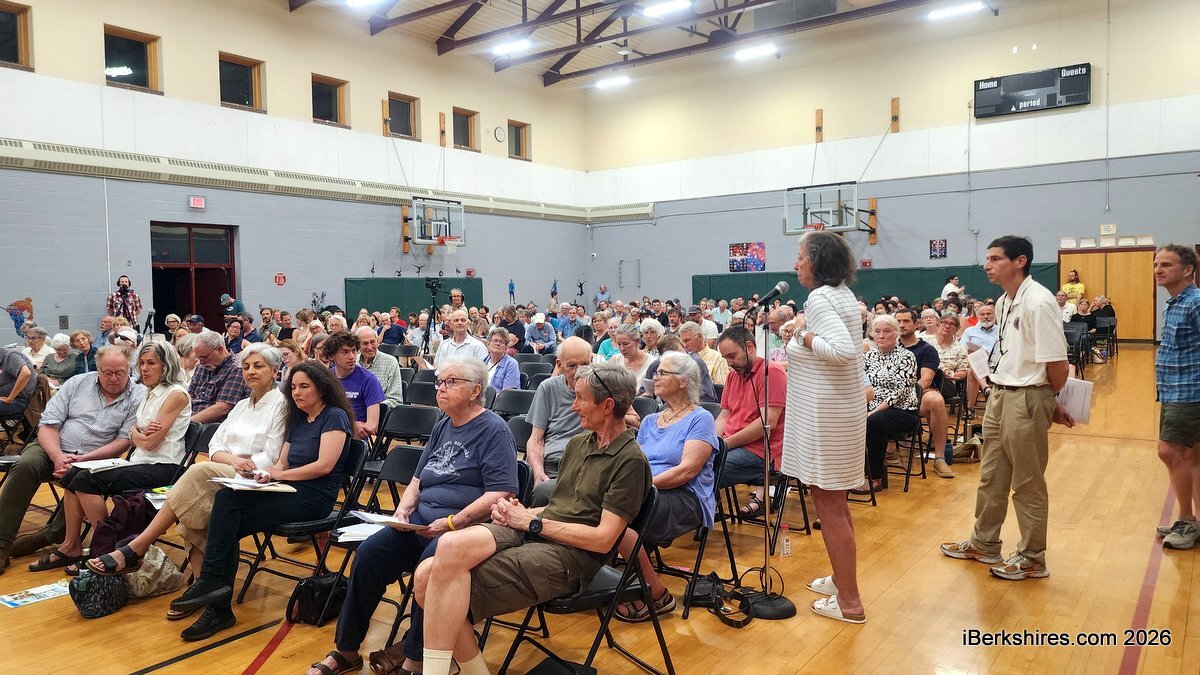
Most of the CPA-related articles passed by overwhelming voice votes at the meeting in Williamstown Elementary School's gymnasium.
The other one to go to a secret ballot "clicker" vote was Article 29, by far the largest CPA allocation of the night, a measure to grant $350,000 to Purple Valley Trails and the Town of Williamstown to build a state-of-the-art skatepark on a town-owned parcel on Stetson Road across from the town's youth baseball field.
One resident questioned why the town should spend so much more money on a facility, like a skate park, that is of no use to, "an octogenarian" like me, unlike Sand Springs, which is usable by residents of all ages. Others questioned why so much town money was sought for a project that was supposed to be financed through fund-raising.
"This comes in a year when … the Community Preservation Committee had to reduce the amount requested for many projects," one resident said. "They reduced the allocation requested for the Affordable Housing Trust, and yet we're allocating a third of a million dollars for a skate park that we allocated money to last year."
The initial request from Purple Valley trails was for $366,911, so the $350,000 recommendation from the CPC did represent a modest, 5 percent reduction employed, in part, to make the numbers work within the total CPA funds available.
And while the project did also receive a $32,000 CPA grant from the May 2025 annual town meeting, planning and building the park has been a multi-year process, PVT President Bill MacEwen told the meeting.
The total cost of the project is $750,000, making the CPA contribution over two years about 50 percent for a facility that will be owned by the town. MacEwen has said that about $100,000 of the money raised through fund-raising was contingent on a successful vote on Tuesday night.
Adkins returned to the microphone to advocate for the park, which will replace an out-of-date, dilapidated park that the town removed last year.
"The coolest thing about new skate parks is they're not just for what you envision as a skate boarder," Adkins said. "The old skate park we had with the ramps that were dangerous, those were for just your traditional skate boards. A new skate parks, which is what we're talking about, are for roller blades, electric skate board things, bicycles, all these other wheeled things. It's a lot less niche than it seems."
The Purple Valley Trails article passed, 164-51. MacEwen has said that with a successful town meeting vote, his non-profit was ready to break ground on the poured concrete skate park this summer.
Tags: annual town meeting, CPA, Sand Springs, skate park,