Clark Art Institute Announces 'American Revolutionaries' Gallery Tour Series
Print Story | Email Story

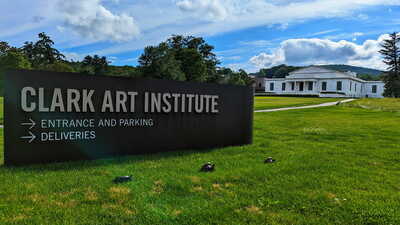
WILLIAMSTOWN, Mass. — The Clark Art Institute has announced a series of gallery talks for April to mark the 250th anniversary of the United States. The "American Revolutionaries" tours will feature artworks from the Burrows Gallery of American Decorative Arts, including silver from the Henry Morris and Elizabeth H. Burrows collection.

All talks begin at 12 p.m. in the Manton Research Center reading room.

The series opens on April 1 with a presentation by Alexis Goodin, curator of decorative arts. Goodin will discuss silver crafted by Paul Revere Jr. and his father, highlighting Revere's dual role as a silversmith and a figure in the American Revolution.

On April 8, curatorial intern Oliver Hess will lead a session titled "George Washington, American Icon." Hess, a graduate student in the Williams College/Clark Graduate Program in the History of Art, will examine the public's historical fascination with Washington's likeness. The talk will cover formal portraits, print culture, and funerary porcelain created following Washington's death.

The series concludes on April 15 with a discussion on the social and political significance of tea in colonial America. Goodin will return to lead the session, focusing on silver and furniture associated with the era and the role of women in organizing tea boycotts following the Tea Act of 1773.

The "American Revolutionaries" tours are free with gallery admission, and no registration is required.
If you would like to contribute information on this article, contact us at info@iberkshires.com.

Discrimination Against Muslim Americans Persists 25 Years After 9/11

By Stephen DravisiBerkshires Staff
WILLIAMSTOWN, Mass. — Dozens of Muslim Americans were among people killed in the Sept. 11 terrorist attacks.
 
Untold numbers of Muslim Americans have suffered countless acts of discrimination in their aftermath.
 
"Of course, you'll find several accounts of Muslims from all over the U.S. describing how they went from the unknown kids in the school to being stereotyped or ridiculed for their Muslim names," Sidra Mahmood recalled recently. "However, many Americans forget that the victims of 9/11 were also Muslim Americans.
 
"I can't forget the time when a classmate broke down in sobs when 9/11 came up in our classroom at the Islamic seminary I went to in Texas, because her father's best friend who was like an uncle to her, died on 9/11."
 
Today, Mahmood is a chaplain at Williams College. In 2001, she was growing up in Karachi, Pakistan, when terrorists forced two passenger jets into the Twin Towers in lower Manhattan and another plane into the Pentagon outside Washington, D.C. A third plane, which terrorists hoped to crash into a D.C. landmark, was brought down in western Pennsylvania after passengers and crew fought back against the hijackers.
 
The attacks, which ultimately claimed 2,976 lives, horrified people around the world, including in Mahmood's native land.
 
"I remember being aghast like anyone who witnessed the fall of the Twin Towers in real time," she said. "However, even as a child, fear gripped me about the possibility of war, especially once we learned that Afghanistan, right adjacent to Pakistan, would be attacked by the U.S. My mother had told me about the 1971 war between India and Pakistan when she remembered hiding in the dark after bomb sirens would go off in Punjab after intentional blackouts.
 
View Full Story

More Williamstown Stories