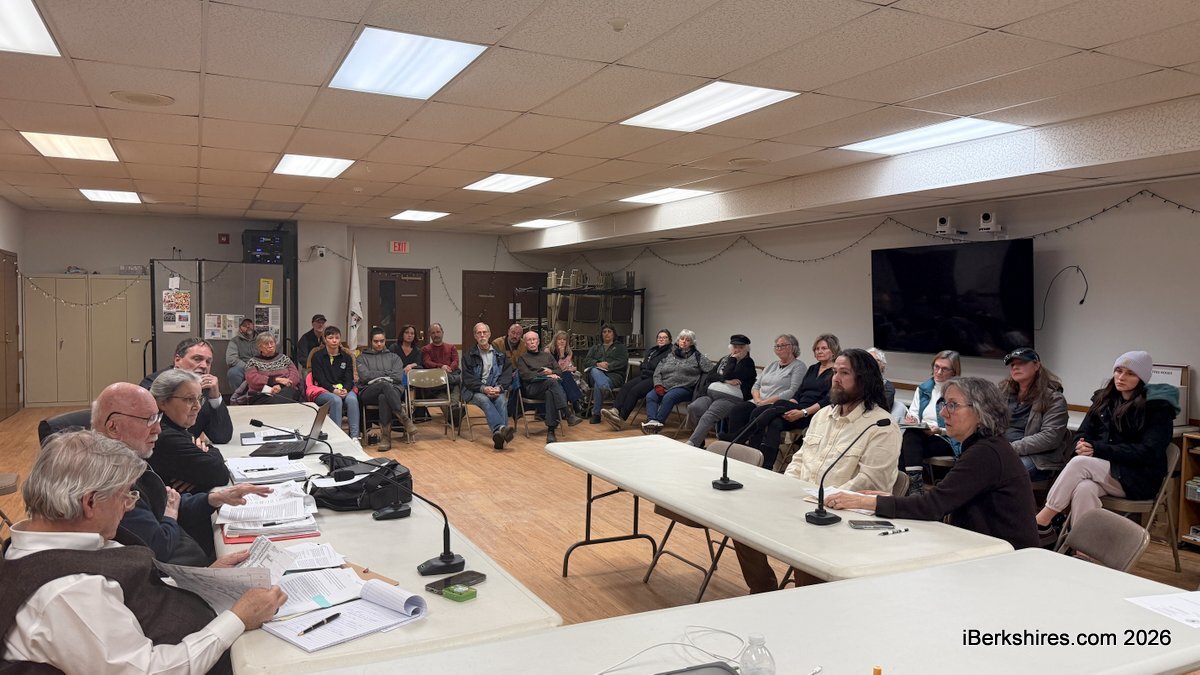
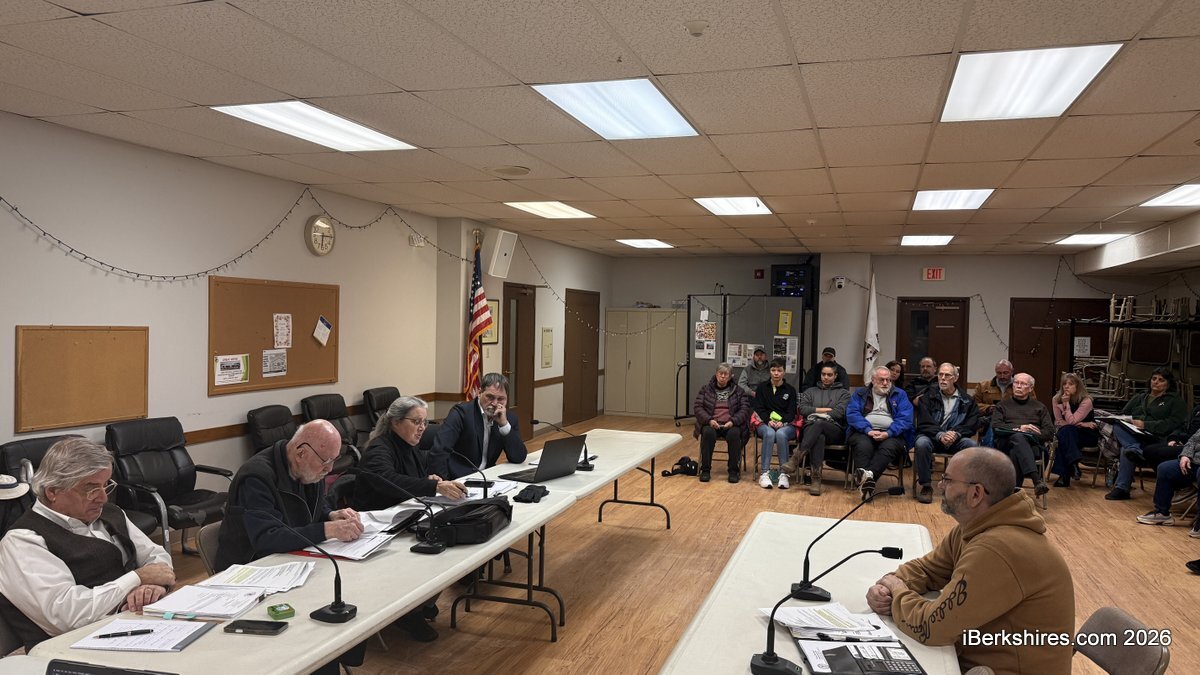
Lanesborough ZBA Asserts STRs Not Yet Permitted
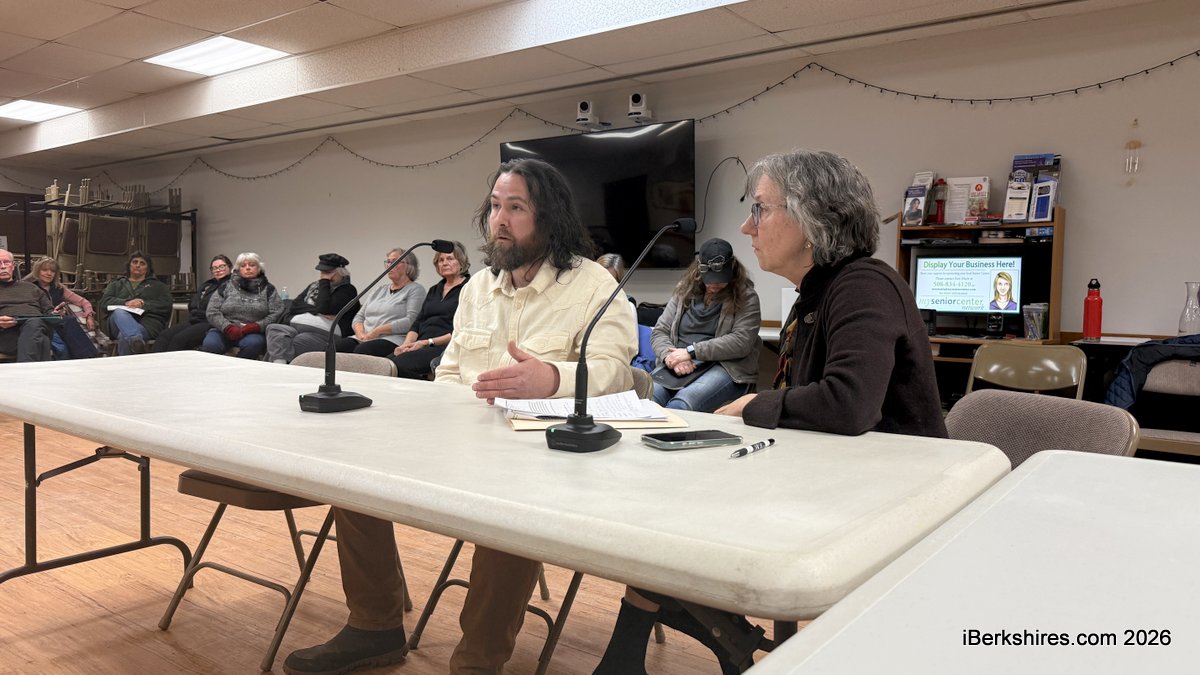
Second Drop Farm owner Patrick Elliot, with attorney Elisabeth Goodman, states his case for short-term rentals at the farm.
The board voted to uphold the cease-and-desist order issued to Second Drop Farm regarding short-term rentals, citing the building inspector's determination that, because of the absence of town bylaw regulations, short-term rentals are not permitted.
The audience erupted in indignation with one attendee saying "You are going to create war in this town."
The decision split the board, with Chair Mark Siegars and Ronald Tinkham voting to uphold the order; and Scott Graves voting to dismiss it.
Alternate board member Leanne Yinger made a motion to dismiss the order, citing concerns that it was not properly issued and arguing that, in the absence of a bylaw, short-term rentals are not restricted.
"The outpouring of distress that this has created in our community is not sustainable … the bylaw doesn't exist. So until the bylaw exists, it's an absence of a bylaw," Yinger said.
The motion was shut down by Siegars, who reminded Yinger that, as an alternate member, she does not have voting authority. The board consists of three voting members and one alternate, who serves in the event of an absence.
During the meeting, Yinger and others pointed out that there are at least 50 other short-term rentals operating in town, noting that enforcement of the order would raise questions about how the town would address those properties.
"I think the circumstances of this cease and desist are so onerous and selective and improperly procedurally granted," said Elisabeth Goodman, of Donovan O'Connor & Dodig, serving as the attorney for Second Drop Farm owner Patrick Elliott.
"There's, like I said, five or six reasons that I believe if we had to go to court, we would win."
Goodman was eager to speak, providing several reasons why the farm's short-term rentals are permitted. These included:
- The notice for the cease and desist was incorrectly served
- The short-term rentals are incidental to the farming operations and therefore permitted by state law
- The town's zoning bylaws are vague regarding short-term rentals, but the town does collect taxes and fees on them, suggesting they are allowed in business districts.
- The town's bylaws allow rentals in residential and business zones for no more than four persons per dwelling.
A major concern from the board surrounded building code compliance to ensure safety. Goodman argued that is a separate issue not before the board.
The meeting lasted two hours, with more than a few community members speaking in support of Second Drop Farm. About 30 people attended, all seemingly in support of the farm based on their reactions to the arguments.
This included Rebecca Belmont, whose uncle owned Second Drop Farm, historically known as Bradley Farm. For more than 270 years, the farm has been a place of agriculture, commerce and connection, which she said has returned under the new ownership.
Modern farming requires creativity to survive, such as operating farm stores and engaging in agritourism. Farm stays fall under agritourism, which is protected by state law, she argued.
"My concern is simple: if this family cannot generate enough income to sustain this farm, we're going to lose another one. And once the farmland is gone, you know it's gone. Everyone here knows that we're not going to get it back …
"I respectfully ask the board to view this with that in mind, and that's why I've been so passionate tonight, you're going to lose my uncle's farm," Belmont said, as her voice broke.
The board's decision could help lift this family and community, she said, adding how she was looking forward to moving back to Lanesborough and witnessing this situation is breaking her heart.
"I've been here a year, and my heart is getting torn out about the way these people are being treated in my own hometown. But don't make their path harder, lift them up. Have discretion. Let's save this farm," she said.
Siegars asserted that his perspective is that short-term rentals are not a listed use. Goodman corrected him, demonstrating that renting is permitted under residential and commercial zones.
"Not without a permit," Siegars said, reminding her that public comment was closed.
The building inspector is required to enforce the zoning bylaw and does not have discretion to do otherwise, despite pleas from residents, as failure to do so could get both the inspector and the town into trouble, he said.
"We can't grant the use variance, and if we don't enforce the zoning ordinance in this instance, then we are going to create a whole series of claims of selected prosecution, because we are now going to be trying to enforce the zoning ordinance against somebody else," he said, attendees responded that the board was being selective because it was not addressing other short-term rentals.
Although the members disagreed on whether to uphold the cease-and-desist order, the board did agree that the zoning bylaws are a mess and need updating.
"I've looked at all the different definitions, and all I can tell you is like scrambled eggs, but that doesn't mean that we don't enforce what is clear, which is that short-term rentals are not a listed use in the table of uses," Siegars said.
At several points during the meeting Tinkham expressed his concern with the terminology of the bylaws and said he believed that the farm can continue operating its rentals if it were permitted as a bed-and-breakfast.
Once the bylaws are updated to allow short-term rentals, then they can reclassify its permit.
The Planning Board is in the process of developing a bylaw and this "just got ahead of us," Yinger said, who also serves on the Planning Board.
Resident Barb Hassan said short-term rental owners didn't attend the Planning Board meeting to provide input on the bylaw's development, because they fear that they, too, will be shut-down.
"I think the input from the owners is going to be vastly important," she said, while advocating for the town to explore whether a "moratorium" can be placed until it is all sorted out.
Building Commissioner Brian Duval said he had issued another cease-and-desist, and had two more sitting on his desk, which he was waiting for the pending outcome of the hearing to send, taking it on a case-by-case basis.
During the meeting, a short-term rental owner stood up to speak, demonstrating that if the rentals are illegal then she has been paying the tax illegally, too, so should be issued refunds with that logic.
She questioned whether she will get a cease-and-desist, to which Duval responded, "Time will tell."
He also said he heard from the town administrator that, according to the town counsel, the approval of the taxation bylaw before the regulations was a misstep but it is not improper for the town to still get the taxes.
Following the meeting, Select Board Chair Deborah Maynard confirmed she will be getting in touch with the town counsel about the situation.
Since the meeting, several community members have taken to the internet to express their distress over the proceedings, stating that they believe Tinkham was pressured into the decision and appeared confused about the issue. They also encouraged residents to watch the meeting, which was recorded by the town.
"That's two votes for Siegars," Elliott said.
Following the meeting, Tinkham told iBerkshires that he voted as he did because of concerns about short-term rentals in residential zones and the lack of a clear definition for such rentals in the business district.
He added that he now believes there is enough information to work with the building inspector to obtain the required permits.
Tags: ZBA, short-term rentals,