NBSU Committee Open to Discussing Apportionment Changes
CLARKSBURG, Mass. — Clarksburg's partners in the North Berkshire School Union agreed to take a look at the assessment structure for the union's administration and the union agreement.
Town and school officials have questioned Clarksburg's share of administration costs, which is now more than 50 percent.
Select Board Chair Daniel Haskins presented the "super" NBSU School Committee last week with a proposal of a base contribution of 10 percent for each district except for Monroe, which would be 5 percent, and then a ratio based on enrollment.
"Over my four years on the Select Board, I've observed a steady increase in presented percentage that Clarksburg contributes to the North Berkshire School Union as our student enrollment has grown," he said. "The reason behind this proposed adjustment is straightforward: The North Berkshire School Union provides services for all member towns. These include oversight of the principals, management of school facilities, food services and special education programs."
He also pointed to the state reporting and reviews, preparation of school budgets, and meeting attendance.
"For example, the union is not attending five times as many school committee meetings for Clarksburg as it is for Savoy, nor is it overseeing three additional principals for Florida," he said. "While I fully acknowledge that the NBSU staff does spend more time on Clarksburg-related matters than those of the smaller towns, it is worth asking whether the current ratios accurately reflect the difference."
The five towns of Clarksburg, Florida, Monroe, Rowe and Savoy share the services of central office that includes the superintendent, assistant/special education director, information technology director, business administrator, support staff, supplies and rent and utilities for the space in North Adams.
Of the five, Clarksburg is the largest and central office leans on its financial officers for managing payrolls, insurance and employee benefits.
Haskins said the Select Board understood that a decrease in Clarksburg's share would mean an increase in the other towns' contribution, but hoped they could "work collaboratively towards a fair and sustainable solution."
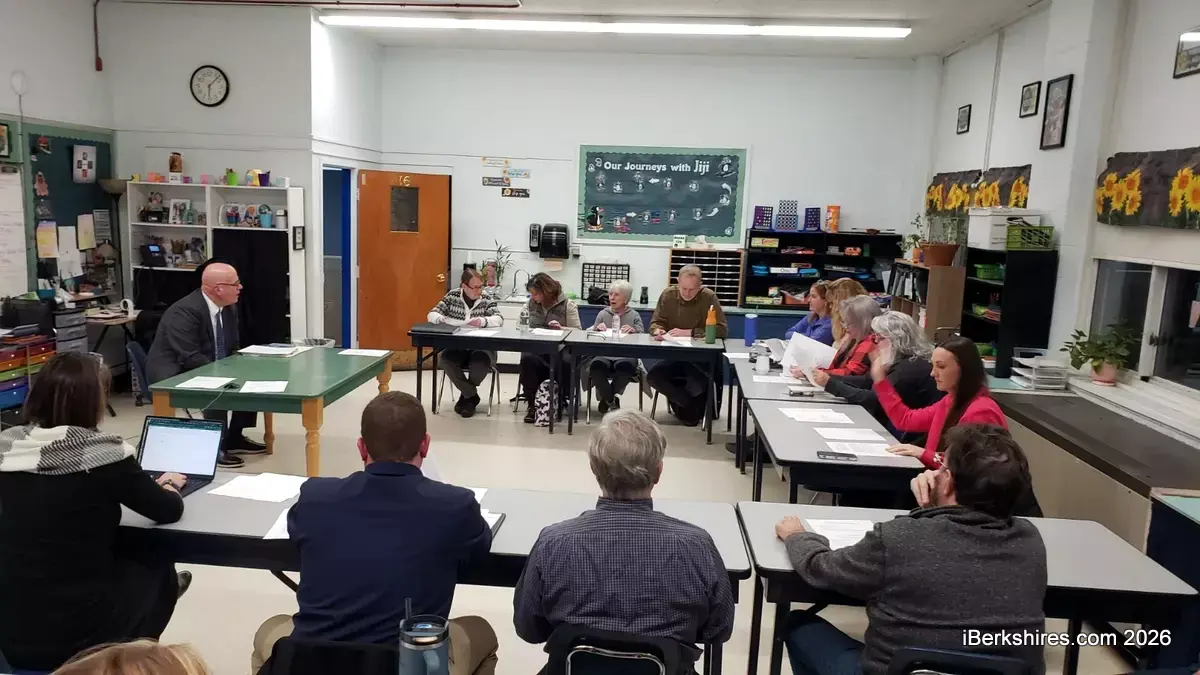
The members of the NBSU committee questioned Haskin's proposal but were open to looking at adjustments in the agreement.
Judy Oleson, longtime member of the Florida School Committee, said the union was created so the schools could hire good specialists and professionals and share them in a way that the towns couldn't do separately.
"I understand your bringing this up, and I'm glad you did, because it's time, every once in a while, we stand and look at this," she said.
Smaller school representatives noted that they didn't have the same apportionment of needs that Clarksburg has.
"For example, Savoy, as a small school, we don't have the same needs on all of the line items as Clarksburg," said Savoy Chair Arleigh Cooper, who added she was not speaking on her committee's behalf. "I would always reference Clarksburg and Florida, because there's a larger two compared to Savoy."
Savoy has an enrollment of 42, Clarksburg around 200. So Clarksburg uses more time with the business administrator because it has more employees, she said.
Superintendent John Franzoni said the amount of time the staff spend in the schools and towns can vary. For example, Rowe has the "most active" Finance Committee, requiring multiple meetings, while Savoy does a joint board meeting, and Monroe barely at all.
In terms of special education and paraprofessionals, the districts are charged based on the amount of time they spend in each school.
But, he noted, the trend has been a decline in enrollment in the smaller schools while Clarksburg has been trending in the opposite direction.
Cooper asked where the 10 percent base proposal came from; Haskins said the board had tried to figure out a model to set a "buy-in" for the towns that also recognized Monroe does not have a school building (it sends its children to Rowe.)
A 10-percent "base" would mean a big jump in costs for Savoy, Cooper said. "I do see where you're like, alright, there does need to be some sort of adjustment, and I would love to be able to work together to figure out what that could be."
Assistant Superintendent Tara Barnes, who has been doing double duty on the school union's finances, did a rough estimate of the towns' share of the $520,000 in shared expenses using Clarksburg's proposal. Savoy would jump around $24,000 to $25,000, Florida by $9,000, Rowe by $19,000 and Monroe $14,000. Clarksburg hopes to save around $70,000.
The superintendent said he had spoken with union's attorney, Adam Dupree, who recommended an ad hoc committee to review the agreement which is now seven or eight years old. Clarksburg and Florida have also asked for a review of the voting structure to one that better represents the five districts.
The super committee is currently made up of all the school committee members of all the towns, creating a 15-member board. The smaller schools were not as welcoming to that proposal, which would give more weight to Clarksburg and Florida.
Oleson asked for an itemized list of the costs to operate central office and what is paid based on each school and Cooper asked Barnes to run the numbers for a 5 percent base, with Monroe at 2.5 percent.
In other business, the committee offered the post of business administrator to Jordan Rennell. Rennell is a speech pathologist and director of summer programming, but in her interview she noted the nearly $1 million in grants she has worked on, including the $64,000 Feigenbaum Foundation grant for new playground equipment, and her love and loyalty to Clarksburg.
"I really did some soul searching about this position, because I do have a love for students and families and teaching and really being creative in education. In collaboration with some of our admin, they said, 'think about all the grants you've written and think about all the money that you've brought to this program,'" she said. "I really feel strongly about being people-oriented and transparent, clearly with each other, and having a strategic approach to the school operations."
Rennell is four courses away from obtaining her master's in education and believed that she could obtain the business administrator certification in 30 months.
The committee spent some time debating a salary proposal, noting Rennell did not have a financial background but also the difficulty the union's had in getting a business administrator. They determined to offer a prorated salary of $87,600 effective Feb. 1, with a three-year contract contingent upon Rennell obtaining her certification, at which time she will get a bonus. The contract is expected to be finalized on Tuesday.
Tags: NBSU,