William Russell Allen House Study Near Complete
PITTSFIELD, Mass. — A feasibility study on the William Russell Allen House is expected by the end of the month.
What comes after that is unclear, but local historians are confident that a group dedicated to rehabilitating the historic East Street home could be assembled. The state, which owns the Russell Allen House, has been spinning its wheels on redevelopment for about 50 years.
In 2003, the 13,000-square-foot mansion was estimated to cost around $4 million to rehabilitate. Today, that number is expected to be at least doubled.
"I think that this is a group effort," City Planner Kevin Rayner told the Historical Commission earlier this month.
"We need to talk with the state. If the state wants to make a map forward, that map doesn't start with dumping the property on the city. That map starts with working with the city to rehabilitate the property as a partner."
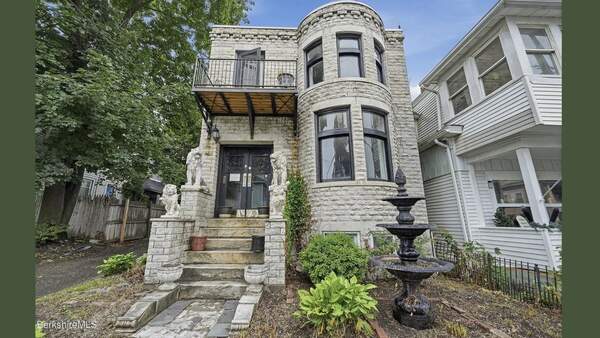
Now owned by the state's Division of Capital Asset Management and Maintenance, it was built by the son of Thomas Allen, who underwrote the construction of the Berkshire Athenaeum, and was the great-grandson of Thomas Allen, Pittsfield's first congregational minister.
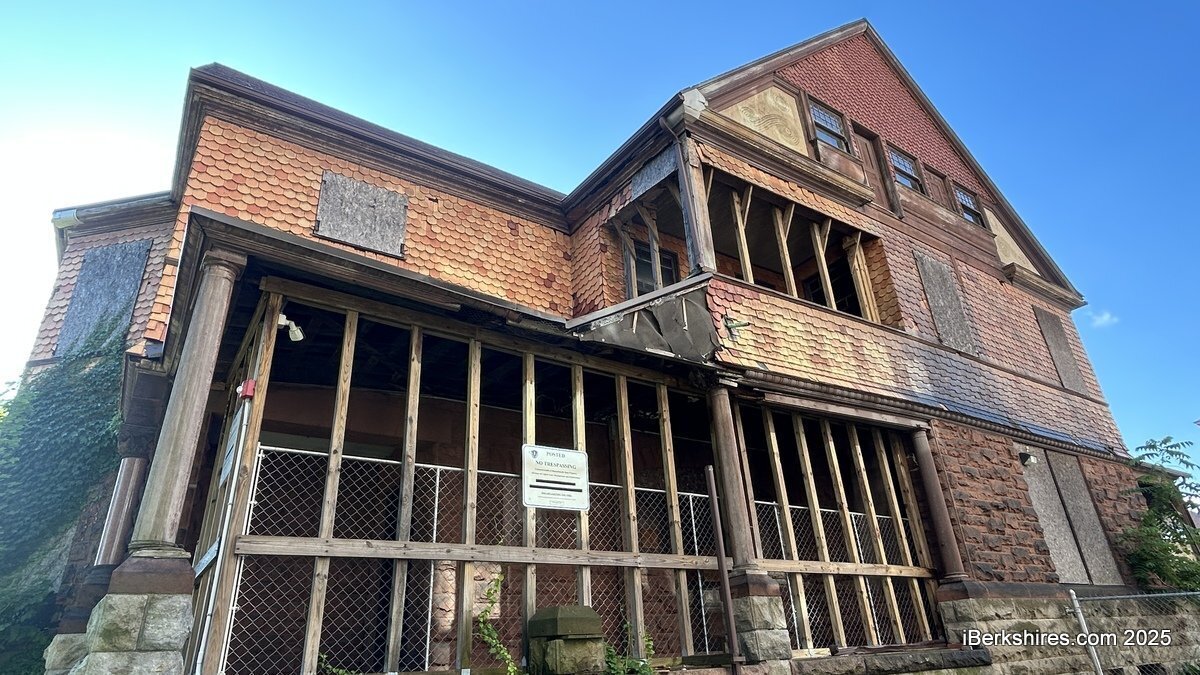
The Historical Commission received more than $33,200 in Community Preservation Act funding for a feasibility study on the 1886 home, said to be "the finest example of Queen Anne design in Pittsfield and one of the finest in Berkshire County." Now, its bones are showing in several places, and windows are boarded up.
The $42,500 feasibility study done by Finegold Alexander Architects was funded in the city's $526,548 CPA budget for fiscal year 2025. The rest of the cost was covered by the Berkshire Historical Society.
"This study hopefully will be able to tell us what really needs to be done. We can all collectively make a determination," said Lesley Herzberg, the historical society's executive director.
"We obviously want to see this building saved, everybody does, but it comes with a pretty big price tag, we all know."
The study will assess the building's condition, determine its repair costs, and explore possibilities for reuse. It was suggested that a Friends of the Russell Allen House type group lead any effort that comes out of it.
Rayner detailed the existing conditions listed in the preliminary executive summary. Images of the home from 2003 and 2025 were displayed to show aging over the last two decades.
He pointed out that the interior isn't much different from the 2000s, and the lower floors are in better shape than the upper floors. The woodwork is in fairly good shape, he added, and consultants were amazed at how the inside has held up over the years.
Though outside, the porch is pulling on the main structure, and degradation can be seen from the road.
"It's a beautiful house, and it's a very salvageable house," Rayner said. "It's not a cheap house to salvage, but it's in really good shape. It's not going to fall apart."
The city commissioned an outside group for a repurpose study on the Russell Allen House in 1979, and there were studies in subsequent years, but no actions. The home is still being heated, but the state is reportedly pushing to keep it in a cold state, which would drive it into further disrepair.
Rayner doubts that the city would want to take on an $8 million rehab unless there was some kind of incentive. He sees Community Preservation Act funding as a way to get one stabilization project done per year.
"I think that could go a long way for gradually restoring the building, and if we can get some other kind of funding to add on to that as we go forward, we can start to gradually put this building back online, but the biggest problem with that solution is we have to figure out who owns it," he said.
"The state, obviously, would be an unwilling holder, but they've held it for 50 years, so I don't know. I think it's time to have a conversation with the state and ask, 'Well, what are you guys willing to do?'"
The study also examines the cost of relocating the building as a last resort option.
The William Russell Allen House is also listed in Pittsfield's Community Preservation Plan as a significant historical structure.
Designed by H. Neil Wilson and added to the National Register of Historic Places in 1980, the property is said to be one of the last structures to embody the look of East Street in the late 19th century. For many people's lifetime, it has sat abandoned between the Registry of Motor Vehicles and Providence Court, the former St. Luke's Hospital.
Tags: CPA, historic buildings,