Hoosac Valley Presents Academic Certificate, Talks Absenteeism
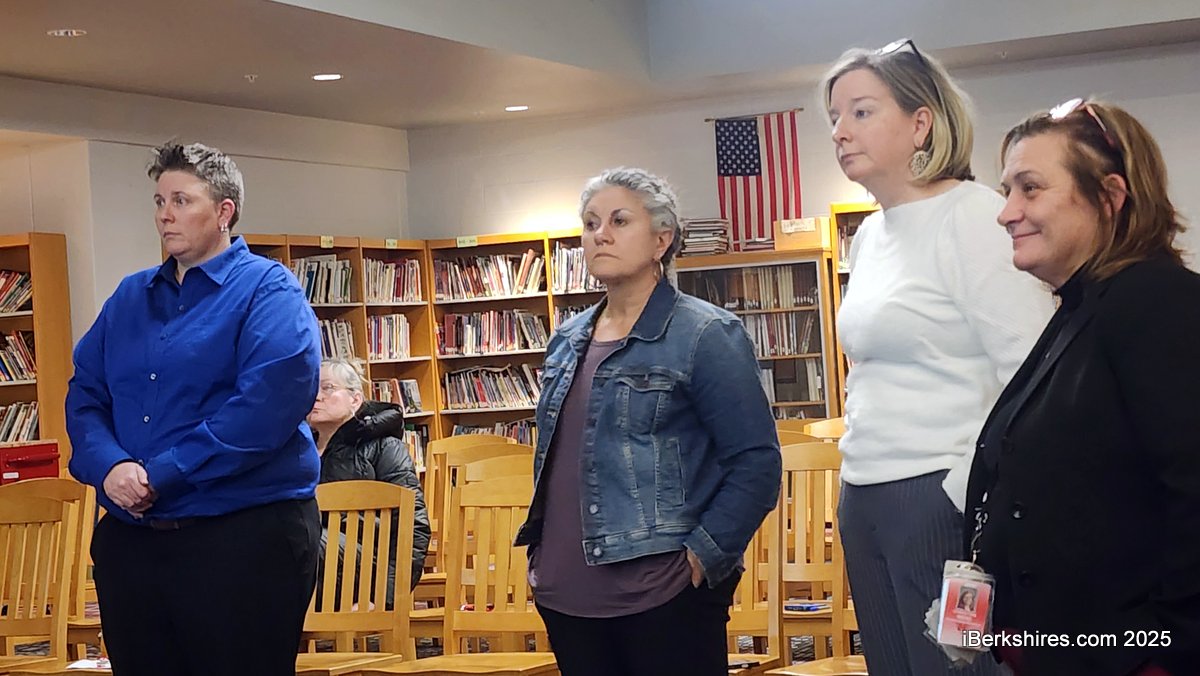
Dean of Students JJ Choquette, left, high school Principal Colleen Byrd, middle school Principal Lisa Lesser and elementary Principal Chris Wenz explained their efforts to combat absenteeism.
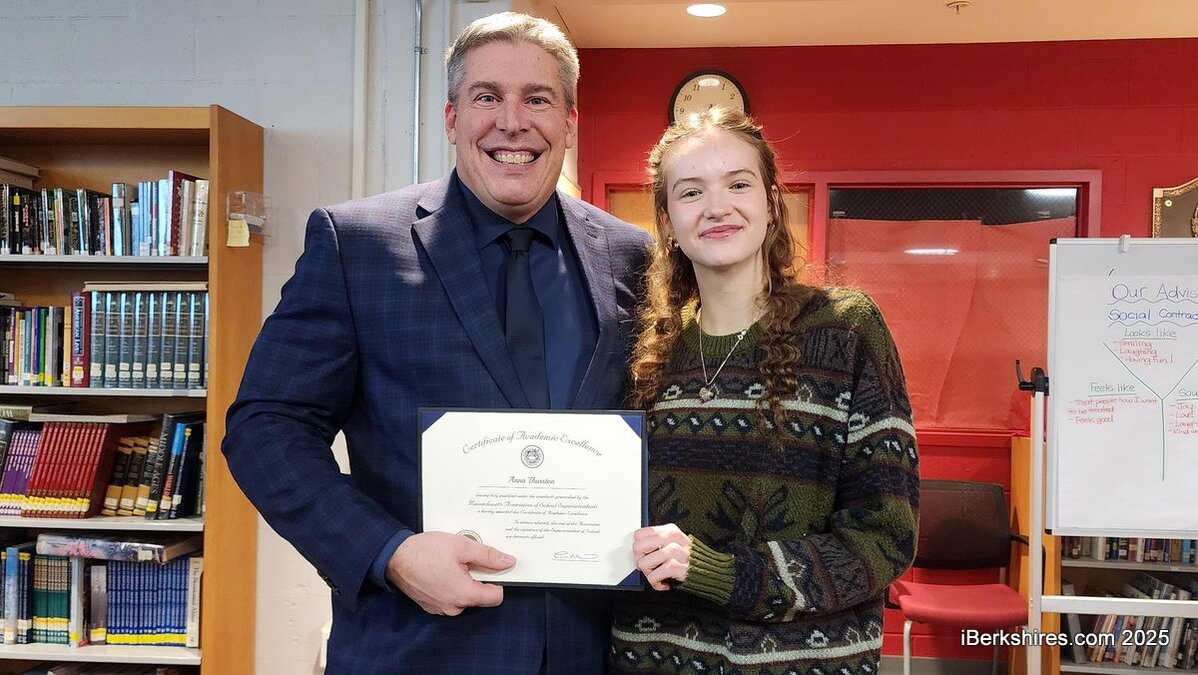
The award was presented at Monday's School Committee meeting by Superintendent Aaron Dean, who said she has been involved "in anything that brought student voice to the table."
"She conducts herself in a professional way, but brings humor to the table. She's just really a joy to be around and a joy to work with," he said. "Congratulations on this great accomplishment and congratulations to your parents."
Thurston is an honor roll student and a recipient of a John and Abigail Adams Scholarship. She's been a member of the Portrait of a Graduate committee, the Leo Club, the school's Student and Adult Advisory Board and the National Honor Society. She was on last year's first-place team in the General Dynamics STEM Competition and is a medal winner for figure skating in the Bay State Games.
Principal Colleen Byrd read letters of endorsement from Thurston's teachers, who described her upbeat attitude, intelligence and confidence, her curiosity, and the positive, can-do energy she brings to all her efforts. One teacher spoke of how she joined the engineering class during her free period to support the only girl in that class.
"Of course, she accepted instantly, soon became one of the strongest students in the class and paved the way for other young women to flourish," the teacher wrote.
In other business, the committee heard about efforts to stop chronic absenteeism from Byrd, Principals Lisa Lesser and Chris Wenz, and Dean of Students for the middle and high school JJ Choquette.
The pandemic had exacerbated absenteeism and the district is working to get the numbers back to normal, said Dean. "Last year, we made considerable improvement. We certainly weren't resting on our laurels, but it's a situation where we still have to continue to try to push and find ways to keep students engaged with school or re-engage students in school, which, whichever, whichever is appropriate for the situation."
The district chronic absentee rate — 18 or more unexcused absences — is 25 percent compared to the state's 18.8 percent. The rate peaked in 2022 at 48 percent and dropped to 40 percent last year.
The attendance rate is 92.2 percent with an average of 13 days missed. The highest numbers are with students of high needs, low income and disabilities; Black and mixed race children also have higher rates of absenteeism.
The principals and dean outlined the process for identifying absenteeism and tactics to ameliorate it. This ranges from calls and letters and meeting with parents to determine obstacles to attending school to literally going to homes to wake children up or taking parents to court.
Administrative staff that can include school adjustments counselors, nurse and school psychologist meet regularly discuss absent students and possible corrective actions. The principals credited Choquette with creating a "one-stop shopping" spreadsheet capture all the data at a glance.
They said communication with parents and guardians is key, including how that communication is delivered.
"We've done some work around the communication processes, a little bit to try to try to make it so people understand that our main goal is to make sure that the kid is all right and to get the kid to school so they can learn that's really the bottom line," Dean said.
The principals agreed that the main excuses were sickness, family vacations, and transportation difficulties. But Byrd said older students are now thinking they can take a day off in the post-pandemic world and make it up online.
"There's this kind of, 'I'm taking a day today, and I'm just going to, I'll do my work on my online classroom, and then everything will be fine,'" said Byrd. "And the reality is, a little bit of that is OK here and there, maybe five, you know, five, six times in the entire year.
"But it starts to creep up, because you get into that, oh, I took a day here. I'll take a day next week. Next thing you know, you're in this pattern of, once a week I'm taking a day off."
Dean said the high school has the most leverage in terms of getting students into the classroom because absences can mean no sports, no school activities. But that's missing for the younger students.
Lesser said her kids get up and go to school because "that message is coming loud and clear from me." But, she added, not every parent has that appreciation of getting kids to school.
"What would build that within our community? And do they understand that this is what will happen to their child if they are missing that much," she continued. "Some of our heavy-duty offenders are sitting at 20 to 30 absences. It's a lot of days."
That led into a presentation on the district's multitiered support to engage and support children academically and behaviorally in all three schools. Dean went through the various programs available at each academic level.
The committee also approved a field trip next spring to Nature's Classroom for Grade 6 and an update from the facilities subcommittee on preparing for winter. Committee member Fred Lora said there was also a discussion on the roof replacement on the non-renovated portion of the middle and high school and the membrane on a section of the elementary school.
The window for application to the Massachusetts School Building Authority's accelerated repair program doesn't open until next year, he said. "The good news is that the elementary school, the reason why the middle portion of that building's roof has survived going on 35 years is because they did it right. ...
"This one (at the high school) reached 25 years, and it's a serviceable life, but again, it's not something that we're going to be presenting to our communities next year or as part of this upcoming budget cycle."
Tags: absenteeism, academic award, HVRSD,