image description
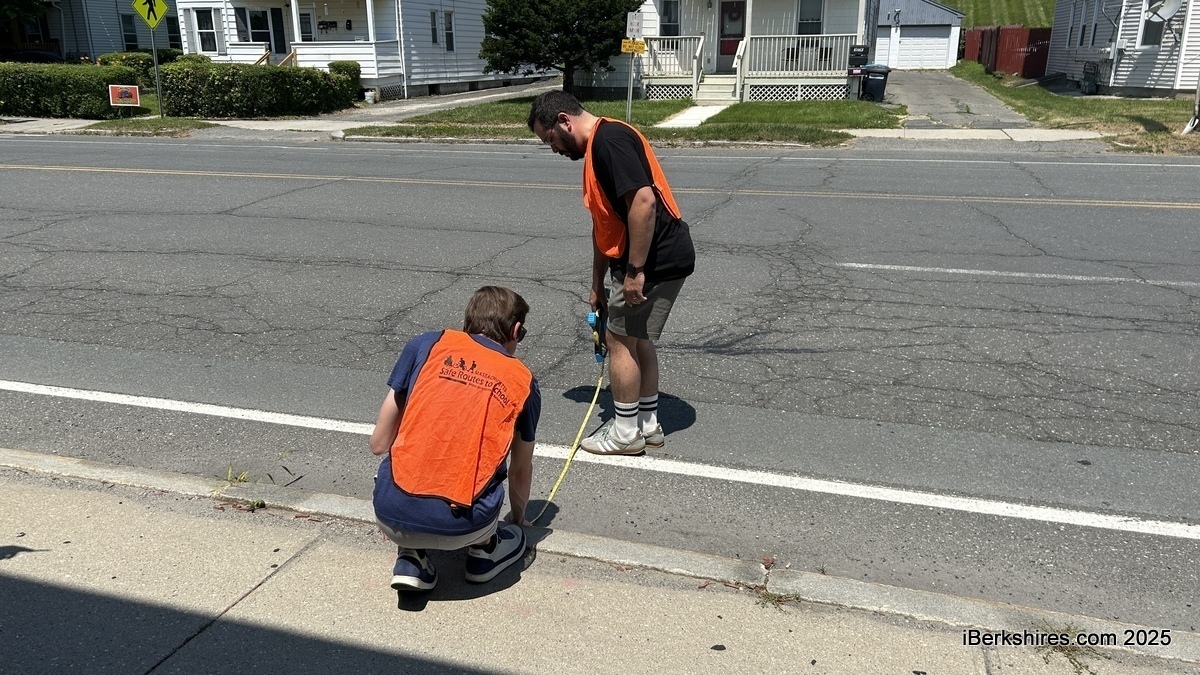
PCDC's Nicholas Russo and Commissioner of Public Services and Utilities Ricardo Morales measure lanes during the walk audit on Dalton Avenue last June. The City Council is reviewing a report with recommendations from the audit.

Pittsfied Councilors See Dalton Ave. 'Walk Audit' for Safety Improvements

By Brittany PolitoiBerkshires Staff
Print Story | Email Story

PITTSFIELD, Mass. — A walk audit done on Dalton Avenue over the summer has made recommendations for a safer corridor. 

The City Council's public works subcommittee will review the Pittsfield Community Design Center's report on an area where a fatal vehicle-pedestrian crash occurred over the summer. It makes five recommendations to deter speeding and improve pedestrian facilities on the well-traveled, quarter-mile stretch. 

There have been more than 90 reported crashes on the lower section of Dalton Avenue since 2020, 19 causing injury, and the June 20 fatality at the corner of Dartmouth Street that is still under investigation. 

"The crash that killed Luis Chin in the summer of 2025 was the first known fatality to have occurred on that corridor. It is imperative that we take lessons learned from why this crash took place and take steps to prevent another from happening," the PCDC report reads. 

"This is to both honor the life of Luis and to make sure that no further lives are lost unnecessarily." 

The AARP Walk Audit Toolkit guided the July audit. Community members identified areas needing improvement on clipboards from the intersection of Dalton Avenue and Benedict Road to the roundabout, studying the road and sidewalk conditions while observing traffic patterns. 

Commissioner of Public Services and Utilities Ricardo Morales, as well as city councilors, were present. 

The report recommends that Pittsfield formalize and enforce speed limits, mark all crosswalks, establish "daylighting" at corners with on-street parking regulations to improve visibility, establish right-sized travel lanes that discourage speeding, and improve the bus stop. 

Nicholas Russo, founder of PCDC, asked that the City Council review the recommendations. It was referred to the subcommittee on public works. 

"I'm sure we, either ourselves or we know someone who was affected by a traffic crash in one way or another, whether it was even just a minor accident or something that you're able to walk away from, or just a fender bender," Russo said at the Nov. 25 council meeting. 

"It still affects us all, as that little bit of anxiety when you get out on the road makes you keep a watch on your back that much more often, because you never know what could be around the next corner. So I think we can all agree on that, that we want to be safer on the roads, all users and modes of transportation." 

Russo and other community members marked the World Day of Remembrance for Road Traffic Victims, which is observed on Nov. 16, during the meeting. 


The walk audit report identified the Dunkin' Donuts at 84 Dalton Ave. as a "major traffic generator" that frequently causes traffic to spill out onto the sidewalk and travel lane. From Harvard Street to Benedict Road, there is no signage allowing or prohibiting parking, and there are no posted speed limits from Benedict Road to Woodlawn Avenue. 

While the citywide statutory speed limit applies to the corridor, not posting it "provides no clear guidance to motorists for consistent or predictable travel, especially on a gateway where travelers from outside the city are likely passing through," the report says. 

The nearest posted limit reduces traffic to 35 mph. 

Through records from the Massachusetts Department of Transportation, the PCDC found that Pittsfield, in 2017, adopted a section of Chapter 90 that allows the reduction of the citywide statutory speed limit to 25 mph.  It is recommended that the city install "thickly settled" 25 mph speed limit signs in this area. 

There are only three marked crossings on Dalton Avenue, and all others are unmarked.  During the audit, planners saw a "sight triangle" at the intersection of Dartmouth Street where traffic parked to the curb impedes visibility between walkers and motorists. 

"Daylighting," or leaving one car-length of clear space before the corner with signage, is suggested to ease this occurrence. 

"While signage would be the first step to restricting parking nearby the street corners, a long-term solution would be to install curb extensions or other barriers to prevent parking too close to the street corner," the report reads. 

"These should be considered at the next opportunity for street maintenance or reconstruction along this corridor. In the interim, epoxy gravel paint can be applied to the affected areas to create a contrasting surface that communicates that parking is not permitted within 20 feet of the street corner. Planters or flex posts could also be used as a light, quick, cheap solution in the interim." 

It was also observed that the Berkshire Regional Transit Authority bus stop is just a bench at the corner of Harvard Street with no shelter from sun, rain, or snow. PCDC recommended that BRTA pursue a new bus shelter at this spot to encourage more transit use and protect passengers. 

The Berkshire District Attorney will conduct the final investigation on Chin's death, and any released updates may be incorporated into the recommendations, the report explains. 


Tags: traffic safety,   
If you would like to contribute information on this article, contact us at info@iberkshires.com.

BRTA Focuses on a New Run Schedule

By Breanna SteeleiBerkshires Staff

PITTSFIELD, Mass. — The Berkshire Regional Transit Authority is still working on maintaining its run schedules after dropping the route realignment proposal.

Last Thursday's meeting was Administrator Kathleen Lambert's first official meeting taking over the reins; retiring director Robert Malnati stayed during a transition period that ended last month.

Lambert is trying to create a schedule that will lessen cancellations. There was a two-hour meeting the week before with the drivers union to negotiate run bids and Lambert is working with the new operating company Keolis, which is taking over from Transdev.

The board spoke about anonymous emails from drivers, which Lambert said she has not seen. iBerkshires was not able to see those letters, but has received some. 

"They were lengthy emails from someone describing themselves as concerning BRTA employee, and there was a signed letter from a whole group of employees basically stating their concerns. So, you know, to me, it was a set of whistleblowers, and that, what my understanding is that this really triggers a need for some type of process to review the merits of these whistleblowers, not going to call them accusations, but basically expressions of concern," said member Stephen Bannon.

A letter iBerkshires received spoke of unhappy drivers who were considering quitting because of decisions being made without "input from frontline staff," frustration and falling morale, and the removal of the former general manager shortly after Lambert came in.

Lambert said it's difficult to navigate a new change. She also noted many drivers don't want to do Saturday runs and it has been hard negotiating with drivers on the new runs.

"I would like you all to keep in mind that the process of change is super difficult. Transdev has been here for 20 years, and some of these drivers have never known any other operating company, the way some of the operations have been handled has been archaic," she said. "So getting folks up to speed on how a modern transit system works is going to be painful for them. So I don't want to say that I'm unsympathetic, because I am sympathetic, but I am trying to coax people along with a system that's going to seem very strange to them."

The board spoke about better communication between them and Lambert, citing cooperation will be best moving forward.

"There's just a lot of stuff in the air right now, and there are a lot of fires to put out to make this a coordinated effort. And if we don't keep our communications open and be straightforward, then you get blindsided about how you know the input that you could get from us about your position, and how you know what's going on in your direction, and we get blindsided. And I think that we have to make sure that this is a collaboration," said member Sherry Youngkin.

"Both sides have responsibilities, because in the long run, this advisory board is going to have to make decisions as to how we brought forward and if we've gone forward in a fair and helpful way. And I think that's hopefully what everybody is looking for also." 

Transdev and Keolis held a three-day recruiting event interviewing almost 40 candidates and offering jobs to eight, but only three stayed on to start training. Lambert said it was disappointing but she will keep trying to retain more people.

In her first report to the board, she noted that ridership dipped a little over 10 percent, but still remains higher than last year, adding that was because of cancellations of services because of the lack of drivers.

Like the last meeting, some of the advisory board members were torn over the start of the Link413 service, worried that the start of the service took drivers away and the numbers of riders are low.

Lambert, however, said the ridership has doubled from last month.

"As I've spoken before, we have, generally, a six-month adoption for brand-new service before you can really go in and evaluate, are you being successful based on the grant that my predecessor wrote along with the team for PBTA and RTA, we are ahead of schedule, which is pretty good, so I'm hoping that will continue to improve," she said.

Member Renee Wood said the board never approved the service, adding the only thing she could find in the minutes was a vote to accept the equipment. She said it was supposed to be put on the agenda to discuss.

"The Link413 service has been three years in the making. It's been a grant that was accepted and has been working with our partners, PVTA and FRTA, to put into place. So I don't have the entire history of how that process worked, but it's been three years in the making, and did we not understand that once we accept that grant that we were going to put in new service?" Lambert said.

The board discussed if Title VI, the Civil Rights Act, was followed with an accurate review and accurate amount of time for public comment period on the service changes and if its attorney should review if the  grant conditions were properly followed.

Lambert said changes had the 60-day comment period included in the proposed route realignment packet, giving the opportunity for the community to respond to that as well but will look into the legality of the situation with their attorney.

View Full Story

More Pittsfield Stories