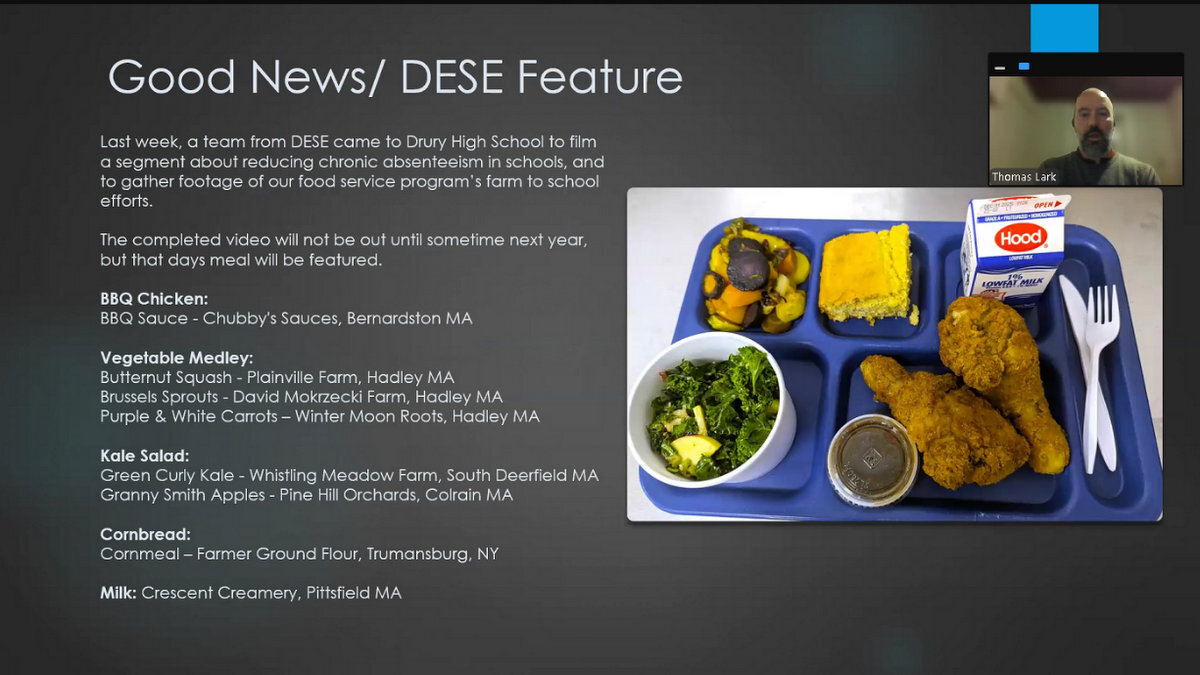
North Adams Schools' Food Service Being Spotlighted by DESE
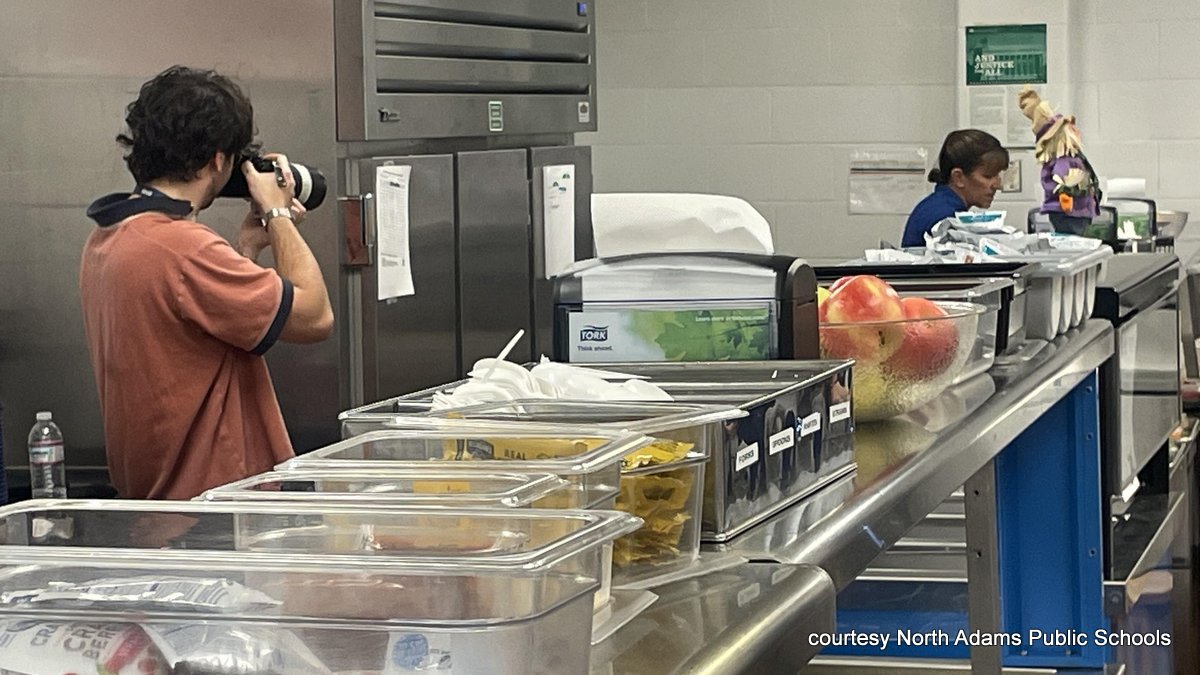
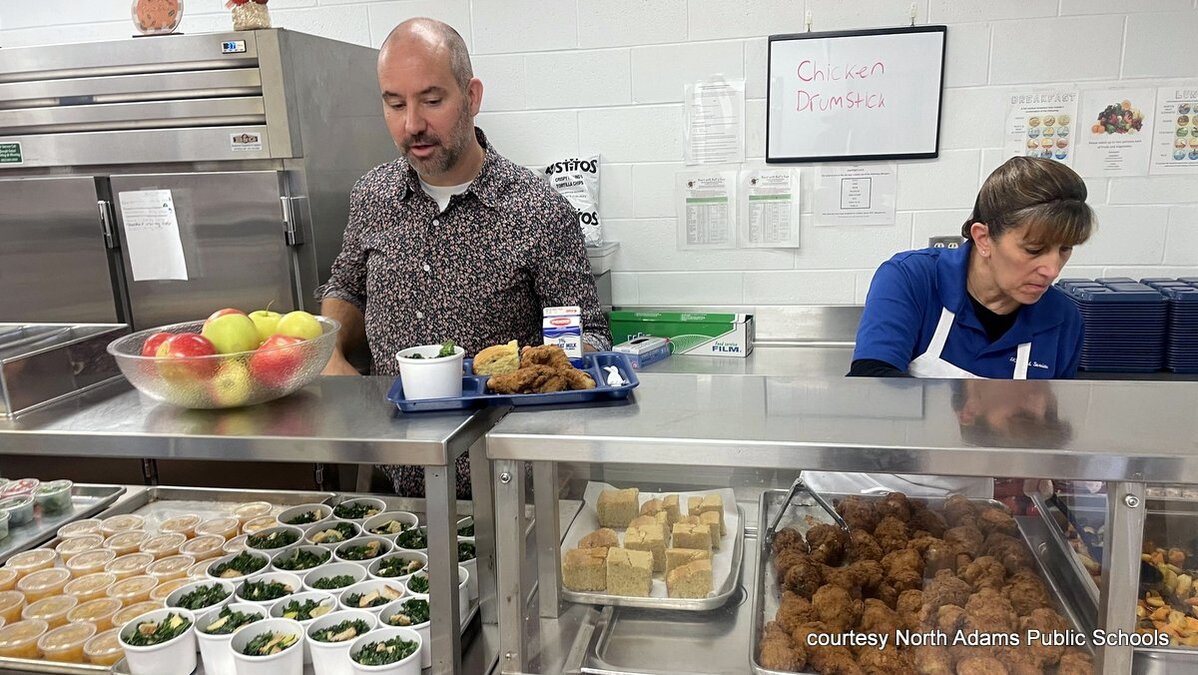
A photographer from DESE captures an employee serving lunch.
The marketing department at DESE visited Drury High School the week of Thanksgiving to showcase the district's farm-to-school food initiatives and look at student attendance.
Food Service Director Thomas Lark, in a presentation to the School Committee on Tuesday, said the district is in line for grant funding, but he couldn't release details just yet.
"We did secure some grant funding to do some farm-to-school programming, which will involve things in the dining rooms, as well as some after-school programming," he said. "I can tell you that we're working on it. Most of that will be January through June of this coming year.
"We're also working with the John Stalker Institute, which is out of Framingham State, on doing some training around scratch cooking."
The John C. Stalker Institute of Food and Nutrition was established 40 years ago to provide education and trainings for food service managers and directors and later expanded to include all school professionals.
"In the past year and a half, we've upgraded our point-of-sale system, which is integrated with our menu management and really that's just going to help facilitate doing more scratch cooking and making sure we meet the federal standards," Lark said. "Because pretty much every year, something changes, lower sodium limits, higher protein amounts, less added sugar."
It's more convenient to use prepackaged foods because they have to meet the federal nutrition standards, while cooking from scratch takes more effort and calculation.
"I think we kind of slid into that in the past, and we really want to focus on doing more scratch cooking," he said. "So part of it means having the software to analyze recipes to make sure you're meeting those standards as they change."
The district has been sourcing through Marty's Local in Deerfield and was able to show DESE a fried chicken lunch for which almost everything but the chicken was certified regional.
Scratch cooking will mean the district can use more locally and regionally sourced ingredients and extend nutritional education by planting gardens and inviting farmers and producers to speak with students.
Lark gave the example of "Farmer Kyle," (Kyle Zegel of Just Roots) who serves taste tests of foods made with local produce in the Greenfield schools. He said his first-grader came home asking for a kale quesadilla because she'd tried Farmer Kyle's.
"Part of that grant that we secured, that I can't name, will perhaps include bringing chef Kyle in monthly to our elementary schools to do those taste tests and get kids trying some new and different stuff, perhaps," he said.
School Committee member Emily Daunais said her son had participated in the Greenagers program at Many Forks Farm in Clarksburg and had learned to like new foods.
"There's something about kids seeing the food and making it," Daunais said. "My son wouldn't touch something green if his life depended on it, but they made kale chips and kale salad, and now he loves kale and my daughter had lettuce soup. I don't even know what that is."
Lark also said he was looking into composting and recycling in response to questions about waste and disposable products. He felt some of that was left over from the pandemic and that some schools were using reusable trays again, but it was difficult to not use packaging for lunches being delivered outside the school system.
"One of the things right now is just, everything goes in the trash, and it would be great if we can start [recycling]," he said, adding that it would be best to start training in the early grades. "One of the things that I've heard from other directors, and just people in school food services, like if you've got something new, start it with your littles and work your way up."
He'd also provided input for the kitchen design in the new Greylock School with some of his initiatives in mind.
Lark had mentioned the DESE visit in passing during his presentation, putting the emphasis on the attendance but Superintendent Timothy Callahan said he was being modest and it was the opposite.
"They reached out to us, and they said, 'Hey, we heard you're doing some cool things out there,'" he said. "This is the marketing department from DESE, and they wanted to come and take take some photos and get some video of the food service specifically."
The video is expected to be released next year.
Lark also gave a general rundown on how the food service department operates.
"We thought this was appropriate because we know that we had the challenges to the SNAP benefits last month, and we know that there are a lot of questions about how we provide food to our students and our community," said Callahan.
North Adams serves free breakfast and lunch to children in North Adams, Hancock and Savoy through the Community Eligibility Program, and supplies meals as a vendor to Berkshire Arts & Technology Public Charter School, Child Care of the Berkshires and some Head Start locations. It also runs the Child and Adult Care Feeding Program (CACFP) after-school supper program and the feeds the summer 21st Century program.
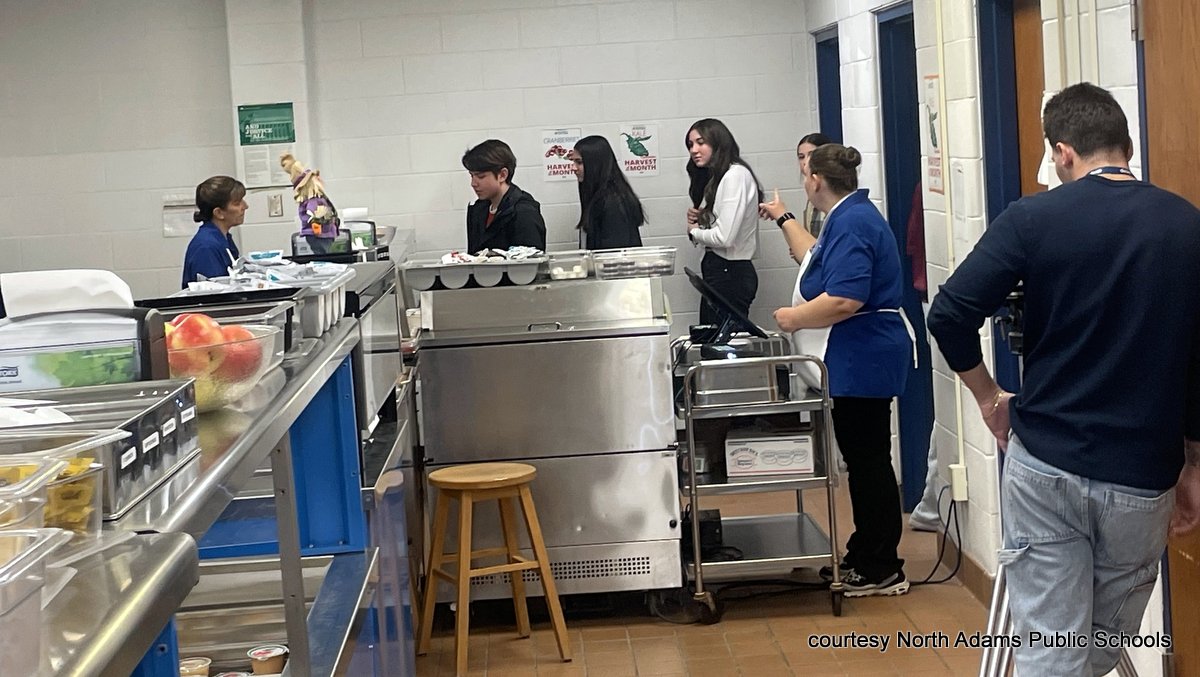
The video featuring North Adams will released next year.
Participation in the Community Eligibility Program is based on a minimum of 25 percent of students eligible for free and reduced lunch; the district's percentage is 70 percent. The federals funds are released to the state a month ahead and the district files for reimbursement a month later; schools are recommended to have two months of expenses on hand.
"We're got a good amount of cash on hand, basically the amount that you want and can have without getting in trouble, effectively," Lark said. "So if there was a further reduction in funding, something that didn't come through, we probably have a little lead time make adjustments and have cash on hand."
Callahan, in responding to questions, said the Wellness Committee is being re-established using a rubric designed by DESE and that there will be call for School Committee members to join.
In other business, the committee
• Heard from Brayton Elementary Principal Anne-Mary Riello and Colegrove Park Elementary Principal Amy Meehan on school improvement plans.
• Got an update on the Greylock project from Callahan, who said pre-bid site walk was being held this week for prospective bidders. Subcontractor bids are due by Dec. 17, and the general contractor bids by Jan. 14.
• Accepted at $6,500 donation from Berkshire Innovation Center to be used for Mystery Science Kits for Grades kindergarten through 5 and for other science materials for middle school.
Tags: DESE, food service, NAPS,