Clark Art Lecture on Emamzadeh Yahya Project
Print Story | Email Story
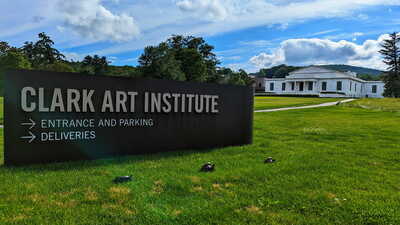
WILLIAMSTOWN, Mass. — On Tuesday, Nov. 11 at 5:30 pm, the Clark Art Institute's Research and Academic Program hosts a talk with Keelan Overton (Independent Scholar / Clark Fellow) on the Emamzadeh Yahya Project. 
 
The talk takes place in the Manton Research Center auditorium. 
 
Established in 2021, the aim of the Emamzadeh Yahya Project is to increase awareness and understanding of the Emamzadeh Yahya shrine complex and its dispersed tiles, collections, and archives worldwide, without pursuing commercial, political, or institutional objectives. The project's key values are independence (of conception and production), collaboration (between individuals and disciplines), and accessibility (across languages, formats, and audiences). This talk provides a behind-the-scenes glimpse of the project's evolution and first scholarly product, The Emamzadeh Yahya at Varamin: An Online Exhibition of an Iranian Shrine, a website containing an online exhibition, exhibition catalogue, and academic edited volume 
 
Overton is an independent scholar and art historian based in Santa Barbara, California, specializing in the Perso-Islamic world from Iran to India. She has worked as a curator inside museums and independently, and her publications have explored such topics as patterns of collecting and museology in the field of "Islamic art," diachronic histories of manuscripts and buildings, and cultural relations between Iran and the Deccan. Since 2021, she has directed an independent, interdisciplinary, and international research project devoted to the Emamzadeh Yahya shrine complex at Varamin. The first outcome is a website that charts some alternative paths in museology, publishing, collaboration, and accessibility. At the Clark, Overton will complete some final aspects of the website.
 
Free. Accessible seats available. A 5 pm reception in the Manton Research Center reading room precedes the event
If you would like to contribute information on this article, contact us at info@iberkshires.com.

Discrimination Against Muslim Americans Persists 25 Years After 9/11

By Stephen DravisiBerkshires Staff
WILLIAMSTOWN, Mass. — Dozens of Muslim Americans were among people killed in the Sept. 11 terrorist attacks.
 
Untold numbers of Muslim Americans have suffered countless acts of discrimination in their aftermath.
 
"Of course, you'll find several accounts of Muslims from all over the U.S. describing how they went from the unknown kids in the school to being stereotyped or ridiculed for their Muslim names," Sidra Mahmood recalled recently. "However, many Americans forget that the victims of 9/11 were also Muslim Americans.
 
"I can't forget the time when a classmate broke down in sobs when 9/11 came up in our classroom at the Islamic seminary I went to in Texas, because her father's best friend who was like an uncle to her, died on 9/11."
 
Today, Mahmood is a chaplain at Williams College. In 2001, she was growing up in Karachi, Pakistan, when terrorists forced two passenger jets into the Twin Towers in lower Manhattan and another plane into the Pentagon outside Washington, D.C. A third plane, which terrorists hoped to crash into a D.C. landmark, was brought down in western Pennsylvania after passengers and crew fought back against the hijackers.
 
The attacks, which ultimately claimed 2,976 lives, horrified people around the world, including in Mahmood's native land.
 
"I remember being aghast like anyone who witnessed the fall of the Twin Towers in real time," she said. "However, even as a child, fear gripped me about the possibility of war, especially once we learned that Afghanistan, right adjacent to Pakistan, would be attacked by the U.S. My mother had told me about the 1971 war between India and Pakistan when she remembered hiding in the dark after bomb sirens would go off in Punjab after intentional blackouts.
 
View Full Story

More Williamstown Stories