Greylock School Project Passes ConCom, Preps for Planning Board
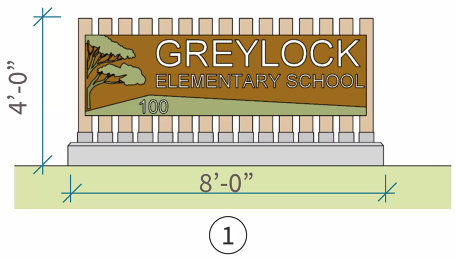
The School Building Committee opted to go with the post sign, but asked for changes to the font and graphics.
The Conservation Commission gave the OK for the $65 million project on Tuesday.
"We're targeting a completion date for the documentation on Nov. 17," Jesse Saylor of TSKP Studio told the School Building Committee meeting just before the Conservation Commission. "The real reason that's later than we had anticipated is because of the local review meetings ... We have a Conservation Commission meeting, public hearing today, Oct. 21, at 6 p.m., that's what we're going to right after this meeting, and that will be our first time meeting with the Conservation Commission. ...
"We anticipate meeting with the Planning Board at a public hearing on Monday, Nov. 10. If we're approved to proceed at that meeting, will be ready to go to bid. And so we've set the bid date one week later, leaving a week if there are any amendments that are required to the documentation."
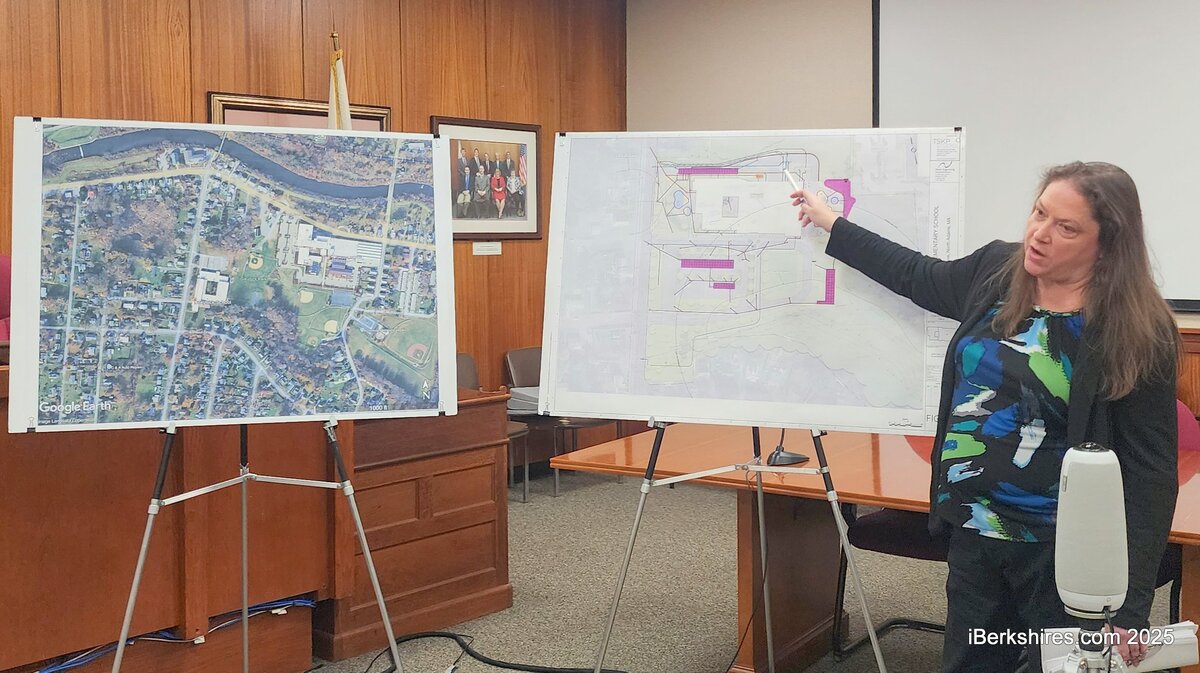
Saylor and Chelsea Christenson, a civil engineer with Nitsch Engineering, presented the plans to the commission.
"Our goal of the project is to bring nature to the students through the design of the school, also the building itself is a good environmental steward," said Saylor. The building systems are all electric. No fossil fuels are used to heat or cool the building. Energy models anticipate that the building will be highly energy-efficient thanks to its highly insulated walls and roof and also due to geothermal wells that will harvest the relative warmth of the earth in the winter and its coolness in the summer to offset human cooling loads."
The site itself "retains some natural resources worthy of protection," he said, including an intermittent stream that runs into a pipe on the southern edge and, to the north, there's a "more significant" wetlands area.
The stream will not be affected and the wetlands are part of the school drainage will continue to be fed that way. The project also is not expected to affect Well No. 2, a backup for the city's water system.
"The project will also conserve mature tree growth at the north edge of the site and at the south edge of the site, which creates a natural buffer to residential residential neighborhoods to the north and south," Saylor continued.
Con Com Chair Andrew Kawczak asked the city's Public Services Commissioner Timothy Lescarbeau, who was in attendance, if the plan met the wellhead protection requirements.
"The well is in a non-conforming zone to begin with, because it's close to the roads and you know the school, the old school," he said. "The area is much better now than it was considering GreylockWorks was an aluminum anodizing plant that always made me cringe. Now it's retail and rental space, residential, so I don't see any impact from this."
Christenson walked through the details for water drainage and catchment, noting "we did get a letter from DEP Water Resources supporting the project."
In response to questions, she and Saylor elaborated that the turtle pond is a manmade educational component and not part of the water management system.
"A lot of design and research has gone into this pond to make these turtles survive," Christenson said. "I know our landscape architects have done a lot of research on what they need and hibernation and all sorts of things. So it's been fascinating listening to it."
The turtle pond was a feature of the open courtyard in the old school that is being replicated in the new school. Saylor said it will be lined without about 3 feet depth of sand, though there are conversations about the depth because of the age of the children in prekindergarten-through-Grade 2 school.
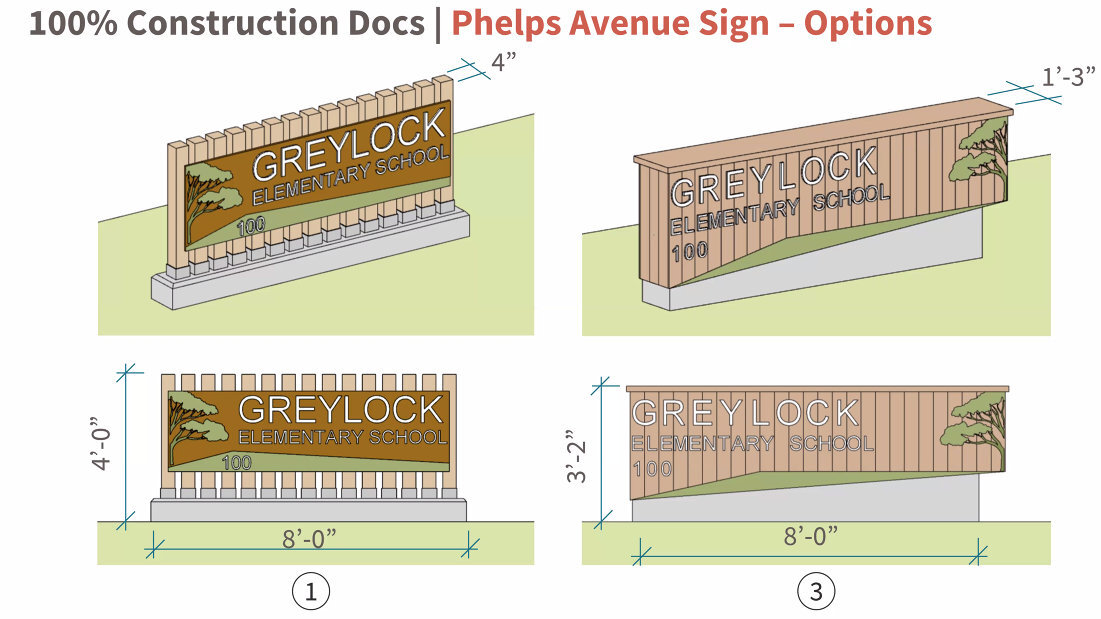
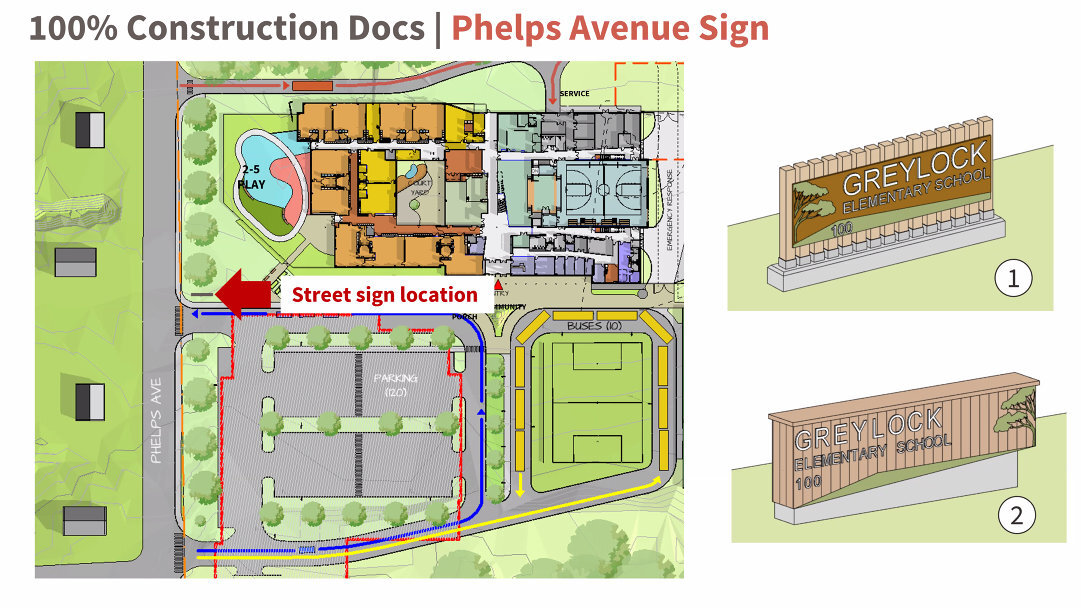
Before the commission meeting, the School Building Committee narrowed down its choices on the main sign. The members had not liked the previous iterations, so TKSP came back with options incorporating their feedback.
"There's a attempt in both of these signs to kind of match up with the building in a little bit of an abstract way," said Saylor.
They were offered a modification of the post sign with straight rather than peaked top (Option 1) and a simpler sign using the vertical fiber cement siding planned for the school with a flat top (Option 3). Members liked the graphic on the post sign and the sided option but there were concerns it looked too much like a bench for hanging out. Several stated concerns on the font and the ability to read the lettering; Superintendent Timothy Callahan reminded them the signs would be about 8 feet long, which would be reflected in the letter.
"I want something that has a little bit more whimsy, that's a little bit more exciting, because, like, we're making this for them, like we want them to see the sign and get excited," said member Andrew Rosenburg, pitching for the post sign. "It's a nice time, but 3. That's I feel like it kind of goes towards more adult sensibilities."
The members voted for Option 1, the post sign, but asked for more work on the font and graphic.
The committee also voted to hire Energy Tax Savers Inc., a consulting firm specializing in green energy grants, to work on its federal geothermal financing.
Tim Alix of Collier's International, the owner's project manager, said it's been recommended by other districts and the Massachusetts School Building Authority to have a consultant because the applications will be completed after the system in operational.
"By having somebody work with us and assist us, we'll be requesting that the contractor document the costs and breakdowns in such a way that we have all that information available to us, and this consultant would then work with the district on assembling that application and submitting those those documents," he said.
Collier's sought three proposals and Energy Tax Savers was the lowest at $15,900 compared to the other two about $50,000 with alternative add-ons.
"I think that that would be the outfit to go with, the prices which is more reasonable, and we have experience of working with them, and things have gone well," Alix said.
Tags: Greylock School Project,