Dalton Voters Unanimously Approve All Articles at Special Town Meeting
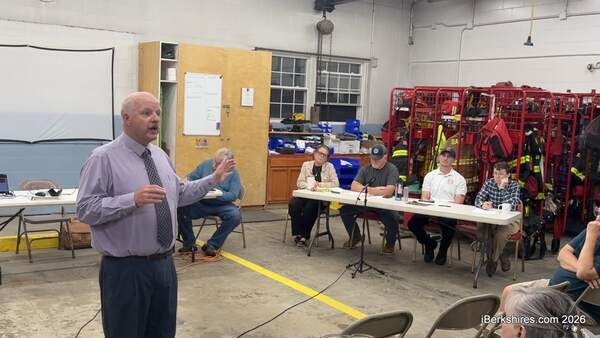
DALTON, Mass. — Some 53 voters unanimously approved all five articles on the special town meeting warrant on Wednesday.
The meeting that lasted 30 minutes resulted in the authorization of funding for specific projects, addressed budget changes and the approval of the Central Berkshire Regional School District's regional agreement.
The article that received the most discussion but was ultimately unanimously approved was the authorization to transfer $89,000 to fund hiring engineering firm Fuss & O'Neil to complete the remaining engineering work for the Dalton Division Road Sewer project.
The Dalton Division Road sewer project aims to extend sewer service to the middle third of Dalton Division Road, where homes currently rely on septic systems.
Those initially against the article questioned the value of the project because it would only benefit a limited number of people in town, those without septic on Dalton Division Road.
"I see this benefiting just a few homes on Dalton Division Road. I don't understand why those homeowners aren't paying directly for this, or why we do this at all. There are people having trouble paying their taxes," voter Henry Rose said.
It was explained that the residents will have to pay to connect to the septic system and that there is enough land for future development, which would also be connected to the system.
Voter Richard Holt questioned whether this would affect residents on the Pittsfield side.
"Obviously it wouldn't be wrong to run a sewer line, one sewer line, and not allow homeowners on both sides. That's true, the homeowners on the western side live in Pittsfield and those on the east live in Dalton. But, obviously, if that happens, we'll take into account some cost sharing," interim Town Manager "Terry" Williams said.
Williams explained the need to complete the engineering so that the town is eligible for grants and low-interest loans to help fund construction.
The plan is to have the construction of this project coincide with the reconstruction of Dalton Division Road, which is on the Transportation Improvement Program list for 2028.
"I think it's about time that we get some infrastructure and put that sewer in, instead of spending money on police stations and all the toys the town wants. We need to be paying the taxes, and I expect to get some infrastructure on our road," said voter Gert Thompson.
Voters approved Article 3 with no discussion, authorizing about $94,000 from sewer stabilization to fund environmental consultant services to address stormwater management concerns to align with the state's Municipal Separate Storm Sewer System permit.
Prior to these authorizations the town had $1,107,953 remaining in sewer stabilization.
The regional agreement passed unanimously after some clarification on the language surrounding the vote for incurring debt for capital projects.
The topic of the regional agreement has been contentious over the last year, stemming from the School Committee's 2019 decision to use a popular vote for the approximately $72 million Wahconah Regional High School building project, and two years earlier, using the popular vote for the feasibility study.
Voter Al Nadeau questioned whether language was included in the regional agreement to prevent this from repeating itself in the future.
"State law does allow two options for capital projects, one being the popular vote, one being the town-by-town vote. So, the regional agreement can never say one will always be used," Director of Finance and Operations Greg Boino said.
"But the amended regional agreement does say that the default method of the school district would be the town-by-town vote. So, we can't say no more popular votes but we can at least put it in that that will be the default."
Voters approved Article 2 unanimously, which amends the operation budget of $11,074,918 approved at the annual town meeting in May.
The article authorizes a number of budget increases and decreases for personnel, vocational education, and debt service changes, amounting to a decrease in the operational budget $90,824.
It passed after clarification that the health agent position is not remaining vacant; rather the funds allocated for the position's salary is being moved to the health agent expenses line item.
After former Health Agent Agnes Witkowski's resignation, the town contracted Berkshire Public Health Alliance to fill the role until a permanent replacement could be found.
"What's fantastic about this is we have one person who is in the office a minimum of 10 hours a week and we also, by the way, have a salaried aide up there who fills in the rest of the time," Williams said.
Berkshire Health Alliance has specialists to cover the other duties health agents are responsible for such as overseeing septic systems concerns, hoarding cases, and licensing for food events, restaurants.
"So, essentially, we contracted for this at pretty much exactly the same as we had for the salary of the health agent who had resigned for 11 months, August 1 to June 30," he said.
Voters also approved the transfer of $175,000 funds from capitalization for three projects, including new computers, Town Hall gutters, and repairs to a failing culvert on Yvonne Drive that has become a safety concern.
Prior to this vote the town had $1,295,826 in capital stabilization.
Tags: CBRSD, regional agreement, sewer, special town meeting,