The Bible Speaks 'Cult Survivor' Speaks at Ventfort Hall
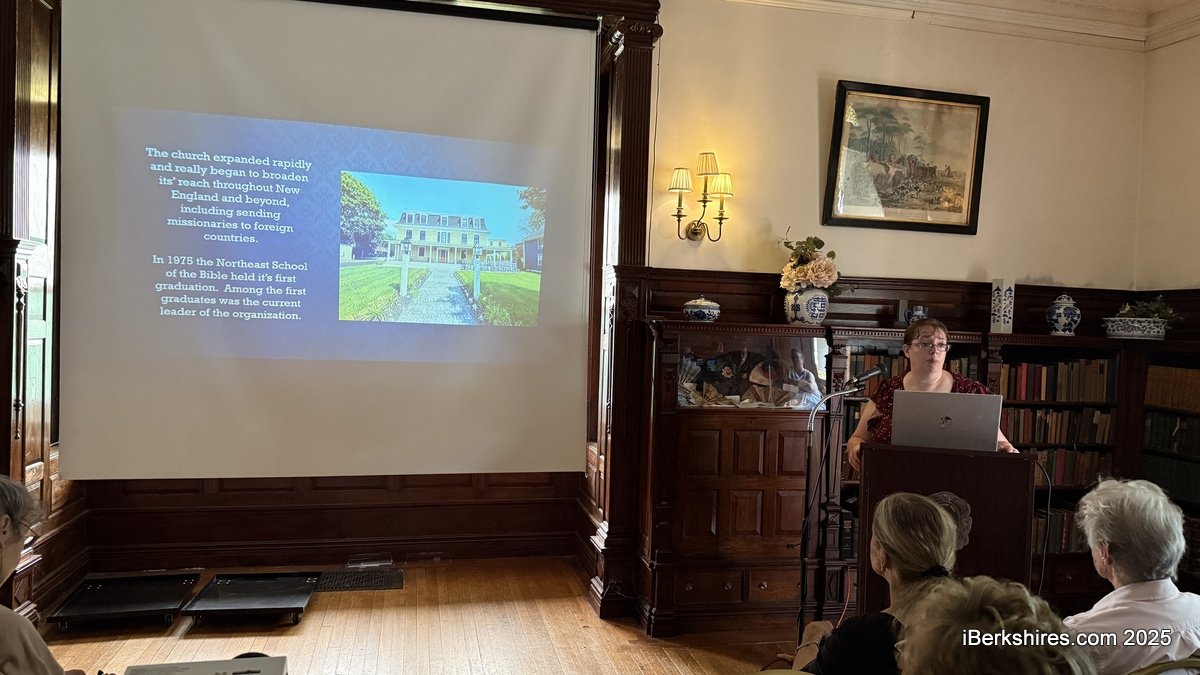
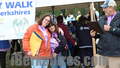
Elita Galvin speaks at Ventfort Hall about her time as a child at The Bible Speaks and the podcast she does with her sister about the church.
Despite the manipulation and exploitation wrapped in a shroud, light still shines through. Buried in the history of the "forgotten cult" is the path to healing. So say two women who had been wrapped up in its inner workings.
Cult survivor Elita Galvin spoke before nearly 60 people at Ventfort Hall at its recent Tea and Talk series, outlining the evolution of the church and its cult-like actions.
Galvin and her sister, Karen Briggs, host the podcast "Children of Grace," in which they research the church's history and hear from fellow survivors — a journey that has become healing.
"I think coming to understand how we got here was hugely helpful in healing, and being able to sort out some of the things that maybe we had been ingrained to think that weren't great and maybe some things that were," Galvin said.
"But then also to hear other people's stories and understand that, while we wouldn't wish our experiences, or worse experiences, on anybody else, there's a comfort in knowing you're not alone and being able to share those stories and experiences with each other. It's like, we've all been able to help each other address our stories and begin the healing process."
A lot of the organization's former members that Galvin and Briggs speak to or are told about were wonderful people who genuinely had a desire to get to know God, help their community, and do good for other people, she said.
"While certainly, there was a fair share of people who may not have had the best intent with what they were doing, a lot of people who did get wrapped up in this, even though they ended up in maybe not the best situation, they were personally there, for the right reasons, and ended up in the wrong place doing it," Galvin said.
The fundamentalist church had its headquarters in Lenox for more than a dozen years until Elizabeth Dovydenas sued founder Carl Stevens and the religious organization for coercion and fraudulent manipulation, winning a $5.5 million judgement. She had donated some $6.6 million to support the church and pay off its Kemble Street property, the former Lenox School for Boys and now the home of Shakespeare & Company. Ventfort Hall had been used as a restaurant.
Stevens made an enterprise out of his claims of being appointed by God, fostering messaging infected by greed and establishing loyalty out of fear, say survivors.
"While he would preach from the pulpit about things such as virtue and chastity, he was reportedly engaging in inappropriate commentary behavior toward women, and was also alleged to have had several affairs prior to his first wife passing away. So, it appears as though quite a bit of time he was not always practicing what he preached," Galvin said.
She illuminated Stevens' decades-long cycle of domineering, tyranny, facing criticism and, at times, fleeing only to begin again under the guise of expansion or making false promises of change.
In his lifetime, Stevens and his church were the spotlight of several scandals. In the early 1980s, Stevens requested an independent report from the Christian Research Institute because "they were trying to ingratiate themselves with some of the other local churches, and were not having a lot of success," Galvin said.
"So they asked them to come in and maybe take a poke around and see if they could help them figure out what the disconnect was and what they could be doing better."
The "very lengthy" report expressed support for the church, "but one of the things they raised the most concern about were the teachings surrounding pastoral authority and loyalty to one pastor teacher, which was Carl," Galvin said.
At first, The Bible Speaks and Stevens praised the report and promised change. However, the reaction was different behind closed doors, she said.
"So, there was a group of concerned people, some of whom were very much involved in the first report, who would reach back out to the Christian Research Institute and ask them if they would come back, because what they were actually hearing from Carl behind closed doors was not at all what was being said publicly," Galvin said.
"And so they came back and they amended the report and had to withdraw a lot of the support they initially had for the church because of what they found."
Some believe this cycle continues today under Stevens' successors or for some at Ventfort Hall, a haunting visit by Stevens, who died in 2008.
"Unfortunately, I just think at this point, I don't know that there's any way to convince them that what they believe for 40 to 50 years is not necessarily accurate, and the way they do things is accurate," Galvin said.
When the church relocated to Baltimore, it was renamed Greater Grace World Outreach, which it is still called today. It has dozens of ministries in the United States, South America, Africa, the Middle East, Europe and Southeast Asia. It no longer has a presence in Berkshire County.
The current church officials are trying to distance themselves from some bad things, Galvin said, but that it continues to operate the way Stevens had trained them, unfortunately, that has come at the expense of the local area.
"When they moved [to Baltimore], the local area was not pleased, and staged quite a bit of protest that ultimately failed, and they continue to be plagued by scandal and by rumor of unethical behavior. To this day, currently, the location is facing five lawsuits for abuse to minors," Galvin said.
(These lawsuits refer to accusations from the 1990s; one former pastor was arrested this week for accusations from when the church was in Lenox.)
The church has subject to a series of investigative articles in the Baltimore Journal (and also The Berkshire Eagle) and is currently undergoing an outside investigation review, which they did hire, admittedly under pressure from outside groups, she said.
"I'm also surprised it's still around. I thought that the church went away in the '80s when this was shut down here. I'm a little shocked, and I'm a little sad that people are still being taken advantage of, it sounds like," attendee Carrie Vibert said.
"I come to the story of The Bible Speaks here through [Ventfort Hall's] ghost tours and the ghost investigations, where sometimes in the investigations, they've had the pastor make his presence known. So, I'm not surprised to hear how evil and greedy he was given what we've learned on those investigations and tours.
"In one of the investigations, there was a heavy presence following us that night, and then all of the other spirits got quiet. He kind of scares everybody else away. Nobody dead or alive wants to deal with him."
As people sold their homes and possessions to bring them God's favors and further the church's mission, Stevens bought "nice cars, helicopters" and "and even some planes," Galvin said
"At one point, it was reported in the local newspaper that The Bible Speaks had filed a request with the Pittsfield Municipal Airport commission for permission to construct a hangar at the airport," Galvin said, and at the time it had two helicopters and a single-engine plane.
"They were looking to construct [a hanger] that could accommodate at least five aircrafts, including three helicopters and two piston engine planes … My understanding from the article is that they were turned down for that request."
Those who gave up everything were promised free housing on church property in return. However, these promises were often not fulfilled, Galvin said.
The fee for on campus housing aligned with the prices in 1976 were $35 per week per person, which included a bed and two or three meals in the cafeteria, she said.
"The amount of devotion that was expected took up a lot of time. And, so the time available to study, to go to every church service and to also go to Bible school classes full time, and then also be able to make a living to support yourself was very limiting for a lot of people, and it was very difficult for a lot of people to make ends meet and to keep up," Galvin said.
Tithing and free will offerings were also expected from the students at the Stevens School of the Bible. Tithing was the 10 percent of one's income before taxes and any deductions.
"It should be 10 percent of the absolute best of your paycheck ... or, as I heard it referred to growing up, the first fruits of your paycheck should immediately go to the Lord and then anything else that wasn't covered from your paycheck, you should trust God to provide," Galvin said.
"And not that I'm saying he can't and I'm sure he did for a lot of people, but that's an awful lot to expect of people."
Galvin and her sister were too young to recognize the facade the church hid behind and, after the talk, described to iBerkshires what life was like living in the organization's campus housing.
"It was a lot of fun," she said because there were families and other kids living together on a very large property, and places to bike, roller skate, sled. "It was a pretty great place to be as a kid."
Hindsight has helped her understand how the church used fear and shame to promote a relationship with God and gain loyalty.
"Which is fine, you can scare somebody into making a choice, but it's not really effective to scare them into a relationship and I think that's where the disconnect happened a lot," Galvin said.
"Over and over again, we weren't sure we did it right, and so we would repeatedly ask Jesus into our hearts because we were scared to death that if we didn't do it right, we'd end up in hell."
Tags: Ventfort Hall,