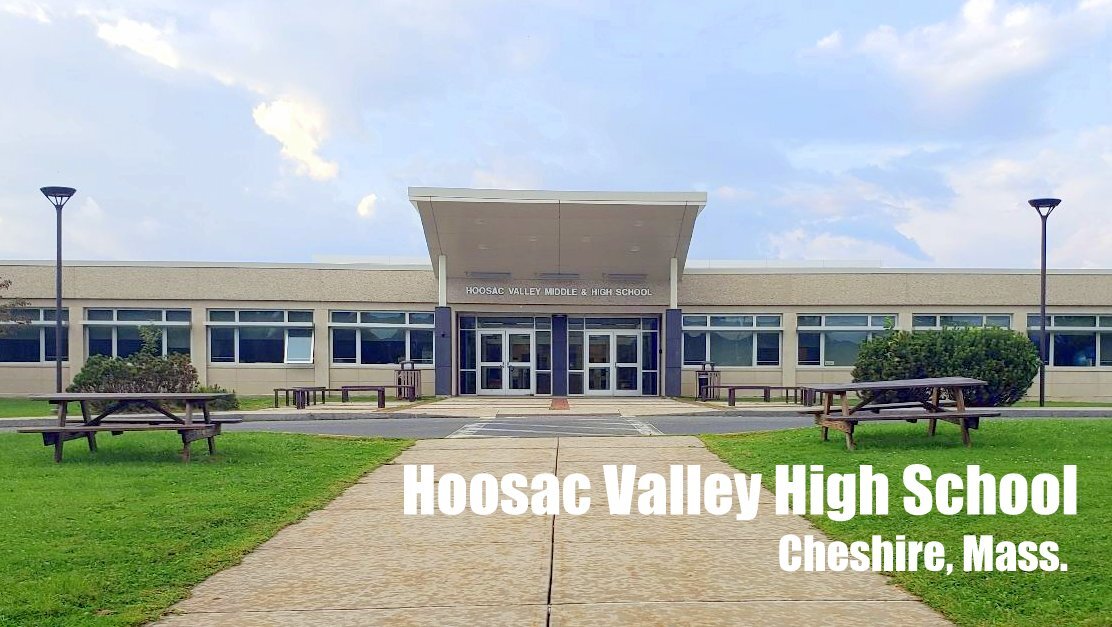
North Berkshire School Districts Participating in Regionalization Study
CLARKSBURG, Mass. — Three North Berkshire school districts are embarking on a state-funded study of secondary education options.
The collaboration's been percolating between Hoosac Valley Regional School District, Northern Berkshire School Union and North Adams Public Schools for more than a year. An application deadline was missed by North Adams last year but state Rep. John Barrett III was able to obtain $100,000 for the project in this fiscal budget.
The Hoosac Valley School Committee approved the next step of creating an exploratory committee on Monday and the North Adams School Committee on Tuesday.
Northern Berkshire Superintendent John Franzoni said the union school committee will be voting at its next meeting but that all of the school officials in the union's five towns are supportive.
"While we haven't had a formal vote as our joint committee, all four of my committees have expressed their support of going forward with it," he said on Wednesday.
"Myself and [Hoosac Superintendent] Aaron [Dean] and [Adams Finance Committee member] Carol Cushenette have driven this as far as we can over the last 15-16 months, and now it's good that we're getting the school committees and select boards. We obviously need all those individuals, town leaders involved so we can get the word out to the communities about what we're trying to do with study this."
The committees approved language to set up first a working group with two representatives from each district to hammer out what the eventual steering committee will look like and come up with language for a request for proposals for a consultant to guide the study.
"We know that the opportunities for Grade 7 through 12 students are diminishing as our schools have fewer and fewer high school students," said North Adams Superintendent Timothy Callahan on Tuesday. "I think it was pretty clear, based on the newspaper articles about the graduating classes last year, that those numbers are small across Berkshire County."
Between them, Drury and Hoosac Valley Regional high school together graduated 116 seniors this year; in 2008, Drury alone graduated 133.
Hoosac Chair Erin Milne said in the preliminary meetings she's attended there was pretty much consensus that "that's where we're likely to get the most bang for our buck, while also allowing districts to kind of keep their neighborhood identities in the earlier grades."
"This is kind of like a finding expedition to look at what each district has, what it might look like if we were reorganized in certain ways, and what the financial implications of each of those will be," said Dean at Monday's meeting. "There's a lot of things that will have to be worked through ...
"I think, ultimately, what people are going to find is that you're probably not going to have a huge amount of savings, if any savings, at the end of this process, but what you're going to have is you're going to get more for your money. You're going to have more programs, more opportunities."
Milne described that as possibilities of more than one language program, larger bands and more instruments, and multiple competitive sports (the high schools already have a number sports cooperatives).
Clarksburg and Gabriel Abbot in Florida have prekindergarten through Grade 8; Emma Miller in Savoy and Franklin County's Rowe Elementary (which Monroe children attend) have prekindergarten through Grade 6.
The school union sends its upper grades mainly to Drury High School in North Adams and Hoosac Valley High School; other options are McCann Technical School, Mount Greylock Regional School, and Berkshire Arts & Technology Charter Public School. Rowe tuitions its middle and secondary students to the Mohawk Trail Regional School District, which is conducting a restructuring study with Hawlemont Regional that could call for merging or consolidating those districts.
"I've encouraged my towns to just to at least be involved in sitting at the table in these studies to find out what are the facts, what is the information," Franzoni said.
Clarksburg school officials have in the past noted that seventh- and eighth-graders attending Drury have more access to sports, language, drama and extracurricular programs than the small elementary school can provide. The superintendent also noted that regionalizing at the high school level would open up state transportation money.
Mayor Jennifer Macksey, chair of the North Adams School Committee, cautioned that this is a very exploratory step and no decisions have been made. Both Dean and Franzoni have stressed that any recommendations would not come to fruition without support from their respective communities and be approved by the Department of Elementary and Secondary Education.
Callahan noted that a regionalization study would probably run from $200,000 to $300,000, based on conversations with those who participated in a recent South County proposal (that was rejected) and the Mohawk Trail study.
"The study process takes two years. Year one is the study ... Year two is the recommendations," he said. "And then the study may indicate the shared services are an optimal solution. It may indicate some form of regionalization of certain grade levels. If regionalization were to happen, the soonest it would happen would be five years. So we're talking 2030-2031 because after the study concludes and after decisions are made at the local level, then it would have to be brought to DESE, and DESE requires two fiscal years in advance of a reformed regional district. So that's the information that we have."
He posited that the grant may be available again next year (DESE has been encouraging regionalization across the state), plus he noted that Berkshire Educational Resources K-12 (which started as a state-authorized working group on local regionalization and shared services) also received $50,000 toward the Berkshires and Mohawk Trail that might be used.
"BERK12 has facilitated some of the regional conversations and conducted the study, and they have $25,000 set aside for regionalization efforts, so even if they're not selected as the vendor, my understanding is that money can be used for a vendor that we choose," Callahan said. "So that's another $25,000 ... it's possible that there could be a stall if there's not funding ... so there might be a pause for a year until other funding is secured."
The state doesn't recognize the school union as such so Clarksburg, rather than Northern Berkshire, will be the financial agent for the grant.
"The only thing I would add is that, as we embark on this, that everyone who's involved, and that's steering committee, that's everyone that's involved, that's parents, that's students, that's everyone — that they go into this with their eyes absolutely wide open," School Committee member Richard Alcombright said. "And don't come in with prejudice. You come in with an open, really, really wide open attitude of this thing, with an idea that it can succeed."
Correction: the attribution of the end quote in this article was incorrect in an earlier version.
Tags: HVRSD, NAPS, NBSU, regionalization,